Two listings, two spec tables, and no two numbers measured the same way - so the comparison you are trying to make is between figures that do not line up.
Picked on published fit specifications, each linked to its source. How we pick.
The short answer
Compare on six published figures only: seat height range, seat depth, seat width, backrest height, weight capacity and warranty term. Everything else - adjustment counts, lumbar descriptions, material claims - is written by marketing departments and is not comparable between brands.
We earn a commission if you buy through our links. It does not change your price, and it does not change our ranking. Prices are pulled from Amazon's own API and stamped with the date we fetched them — where we have no live figure, the button opens the current price on the retailer's page instead. Full disclosure.
Ranked picks with published seat height, seat depth and weight capacity
#ad Seat height and capacity are the manufacturer's published figures, sourced under each pick. Prices come live from Amazon's own API and carry the date we fetched them; where a figure is missing the button opens the current price instead. Seat depth for every pick is in the spec block below. Seat depth summary: Steelcase Leap v2 15.75" · Hbada E3 Pro — · Herman Miller Aeron 16"–18.5"
Why most chair comparisons fail
Because the two spec sheets are not describing the same measurements. One maker publishes seat height from the floor, another publishes overall chair height including a headrest. One publishes pan length, another publishes how far the pan slides. One counts adjustment points, another describes the lumbar in adjectives. Put those side by side and the table looks like a comparison while actually being two unrelated documents.
The fix is to compare on a smaller set of figures that are measured the same way everywhere, and to treat an absent figure as information rather than as a gap to fill with a guess. Our comparison chart is that table for the chairs on this site; this page is the method behind it.
The six figures that compare cleanly
Comparable figures, and what each one decides
Figure
What it decides
How to read it
Seat height range (floor to top of seat pan)
Whether you can get your feet flat with hips level with knees
Needs a RANGE with two numbers. One number means it does not adjust
Seat depth / pan length
Whether the front edge presses into your calf
A range means a sliding pan; a single figure means fixed
Seat width
Whether the raised pan edges press on the outside of your hips
Compare against your SEATED hip width, not your waist
Backrest height
Whether the top of the back lands above your shoulder blades
Rarely published; absence is common rather than suspicious
Weight capacity
How the base, cylinder and seat plate were engineered and tested
A BIFMA-standard structural figure - read it as build quality, not just a limit
Warranty term and duty wording
How long the maker will stand behind it, and at what intensity of use
Multi-shift or 3-shift means rated for more than one working day per day
Six figures, four of which you can check against measurements of your own body taken in five minutes. What size office chair you need is where to take them, and from that point every listing resolves to a yes or a no.
The three that look comparable and are not
Adjustment point counts. "9 adjustment points" and "12 adjustment points" are not comparable because nobody agrees on what counts as a point. Tilt tension and tilt lock can be one or two; a 4D armrest can be one or four. Read the list of what actually moves instead of the number.
Lumbar descriptions. "Dynamic", "self-adapting", "ergonomic" and "three-zone" are not specifications. The only lumbar figure that compares is a published height adjustment range in inches, and very few chairs give one. Adjustable versus fixed lumbar separates the claims from the mechanisms.
Material claims. "High-density foam" and "breathable mesh" appear on chairs at every price with no density figure or tension spec attached. Mesh versus foam covers what the materials genuinely change; the adjectives do not help you choose between two mesh chairs.
How to build a shortlist in ten minutes
Take four measurements. Floor to the back of your knee, hip to the back of your knee, seated hip width, and seat to shoulder blades.
Write them at the top of a page. They do not change; the chairs do.
For each candidate, fill in the six figures. Leave blanks where the maker does not publish - do not estimate, and do not substitute a different measurement.
Strike anything that fails on a figure you measured. A chair that cannot reach your seat height is out regardless of how it reviews.
Rank what survives on warranty and capacity. Those are the two figures that speak to how long it will last.
Only then look at price.What each tier buys tells you whether the gap is worth it.
What a comparison cannot tell you
Two things, and it is worth being clear about both. Seat firmness is not published by anybody in any comparable unit, so whether a pan feels hard is something you discover after delivery - why an office chair seat feels too hard covers what to do about it. And build quality within a price band is not visible in a spec sheet at all; the warranty term is the closest proxy available, which is why how long office chairs last leans on it so heavily.
This is also why single-model pages exist. A spec table narrows the field; a model review goes through what each published figure means for a real body, and a head-to-head puts two of them in the same table with a verdict on who each one is wrong for. Use the three in that order.
If you want to build your own version of this table for chairs we do not cover, how to compare office chairs sets out the method: the six published figures that are measured the same way everywhere, the three that look comparable and are not, and how to turn four body measurements into a shortlist in ten minutes.
For the wider version of this question across every category rather than these three, office chair pros and cons by type puts mesh, upholstered, big-and-tall, kneeling, saddle and gaming side by side with what each one genuinely gives you and genuinely costs you.
Material is one axis of a larger choice. Office chair pros and cons by type sets mesh and foam alongside the four other families - big-and-tall, kneeling, saddle and gaming - and names which trade each one is asking you to make.
The picks in full
1. Best for A spec sheet that answers every question
Steelcase Leap v2
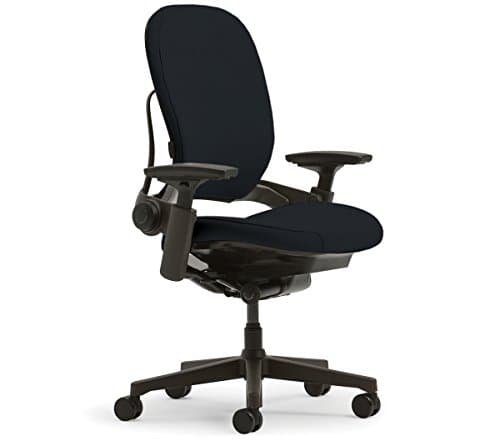
Used here as the worked example rather than as a recommendation, because it is one of very few chairs in our registry that publishes every figure this page asks you to compare on. Steelcase and its retailers give a seat height of 16 to 20.5 in, a seat depth of 15.75 in, a seat width of 19.25 in, a back height of 25 in, armrests 7 to 11 in above the seat, a 400 lb capacity and a 12-year multi-shift warranty, alongside a height-adjustable lumbar with a separate firmness dial. You can sit that against your own four measurements and get a yes or a no in about a minute, which is exactly what a comparable spec sheet is for. The one figure that disqualifies it for some readers is visible in the same table: the pan is fixed.
Who it fits
Anyone learning to read a spec sheet, and anyone whose measurements fall inside those figures.
Who it does not fit
Long-thighed sitters. Anyone outside the premium band.
Published specifications
Seat height
16"–20.5"
Seat depth
15.75"
Seat width
19.25"
Back height
25"
Arm height
7"–11"
Weight capacity
400 lb
Lumbar
Height-adjustable lumbar plus a lower-back firmness dial
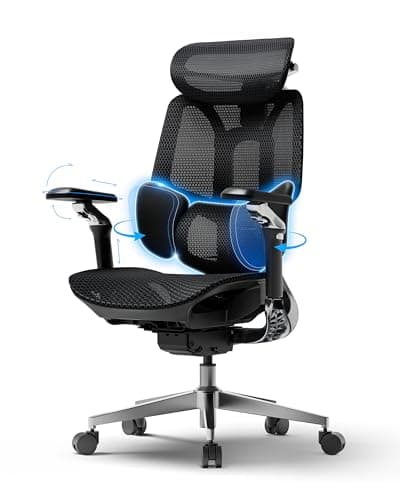
The instructive counter-example, and included for that reason rather than as a criticism of the chair. Hbada publishes a 25.6 in seat width, a three-zone dynamic lumbar with 3.15 in of backrest height adjustment, a 330 lb capacity, a fit range of 5 ft 1 in to 6 ft 5 in, and a warranty that splits five years on base, gas lift and casters from three on everything else - a genuinely useful set. What it does not publish is a seat height, giving an overall height of 43.7 to 51.8 in instead, or a pan length, giving 1.97 in of slide travel instead. Those are two different measurements from the ones you need, and no arithmetic converts them. Read it as the common case rather than the exception.
Who it fits
Readers who want to see what a partial spec sheet looks like before trusting one.
Who it does not fit
Anyone over 330 lb, and anyone whose binding constraint is seat height.
Published specifications
Overall height
43.7"–51.8" (seat height not published)
Seat width
25.6"
Weight capacity
330 lb
Lumbar
Three-zone dynamic lumbar, 3.15 in of backrest height adjustment
Maker's fit range
5 ft 1 in to 6 ft 5 in, per Hbada
Warranty
5-year on base, gas lift and casters; 3-year on other components
3. Best for The case where one spec sheet becomes three
Herman Miller Aeron
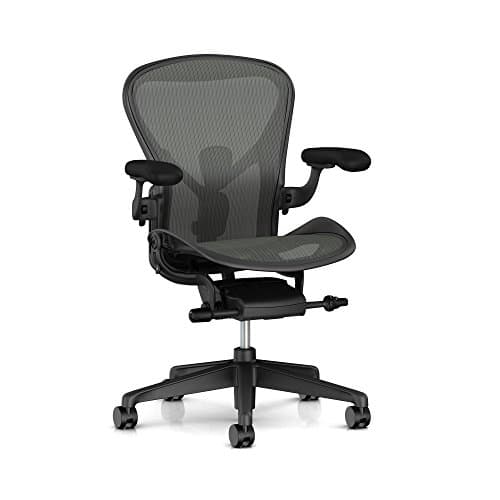
The chair that breaks the one-row-per-chair habit, which is the last thing to understand about comparing properly. Herman Miller publishes size A at a seat height of 14.4 to 19.3 in with a 16 in pan and a 300 lb rating, size B at 14.8 to 22.8 in with a 17 in pan and 350 lb, and size C at 15.8 to 22.8 in with an 18.5 in pan and 400 lb, under a 12-year 3-shift warranty with a height-adjustable PostureFit SL or lumbar pad. Compare any one of those against a single-shell chair and you are comparing a third of the product. Three of our site's spec tables carry this chair as three rows for that reason.
Who it fits
Anyone at the edges of the height range, where a sized shell beats a wider adjustment range.
Who it does not fit
Anyone who will not check which shell they are buying. Anyone below the premium band.
Published specifications
Seat height
14.4"–22.8"
Seat depth
16"–18.5"
Weight capacity
400 lb
Lumbar
PostureFit SL or adjustable lumbar pad, both height-adjustable
Sizes
A (seat height 14.4-19.3 in, seat depth 16 in, warrantied to 300 lb), B (14.8-22.8 in, 17 in, 350 lb), C (15.8-22.8 in, 18.5 in, 400 lb)
On six published figures that are measured the same way everywhere: seat height range, seat depth, seat width, backrest height, weight capacity and warranty term. Check the first four against your own measurements and strike anything that fails.
What specs actually matter on an office chair?+
The ones that relate to your body - seat height, seat depth and seat width - plus capacity and warranty, which relate to how it was built. Adjustment point counts and lumbar adjectives are not comparable between brands.
Why do chair spec sheets not line up?+
Because makers publish different measurements. Overall chair height is not seat height; seat slide travel is not pan length. Both pairs look similar and neither converts into the other.
Is a higher adjustment count better?+
Not reliably, because nobody agrees what counts as an adjustment. Read the list of what moves - seat height, pan length, lumbar height, arm height, arm width, tilt tension, tilt lock - rather than the total.
Should I compare chairs on reviews or on specs?+
Specs first, to eliminate chairs that cannot fit you, then reviews to choose between the ones that can. Doing it the other way round means reading opinions about chairs that were never going to work.