You want the numbers side by side, not seventeen product pages and a marketing adjective on each one - and you want to know which figures the makers never publish at all.
Picked on published fit specifications, not on hands-on testing. How we pick.
The short answer
The Steelcase Leap v2 publishes more of the figures that decide fit than anything else here, which is why it leads the chart. Below it, every chair on this site is laid out on seat height, seat depth, seat width, capacity and warranty, with unpublished figures marked rather than estimated.
We earn a commission if you buy through our links. It does not change your price, and it does not change our ranking. Prices are pulled from Amazon's own API and stamped with the date we fetched them — where we have no live figure, the button opens the current price on the retailer's page instead. Full disclosure.
Ranked picks with published seat height, seat depth and weight capacity
#ad Seat height and capacity are the manufacturer's published figures, sourced under each pick. Prices come live from Amazon's own API and carry the date we fetched them; where a figure is missing the button opens the current price instead. Seat depth for every pick is in the spec block below. Seat depth summary: Steelcase Leap v2 15.75" · Herman Miller Aeron 16"–18.5" · Steelcase Series 1 15.5"–17.75" · Sihoo Doro C300 18.11"
How to read this chart
Every figure below is a published figure. It came from the maker's own specification table, or from a retailer's spec sheet where the maker does not publish one, and each chair's source is named on its own page. We have measured nothing ourselves and converted nothing from a photograph. Where a maker does not publish a number, the cell says so. That is deliberate, and it is the most useful part of the chart: an absent figure is information about the chair.
Four columns do the real work. Minimum seat height decides whether your feet reach the floor. Seat depth decides whether the front edge presses into the back of your knees. Seat width decides whether your hips fit and how far apart the armrests sit. Weight capacity is a structural rating, not a comfort rating. Everything else - material, headrest, number of levers - matters less than those four, and the buying guide works through why.
Seat height and seat depth: the fit columns
Published seat height and seat depth across the whole registry
Chair
Seat height (in)
Seat depth (in)
Herman Miller Aeron
14.4-22.8 (by size)
16 / 17 / 18.5 (by size)
Steelcase Leap v2
16-20.5
15.75 fixed
Herman Miller Embody
16-20.5
15-18 adjustable
Steelcase Series 1
16.5-21.5
15.5-17.75 adjustable
Branch Ergonomic Chair
17-21
Not published
HON Ignition 2.0 Big and Tall
17-21.5
18.74 fixed
Autonomous ErgoChair Pro
18.5-22
19-21.5 adjustable
HAG Capisco 8106
18.5-25.8
13.4-16.5 adjustable
Varier Variable Balans
18-20.5
12
Sihoo Doro C300
Not published (overall 42-49)
18.11, depth-adjustable
Sihoo M57
Not published (overall 42-49)
18.11
Hbada E3 Pro
Not published (overall 43.7-51.8)
Not published (1.97 of slide travel)
DRAGONN by VIVO kneeling chair
Not published (overall 21-31)
12
Sleekform Austin kneeling chair
Not published
Not published
Two patterns come straight off that table. First, the budget brands publish overall height rather than seat height - a figure that includes the headrest and tells you nothing about where your feet land. Second, seat depth adjustment is not a premium feature: the Doro C300, the Series 1 and the ErgoChair Pro all have it, and the Leap v2 does not. If the front edge of your current seat digs into the backs of your knees, read the seat depth guide before you spend anything, and the chairs that actually adjust seat depth after it.
Seat width, capacity and warranty: the durability columns
Published seat width, weight capacity and warranty
Chair
Seat width (in)
Capacity (lb)
Warranty
Hbada E3 Pro
25.6
330
5-year base, lift, casters; 3-year elsewhere
Branch Ergonomic Chair
25
275
7-year
HON Ignition 2.0 Big and Tall
23
450
HON Full Lifetime Warranty
Herman Miller Embody
21.25
300
12-year
Sihoo Doro C300
20.28
330
3-year
Sihoo M57
20.08
330
3-year
Steelcase Leap v2
19.25
400
12-year, multi-shift
Autonomous ErgoChair Pro
19
300
Lifetime, per Autonomous
HAG Capisco 8106
18.5
300
10-year; lifetime on gas lifts
Varier Variable Balans
16
240
7-year wood, 5-year mechanical
Herman Miller Aeron
Not published
300 / 350 / 400 by size
12-year, 3-shift
Steelcase Series 1
Not published
400
12-year, multi-shift
Sleekform Austin kneeling chair
Not published
265
Manufacturer stated
Capacity and warranty travel together, and not in the direction price suggests. The HON Ignition Big and Tall carries the highest rating here at 450 lb and a full lifetime warranty for mid-tier money; the Series 1 matches the Leap's 400 lb rating and 12-year multi-shift term at well under premium price. Meanwhile the two chairs with the lowest ratings on the chart - the Embody at 300 lb and the ErgoChair Pro at 300 lb - are not budget chairs at all. If you are shopping on capacity, the 400 lb capacity page is the short list, and how long office chairs last explains why the warranty term is the more honest durability signal of the two.
Seat width is the column people read wrongly. A wide seat is not automatically a better seat: on a 25.6 in pan the armrests sit further apart, and armrests you cannot comfortably reach do nothing for your shoulders. The figure to compare against is your own hip width plus clearance, which the seat width guide works through.
What the chart cannot tell you
Three things, and they are worth saying plainly on a page built out of numbers. No maker in this registry publishes base diameter, so the chart cannot tell you footprint - which matters if you are working in a small space. Foam density and mesh tension are not published by anyone, so the chart cannot settle mesh against foam. And a specification cannot tell you whether a chair suits your body, only whether it could. The numbers narrow the field to two or three; sitting in them decides.
It is also worth knowing what the categories on the chart mean before you shop them. A task chair, an ergonomic chair and an executive chair are three different products with three different design intents, and the labels get used interchangeably in listings - office chair versus task chair versus executive chair separates them.
Lumbar support, compared
How each chair provides lower-back support, as published
Chair
Published lumbar mechanism
Steelcase Leap v2
Height-adjustable lumbar plus a separate firmness dial
Herman Miller Aeron
PostureFit SL or adjustable lumbar pad, both height-adjustable
Autonomous ErgoChair Pro
Adjustable lumbar with a stated 6 in of height range
Hbada E3 Pro
Three-zone dynamic lumbar; 3.15 in of backrest height adjustment
Sihoo Doro C300
Self-adapting dynamic lumbar
Sihoo M57
Adjustable lumbar support
HON Ignition 2.0 Big and Tall
Adjustable lumbar
Steelcase Series 1
Optional adjustable lumbar; weight-activated tension standard
Branch Ergonomic Chair
Removable lumbar pad
Herman Miller Embody
Backfit curvature across the whole back, no lumbar pad
HAG Capisco 8106
None in the saddle position; the back is a perch rest
Varier Variable Balans
None - the open hip angle replaces a backrest
Height-adjustable beats fixed, and that is the one place where price and quality line up on this chart. Four chairs let you move the support up or down to where your own curve sits; the rest put it where the designer decided it goes. Adjustable versus fixed lumbar is the longer argument, and how lumbar support should feel is how you tell whether yours is in the right place now.
If you want a shorter answer than a chart
Charts are for people who already know which number they are shopping on. If you do not, the problem pages are faster: start from lower back pain, sciatica, being short, being big and tall or sitting for long hours, and each one narrows the chart to three or four rows for you. Our standard for what goes on a chart at all is set out in how we pick.
The picks in full
1. Best for The chair that publishes the most
Steelcase Leap v2
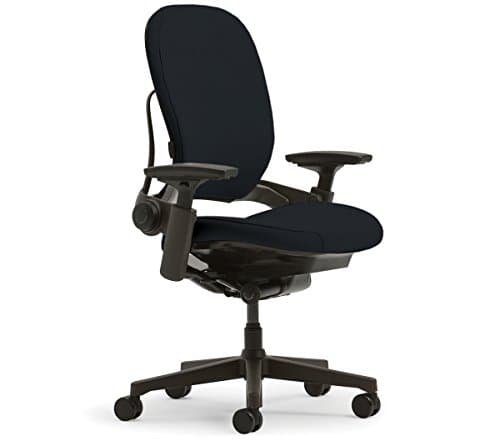
On a comparison chart the chair that wins is usually the one whose maker is willing to be measured, and Steelcase publishes more of this chart than anyone. Seat height 16 to 20.5 in, seat width 19.25 in, backrest 25 in - the tallest here - armrest height 7 to 11 in, which almost nobody else publishes at all, a 400 lb rating and a 12-year multi-shift warranty. The lumbar is height-adjustable and has a separate firmness dial, so it is two controls rather than one pad. The one number that counts against it is seat depth: 15.75 in, fixed, no slider.
Who it fits
Anyone who wants to decide from figures rather than photographs, and anyone whose pain has a specific height on their back.
Who it does not fit
Long-thighed sitters who need more than 15.75 in of pan, and anyone under about 5 ft 1 in.
Published specifications
Seat height
16"–20.5"
Seat depth
15.75"
Seat width
19.25"
Back height
25"
Arm height
7"–11"
Weight capacity
400 lb
Lumbar
Height-adjustable lumbar plus a lower-back firmness dial
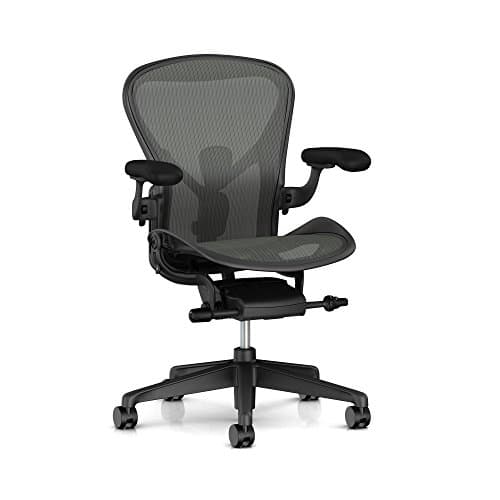
Every other chair in the chart is one shell with an adjustment range. The Aeron is three shells, and that changes what a single row can tell you: size A runs 14.4 to 19.3 in of seat height with a 16 in pan and a 300 lb warranty, size B runs 14.8 to 22.8 in with a 17 in pan and 350 lb, size C runs 15.8 to 22.8 in with an 18.5 in pan and 400 lb. That 14.4 in figure is the lowest seat on this site, and the 18.5 in C pan the deepest Aeron option. Herman Miller publishes no backrest height for it, which we leave as a gap.
Who it fits
Sitters at either end of the height range, where one-size chairs run out of travel.
Who it does not fit
Anyone who will not check which size they are ordering - the wrong shell undoes the whole advantage.
Published specifications
Seat height
14.4"–22.8"
Seat depth
16"–18.5"
Weight capacity
400 lb
Lumbar
PostureFit SL or adjustable lumbar pad, both height-adjustable
Sizes
A (seat height 14.4-19.3 in, seat depth 16 in, warrantied to 300 lb), B (14.8-22.8 in, 17 in, 350 lb), C (15.8-22.8 in, 18.5 in, 400 lb)
3. Best for The best-specified row under the premium tier
Steelcase Series 1
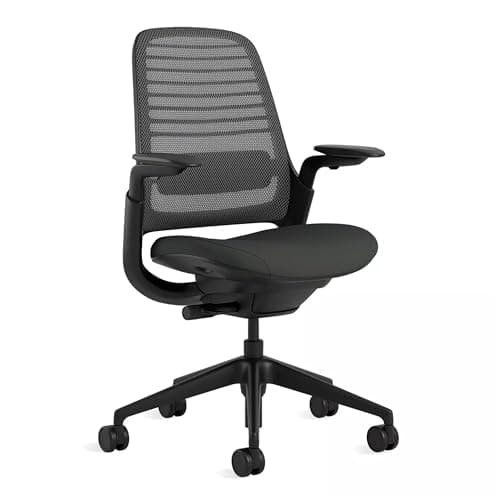
Read down the chart and this is the row that looks out of place: a 16.5 in minimum seat height and a 400 lb rating with the same 12-year multi-shift warranty as the Leap, at a mid-tier price. Functional seat depth is published as 15.5 to 17.75 in, so unlike the Leap the pan actually moves. Steelcase publishes overall height, 36.5 to 41.25 in, but no backrest height, and the adjustable lumbar is an option rather than standard - two gaps worth knowing before you order.
Who it fits
Anyone who wants premium-tier numbers without the premium-tier row above it.
Who it does not fit
Anyone who needs lumbar height adjustment as standard, or a published backrest height.
Published specifications
Seat height
16.5"–21.5"
Seat depth
15.5"–17.75"
Weight capacity
400 lb
Lumbar
Optional adjustable lumbar; weight-activated tension as standard
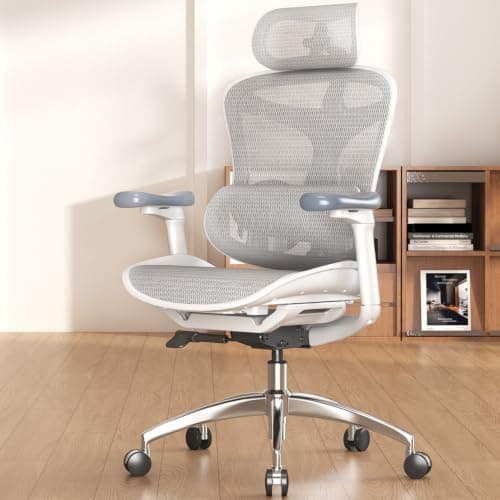
The useful budget comparison is not price, it is which adjustments survive the cut. Sihoo publishes an 18.11 in seat pan with depth adjustment, a 20.28 in seat width, a backrest whose height moves through 18.11 to 21.65 in, a self-adapting dynamic lumbar, a 330 lb rating and a three-year warranty. Depth adjustment and backrest height adjustment are both rare at this money, and both matter more than material. The gap is the one that matters most on a chart: Sihoo publishes overall height, 42 to 49 in, and no seat height from the floor.
Who it fits
Anyone shopping the budget tier who wants adjustments rather than padding.
Who it does not fit
Anyone over 330 lb, and anyone who needs a confirmed seat height before ordering.
What is the best office chair overall on this comparison?+
The Steelcase Leap v2, on published figures: a 25 in backrest, an armrest height range of 7 to 11 in that almost nobody else publishes, a height-adjustable lumbar with its own firmness dial, a 400 lb rating and a 12-year multi-shift warranty. Its weakness is a fixed 15.75 in seat pan.
Why do some cells say Not published?+
Because the maker does not publish that figure and we will not estimate it. Sihoo and Hbada publish overall height instead of seat height; Herman Miller publishes no backrest height for the Aeron or the Embody; Branch publishes no seat depth. Leaving the gap visible is more useful than filling it with a guess.
Which chair here has the lowest seat?+
The Herman Miller Aeron in size A, at a published 14.4 in minimum. The lowest one-size chair is the Steelcase Leap v2 at 16 in, with the Series 1 at 16.5 in just behind it. That matters if you are under about 5 ft 3 in - see best office chairs for a short person.
Does a higher weight capacity mean a more comfortable chair?+
No. Capacity is a structural rating from the test standards - see BIFMA - not a comfort figure. A 450 lb rating tells you the frame and gas lift are built heavier; it says nothing about whether the seat fits your hips or the lumbar sits at your curve.
Are prices included in this comparison?+
No. Amazon pricing moves daily and a figure typed into a chart would be wrong within a week, so every chair here links straight to its current Amazon price instead. The tier label - budget, mid, premium - is the only price signal we print.