The desk is in a corner of the bedroom, there is a shelf above it, and the chair has to disappear under it at the end of the day without being a dining chair.
Picked on published fit specifications, not on hands-on testing. How we pick.
The short answer
The Steelcase Series 1 is the pick for a small room: Steelcase publishes an overall height of 36.5 to 41.25 inches with no headrest, the lowest silhouette of any well-specified chair here, and it still drops to a 16.5 inch seat and carries a 12-year warranty.
We earn a commission if you buy through our links. It does not change your price, and it does not change our ranking. Prices are pulled from Amazon's own API and stamped with the date we fetched them — where we have no live figure, the button opens the current price on the retailer's page instead. Full disclosure.
Ranked picks with published seat height, seat depth and weight capacity
#ad Seat height and capacity are the manufacturer's published figures, sourced under each pick. Prices come live from Amazon's own API and carry the date we fetched them; where a figure is missing the button opens the current price instead. Seat depth for every pick is in the spec block below. Seat depth summary: Steelcase Series 1 15.5"–17.75" · Steelcase Leap v2 15.75" · HÅG Capisco 8106 13.4"–16.5" · Varier Variable Balans 12"
The figure nobody publishes
Let us be straight about the limit of this page before anything else. The measurement that most obviously decides whether a chair suits a small room is the diameter of its five-star base - the circle of floor it occupies - and not one maker in our registry publishes it. Not Herman Miller, not Steelcase, not Sihoo, not HON. We will not estimate it from a product photograph, so you will not find a footprint column here.
What is published, and what does most of the work in practice, is three other things: overall height including any headrest, whether the chair has a headrest at all, and the armrest height range that decides how far the chair tucks under the desk. Those are the columns this page ranks on, and they are enough to get the decision right in a corner of a bedroom. Everything published across the whole registry is laid out in the full comparison chart.
Overall height: the shelf test
Published overall height, lowest first - and whether a headrest is included in it
Chair
Overall height (in)
Headrest
Steelcase Series 1
36.5-41.25
No
Sihoo Doro C300
42-49
Yes
Sihoo M57
42-49
Yes
Hbada E3 Pro
43.7-51.8
Yes, four-dimensional
DRAGONN by VIVO kneeling chair
21-31
No - no backrest at all
Steelcase Leap v2
Not published (25 in backrest)
No
Herman Miller Aeron
Not published
No
Herman Miller Embody
Not published
No
Autonomous ErgoChair Pro
Not published (28-31 in backrest)
Yes
The spread between the Series 1 at 41.25 inches and the Hbada E3 Pro at 51.8 inches is ten and a half inches, and almost all of it is headrest. If there is a hutch, a shelf or a window sill above your desk, measure from the floor to the underside of it and compare - that single check rules out half the market before you read a review. A headrest is also the feature that does least for you at a desk anyway, which our headrest page sets out in full.
Tucking in: why armrest height is a space measurement
In a tight room the chair has to go away, and what stops it going away is almost always the armrests catching on the underside of the desk. A chair whose arms drop low enough slides fully in; one whose arms do not stops six inches out and stands in your walkway all evening.
Only two chairs in our registry publish an armrest height range at all. The Leap v2 publishes 7 to 11 inches measured from the seat; the Autonomous ErgoChair Pro publishes 11 to 14 inches. That difference is the whole story: the Leap can be set to pass under a lip the ErgoChair Pro cannot. For everything else, the arms either lift off or they do not, and you will find out on delivery. Do you need armrests on an office chair makes the case that in a small space removing them is often the right call.
When a dining chair is not the answer, and when it nearly is
The temptation in a studio is to use the chair you already have. It is worth being accurate about why that fails: a dining chair has a fixed seat height, usually around 18 inches, no lumbar support, a flat pan with no depth adjustment, and no ability to recline. All four are the specifications that matter over a working day - can office chairs cause back pain is largely a list of what happens when they are missing.
The nearly-works version is a kneeling chair or a saddle stool, and the reason is honest: both take far less floor, both lift out of the way, and both are designed for stretches rather than eight-hour days. If your small space is also a part-time workspace - two hours in the evening rather than a full shift - that trade is reasonable. How long you can sit in a kneeling chair has the realistic figure, and best kneeling chairs is the wider shortlist.
Floor protection in a small room
A detail that only matters when the room is small: casters wear a track into whatever is under them, and in a studio that track is in the middle of your living space rather than in an office. Hard casters on a hard floor roll the most and mark the most; a mat or a rug contains both. That is not a chair specification, which is why it is in a paragraph rather than a table, but it decides how a small room looks in a year.
The other small-room detail is weight. A chair you have to move daily is a chair whose weight you will notice - the Variable Balans is the only pick here you can lift with one hand, and the premium task chairs are all substantially heavier than they look. Autonomous publishes a 48.5 lb item weight for the ErgoChair Pro, which is the only item weight anybody in our registry publishes at all.
What to buy, by what your small space actually is
Matching the pick to the room
If your space is
The constraint is
Start with
A desk with a shelf or hutch above it
Overall height, headrest included
Steelcase Series 1 - 36.5-41.25 in, no headrest
A full-time workspace in a bedroom corner
Tuck-in depth plus eight-hour support
Steelcase Leap v2 - armrests to 7 in, 25 in back
A kitchen counter or wall-mounted shelf
Seat height, not footprint
HAG Capisco 8106 - 18.5-25.8 in seat height
A room where the chair must physically move
Floor area and weight
Varier Variable Balans - 16 x 12 in, no base
If the desk itself is the problem rather than the chair - a kitchen table is usually too high for a seated workstation - fix that before you choose, because it changes which seat height you need. And if you are furnishing a home desk generally rather than specifically a small one, the home desk chair page is the broader answer.
The picks in full
1. Best for The lowest silhouette with real specifications
Steelcase Series 1
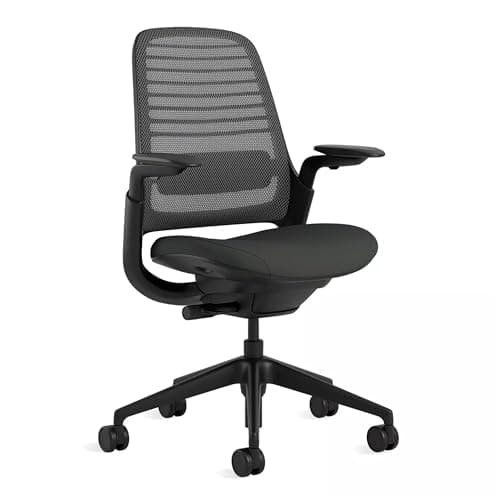
In a small room the figure that rules chairs out is overall height, and most makers quietly inflate it with a headrest. Steelcase publishes 36.5 to 41.25 in overall for the Series 1 and ships it without one, which is the lowest profile of any properly specified chair in our registry - it clears a hutch, a shelf or a low sill that a 49 in budget chair will not. Nothing else is given up for it: a published 16.5 to 21.5 in seat height, functional seat depth of 15.5 to 17.75 in, a 400 lb rating and a 12-year multi-shift warranty at mid-tier money. The adjustable lumbar is an option rather than standard.
Who it fits
Anyone with a shelf, hutch or sill above the desk, and anyone who wants a full-specification chair that disappears.
Who it does not fit
Anyone who needs lumbar height adjustment as standard, or a headrest.
Published specifications
Seat height
16.5"–21.5"
Seat depth
15.5"–17.75"
Weight capacity
400 lb
Lumbar
Optional adjustable lumbar; weight-activated tension as standard
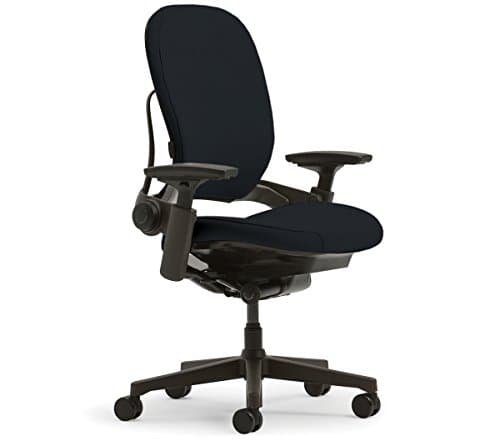
The premium answer to the same problem, and the one to pick if the small room is also where you work eight hours. The back stops at a published 25 in rather than running past your head, so there is no headrest adding height, and the adjustment list is the best here: seat height 16 to 20.5 in, armrest height 7 to 11 in, a height-adjustable lumbar with a separate firmness dial, a 400 lb rating and a 12-year multi-shift warranty. The armrest range is the quietly relevant figure in a tight space - arms that drop to 7 in from the seat let the chair tuck fully under a desk lip instead of stopping short of it.
Who it fits
Anyone working a full day in a small room who wants the chair to tuck right in.
Who it does not fit
Long-thighed sitters - the 15.75 in pan is fixed - and anyone wanting a headrest.
Published specifications
Seat height
16"–20.5"
Seat depth
15.75"
Seat width
19.25"
Back height
25"
Arm height
7"–11"
Weight capacity
400 lb
Lumbar
Height-adjustable lumbar plus a lower-back firmness dial
3. Best for A chair that works at a raised or narrow desk
HÅG Capisco 8106
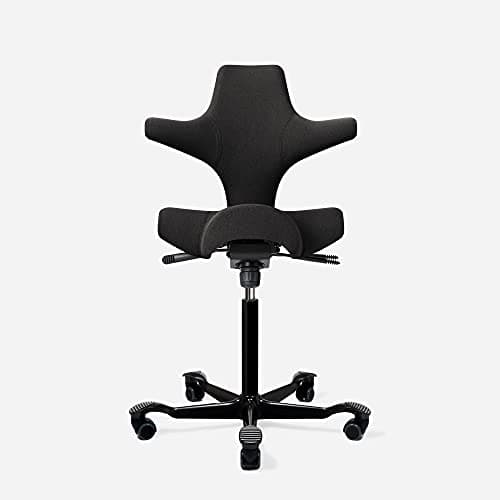
The small-space answer that changes the question. The Capisco saddle is 18.5 in wide and 13.4 to 16.5 in deep - the shortest adjustable pan of any task-height chair here - and Flokk publishes a seat height range of 18.5 to 25.8 in, which is the only range here that reaches a counter-height or standing desk. In a studio where the work surface is a kitchen counter or a wall-mounted shelf, that is the difference between a chair that works and one that does not. It is rated to 300 lb with a 10-year warranty and lifetime cover on the gas lift. There is no backrest to lean into in the saddle position, which is a real trade-off and not a detail.
Who it fits
Anyone whose desk is a counter, a bar or a wall shelf, and anyone who perches more than they sit.
Who it does not fit
Anyone who needs a backrest for a full working day, and anyone over 300 lb.
Published specifications
Seat height
18.5"–25.8"
Seat depth
13.4"–16.5"
Seat width
18.5"
Weight capacity
300 lb
Lumbar
None in the saddle position; the back support is a perch rest
Warranty
10-year against production defects; lifetime on gas lifts
4. Best for The smallest footprint here, by design
Varier Variable Balans
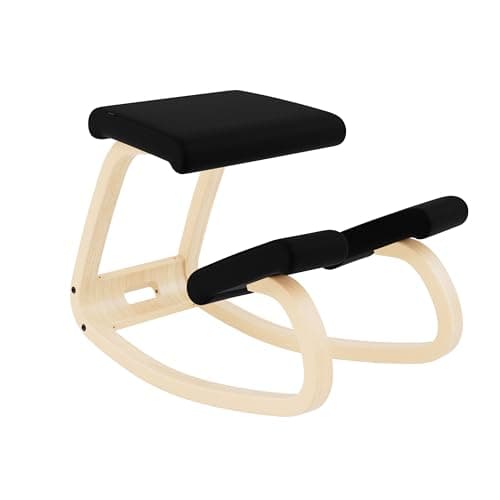
No five-star base, no casters, no gas lift - a pair of wooden runners instead, which is why it takes less floor than anything else on this page and why it can be lifted out of the way with one hand. Published figures are a 16 in seat width on a 12 in pan, a seat height of 18 to 20.5 in, a 240 lb rating and a seven-year warranty on the wood with five on mechanical parts. It is a kneeling chair, so be clear about what you are buying: it opens your hip angle rather than supporting your back, it loads your shins, and it is for stretches of an hour or two rather than a whole day.
Who it fits
Anyone who needs the chair to physically leave the floor space, and anyone already using a kneeling chair part-time.
Who it does not fit
Anyone who needs back support, anyone over 240 lb, and anyone sitting eight hours.
The Steelcase Series 1. Steelcase publishes an overall height of 36.5 to 41.25 in with no headrest - the lowest silhouette of any fully specified chair here - while still giving a 16.5 to 21.5 in seat height, adjustable seat depth, a 400 lb rating and a 12-year multi-shift warranty.
How much floor space does an office chair need?+
We cannot tell you from published figures, and we will not estimate it: no maker in our registry publishes base diameter. What is published and does nearly as much work is overall height, headrest presence and armrest height range - the three things that decide whether a chair fits under your desk and under whatever is above it.
Does a chair without a headrest take less room?+
Vertically, yes, and that is usually the binding constraint in a small room. The gap between the Series 1 at 41.25 in overall and the Hbada E3 Pro at 51.8 in is more than ten inches, and nearly all of it is headrest. At a desk a headrest does very little anyway.
Is a kneeling chair good for a small apartment?+
For a part-time workspace, genuinely yes - the Variable Balans is 16 in wide on a 12 in pan with no base at all and can be lifted out of the way. For a full working day, no: it has no back support, it loads your shins, and it is rated to 240 lb. See how long you can sit in one.
Can I just use a dining chair at a small desk?+
For short periods. It has a fixed seat height of around 18 in, no lumbar support, a flat pan with no depth adjustment and no recline - which is four of the specifications that matter most over a working day. If it is your only option, a lumbar cushion addresses one of the four.