You are not furnishing an office, you are putting one chair under one desk at home - and most of the chairs that get recommended for back pain will not fit under it.
Picked on published fit specifications, not on hands-on testing. How we pick.
The short answer
The Steelcase Series 1 is the pick for a home desk: it drops to a published 16.5 in seat height, adjusts seat depth from 15.5 to 17.75 in, and has no headrest to clear a shelf. Desk chair and office chair are the same product - what changes at a desk is clearance.
We earn a commission if you buy through our links. It does not change your price, and it does not change our ranking. Prices are pulled from Amazon's own API and stamped with the date we fetched them — where we have no live figure, the button opens the current price on the retailer's page instead. Full disclosure.
Ranked picks with published seat height, seat depth and weight capacity
#ad Seat height and capacity are the manufacturer's published figures, sourced under each pick. Prices come live from Amazon's own API and carry the date we fetched them; where a figure is missing the button opens the current price instead. Seat depth for every pick is in the spec block below. Seat depth summary: Steelcase Series 1 15.5"–17.75" · Sihoo Doro C300 18.11" · Steelcase Leap v2 15.75" · Everlasting Comfort Lumbar Support Pillow —
Desk chair, computer chair, office chair: same product
Start here because it saves you an hour of shopping. There is no design distinction between a desk chair, a computer chair and an office chair - they are three phrases for the same category, and retailers use whichever one the listing was written with. Our own search data shows the same readers arriving on the same pages whether they typed desk chair for lower back pain, computer chair for back pain or office chair for back pain. If a page tells you desk chairs are a separate kind of thing with separate rules, it is padding.
The one genuine distinction is the word that is not in any of those phrases: task chair. That is a real design category, and it is the one you want. Office chair versus task chair versus executive chair separates the labels properly.
What actually changes at a home desk
So if the product is the same, why does this page exist? Because the furniture around it is not the same. An office desk is a fixed-height work surface, usually around 29 to 30 inches, in a room designed for chairs. A home desk is whatever you had: a dining table, a secretary desk with a hutch, a writing desk under a window, a corner unit with a shelf above it. Three measurements get decided by the desk rather than by your back.
The home-desk measurements that rule chairs out before back support is considered
What to measure
Why it decides the chair
The figure to compare
Desk surface height
Sets the seat height you need. A tall desk forces a high seat and your feet off the floor
Published seat height range - and whether its minimum is low enough
Clearance under the desk top
Armrests that will not pass under the lip leave the chair sitting a foot too far back
Published armrest height range, measured from the seat
Height of anything above the desk
A hutch, shelf or window sill decides whether a headrest fits at all
Published overall height, headrest included
The second row is the one people discover after delivery. If the armrests do not clear the underside of the desk, you cannot pull the chair in, so you sit further back, so you reach forward to type - and reaching forward to type is one of the most reliable ways to produce exactly the back pain you bought the chair to fix. Chairs whose armrests drop low enough, or out of the way entirely, solve a problem that has nothing to do with lumbar support. Do you need armrests on an office chair covers the case for removing them.
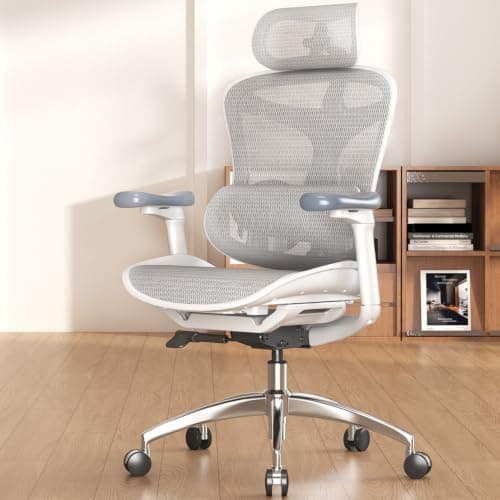
The third row catches a surprising number of budget chairs. The Sihoo chairs here publish overall heights of 42 to 49 inches, the Hbada E3 Pro 43.7 to 51.8 inches, and most of that upper figure is headrest. Under a hutch at 40 inches, none of it fits. The Series 1 at 36.5 to 41.25 inches overall and no headrest is the opposite case, which is the main reason it leads this page rather than the premium chairs above it.
How we ranked these four
Three published figures, in this order. Minimum seat height, because at a home desk with your feet on the floor this is the measurement most likely to be unachievable - a chair that bottoms out at 18.5 inches is wrong for most people under about 5 ft 6 in no matter how good its back is. Seat depth, and whether it adjusts, because the front edge pressing behind the knees is the most common home-desk complaint we see and the one most often mistaken for a back problem. And lumbar height adjustment, because support in the wrong place is close to no support at all.
The three figures this page ranks on
Chair
Seat height (in)
Seat depth (in)
Lumbar
Steelcase Series 1
16.5-21.5
15.5-17.75 adjustable
Optional adjustable; tension standard
Steelcase Leap v2
16-20.5
15.75 fixed
Height-adjustable plus firmness dial
Sihoo Doro C300
Not published (overall 42-49)
18.11 depth-adjustable
Self-adapting dynamic
Everlasting Comfort cushion
n/a
n/a
Fixed contour, strap-positioned
Read that table honestly and the Leap v2 has the better back and the Series 1 has the better fit. That is the real trade-off on this page, and which way it falls depends on your thighs: if the front edge of your current chair presses behind your knees, the 15.75 in fixed pan on the Leap will do it too, and the Series 1 is the pick. The seat depth guide has the measurement to check that against in about two minutes.
Three changes to make before the chair arrives
Clear the desk underside. Drawers, cable trays and a crossbar all eat the clearance your armrests need. Measure from the floor to the lowest thing under the desk top.
Put the monitor at eye level. A laptop flat on a home desk holds your head down all day, and no chair specification compensates for that. Both Cornell's ergonomics group and OSHA's workstation guidance treat screen height as a separate requirement from the chair.
Decide where the chair will live when you are not in it. If it has to tuck fully under the desk, overall height and armrest height are hard constraints, not preferences.
1. Best for Fits under a home desk and still drops low
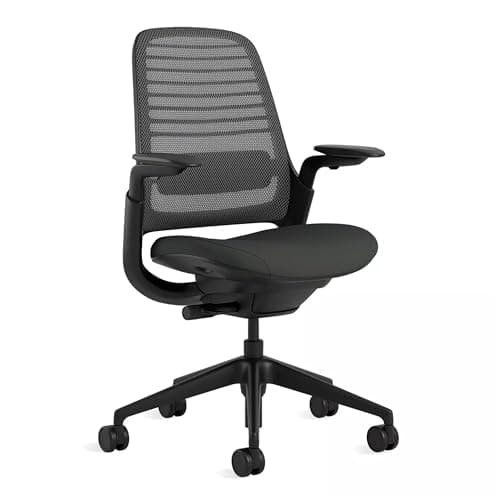
Steelcase Series 1
At a home desk two things decide the chair before back support does: how low the seat goes, and how tall the whole chair is when you push it in. Steelcase publishes a 16.5 in minimum seat height and an overall height of 36.5 to 41.25 in with no headrest, which is the lowest silhouette of any well-specified chair here - it clears a hutch, a shelf or a low window sill. Functional seat depth is published at 15.5 to 17.75 in, so you can shorten the pan until the front edge stops pressing behind your knees. A 400 lb rating and a 12-year multi-shift warranty at mid-tier money is unusual. The adjustable lumbar is an option rather than standard.
Who it fits
Anyone putting one chair under one desk at home, especially under a desk with a shelf or hutch over it.
Who it does not fit
Anyone who wants lumbar height adjustment included as standard, or a published backrest height.
Published specifications
Seat height
16.5"–21.5"
Seat depth
15.5"–17.75"
Weight capacity
400 lb
Lumbar
Optional adjustable lumbar; weight-activated tension as standard
2. Best for The budget pick, if your desk edge is the problem
Sihoo Doro C300
The single most common complaint about a home desk chair is the front edge of the seat cutting into the backs of the thighs, and this is the cheapest chair here that lets you move it. Sihoo publishes an 18.11 in pan with depth adjustment, a 20.28 in seat width, a backrest that moves through 18.11 to 21.65 in of height so the support lands where your own curve is, a self-adapting dynamic lumbar, a 330 lb rating and a three-year warranty. Two things to know before ordering: Sihoo publishes overall height of 42 to 49 in with no seat height from the floor, and the headrest adds height you may not have under a shelf.
Who it fits
Anyone on a budget whose current seat edge presses behind the knees, and anyone who wants depth adjustment cheaply.
Who it does not fit
Anyone over 330 lb, anyone working under a low shelf, and anyone who needs a confirmed seat height.
3. Best for When the pain has a specific height on your back
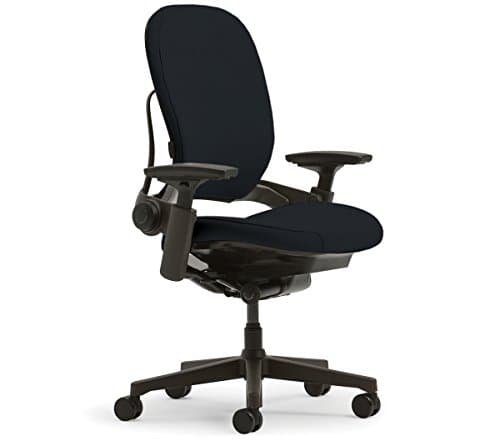
Steelcase Leap v2
If you can put a finger on where it hurts, this is the chair that lets you aim support at that spot rather than near it. The lumbar moves up and down and has a separate firmness dial, which is two controls where most chairs have none. Steelcase publishes seat height 16 to 20.5 in, a 25 in backrest, armrest height 7 to 11 in, a 19.25 in seat width, a 400 lb rating and a 12-year multi-shift warranty. At a home desk the relevant caveat is depth, not height: the pan is 15.75 in and fixed, so long-thighed sitters get no adjustment at all.
Who it fits
Anyone whose back pain is located rather than general, and anyone who will actually use the controls.
Who it does not fit
Long-thighed sitters, and anyone under about 5 ft 1 in.
Published specifications
Seat height
16"–20.5"
Seat depth
15.75"
Seat width
19.25"
Back height
25"
Arm height
7"–11"
Weight capacity
400 lb
Lumbar
Height-adjustable lumbar plus a lower-back firmness dial
4. Best for Testing the idea before you replace the chair
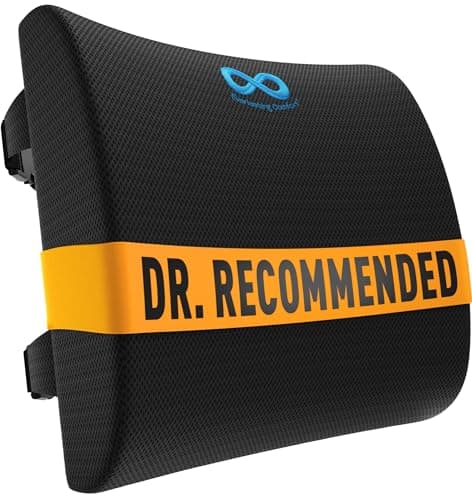
Everlasting Comfort Lumbar Support Pillow
Worth saying on a page full of chairs: a cushion is the cheap way to find out whether lumbar support is actually your problem. Everlasting Comfort publishes a 20.08 by 12.01 by 3.94 in contoured memory foam cushion positioned by two adjustable straps that fit chairs up to 32 in wide, with a stated lifetime replacement guarantee. It does not adjust the chair, it does not move your seat height, and it will not fix a seat that is too deep. What it does is tell you in a week whether support at your lumbar curve changes your afternoon - and if it does, that is the specification to spend on next.
Who it fits
Anyone who wants to test the lumbar theory before committing, and anyone stuck with a chair they cannot replace yet.
Who it does not fit
Anyone whose problem is seat height, seat depth or armrest height - a cushion changes none of those.
Published specifications
Lumbar
Fixed-contour memory foam; position set by two adjustable straps
A desk chair redistributes load while you sit. It does not treat a disc, a joint or a nerve, and some back pain has nothing to do with your furniture. Stop shopping and get assessed if you have:
Pain that runs below the knee, or numbness and tingling in the foot
Weakness in a leg or foot, or a foot that catches when you walk
Pain that wakes you at night, or that is worse lying down than sitting
Sudden onset after a fall, a lift, or an impact
Any change in bladder or bowel control, or numbness around the groin - this one is urgent
Pain with unexplained weight loss, fever, or a history of cancer
NIAMS notes that most people find relief within about six weeks. Pain that is not improving on that timescale, or that is getting worse, belongs with a clinician rather than a new chair - and so does any of the above, immediately.
We are not doctors, physical therapists or certified ergonomists, and nothing here is medical advice. If you are in real pain, see someone who is qualified to look at it.
Questions people actually ask
What is the best desk chair for back pain?+
The Steelcase Series 1, for a home desk. It drops to a published 16.5 in seat height, adjusts functional seat depth from 15.5 to 17.75 in, has no headrest to clear a shelf, and carries a 400 lb rating with a 12-year multi-shift warranty at mid-tier money. If your pain has a specific location on your back, the Leap v2 and its height-adjustable lumbar is the better answer.
Is a desk chair different from an office chair?+
No. They are two shopping phrases for the same product, and so is computer chair. The distinction worth knowing is task chair versus executive chair, which really are different designs - that comparison is here.
What is the best desk chair for lower back pain specifically?+
Lower back pain is where lumbar height adjustment earns its money, so the Leap v2 moves ahead of the Series 1 on that reading - it is the only chair in our registry with both a height-adjustable lumbar and a separate firmness dial. The dedicated page is best office chairs for lower back pain.
Will any of these fit under a desk with a hutch?+
The Series 1 is the one to shop: Steelcase publishes overall height of 36.5 to 41.25 in and it has no headrest. The budget picks are taller - Sihoo publishes 42 to 49 in overall - and most of that top figure is headrest. Measure from the floor to the underside of the hutch before you order.
Should I buy a cushion instead of a chair?+
As a test, yes - it is the cheapest way to find out whether lumbar support is your actual problem. As a solution, only if support was the whole issue. A cushion cannot change seat height, seat depth or armrest height, and those three are responsible for a large share of desk-related back pain.