Every listing calls itself an ergonomic office chair, but the same shop sells a task chair, a desk chair and an executive chair at three different prices - and nobody explains what the words mean.
Picked on published fit specifications, not on hands-on testing. How we pick.
The short answer
A task chair is the one you want: a compact, highly adjustable chair built for eight hours of desk work. An executive chair is a big padded chair built to look senior, usually with fewer adjustments. Ergonomic is a claim, not a category - judge it on the adjustment list.
We earn a commission if you buy through our links. It does not change your price, and it does not change our ranking. Prices are pulled from Amazon's own API and stamped with the date we fetched them — where we have no live figure, the button opens the current price on the retailer's page instead. Full disclosure.
Ranked picks with published seat height, seat depth and weight capacity
#ad Seat height and capacity are the manufacturer's published figures, sourced under each pick. Prices come live from Amazon's own API and carry the date we fetched them; where a figure is missing the button opens the current price instead. Seat depth for every pick is in the spec block below. Seat depth summary: Steelcase Leap v2 15.75" · Steelcase Series 1 15.5"–17.75" · Sihoo Doro C300 18.11"
Four words, three designs
The confusion is real and it is not your fault. Retailers use these labels as marketing categories rather than engineering ones, so the same chair can appear as a desk chair in one listing and an ergonomic office chair in another. Underneath, though, there really are three distinct designs, and they are distinguished by what the designer optimized for.
What each label actually describes
Label
What it describes
Optimized for
Task chair
A compact chair with a mid-height back and a long list of adjustments
Eight hours of close desk work, by one person who sets it up once
Ergonomic chair
A claim about fit, not a shape. Applied to task chairs, kneeling chairs, saddle chairs
Whatever the maker says - judge it on the published adjustment ranges
Executive chair
A tall, wide, heavily padded chair, often with a headrest and fixed arms
Looking senior, and short periods of reclined sitting
Desk chair / computer chair
Not a design at all - a shopping phrase for any chair used at a desk
Nothing. It describes the furniture it sits next to
Two of those four rows are categories you can shop. One is a claim you have to verify. And one - desk chair, or computer chair - is simply the words people type into a search box, as our own search data shows: readers arrive here looking for the best desk chair for back pain and mean exactly what other readers mean by office chair.
Task chair versus executive chair, where it matters
The honest difference is where the money went. On a task chair it went into the mechanism: seat height range, seat depth travel, armrest height and width, lumbar height and firmness, recline tension, a warranty long enough to signal the maker expects the mechanism to last. On an executive chair it went into size and surface - a taller back, wider wings, more foam, leather or a leather substitute, and a silhouette that reads as authority on a video call.
That is not a moral judgment, it is a use case. An executive chair is genuinely pleasant for an hour of reading and reclining. For a working day of typing it tends to fail in three specific ways. The back is often tall enough that the headrest pushes your head forward while you are upright at a keyboard - the same problem the headrest page sets out. The arms are frequently fixed in height, so they either hold your shoulders up or leave your arms unsupported. And the seat is usually deep and softly padded, which feels generous for ten minutes and lets you sink and slide forward over an afternoon - why you slide forward in your chair is mostly a story about seats like that.
Ergonomic is a claim, not a category
There is no certification behind the word on a retail listing. OSHA's workstation guidance describes what a chair needs to do - adjustable height, a seat that supports the thighs without pressing behind the knees, back support that fits the curve of the spine, arm support that does not lift the shoulders - but nobody audits the word against that list before it goes on a box. BIFMA standards cover safety and structural performance, not whether a chair fits you.
So treat the word as an invitation to check the specification table. A chair that publishes a seat height range, a seat depth range, an armrest height range and a lumbar mechanism is making a checkable claim. A chair that publishes overall height and a foam thickness is not. The chart in our office chair comparison is built from exactly that distinction, and whether expensive chairs are worth it looks at what the extra money buys when the claim is real.
Where gaming chairs and alternative seating sit
A gaming chair is an executive chair with racing-seat styling: tall back, bolstered sides, usually a fixed or shallow seat pan and a headrest pillow on a strap. The ergonomics conversation around it is the same conversation as the executive chair, and office chair versus gaming chair runs it in full.
Kneeling chairs and saddle chairs are a genuinely different proposition rather than a style variant - they change your hip angle instead of supporting your back, which is why they publish no lumbar figure at all. The HAG Capisco in our registry is a saddle chair; the Varier Variable Balans is a kneeling chair. Neither is a task chair and neither should be compared with one on a spec sheet. Kneeling chair versus office chair is the comparison that actually applies.
Which one you should buy
If you sit at a desk and type for more than about three hours a day, you want a task chair, and you want to shop it on four published numbers rather than on the label: minimum seat height, seat depth, seat width and armrest height range. How to measure yourself for an office chair gets you your four numbers in about ten minutes, and the buying guide turns them into a shortlist.
Buy the executive chair only if the room needs it and the sitting is short. If it has to be both - a chair that looks formal and works for eight hours - you are looking for a high-back task chair with real adjustment underneath the upholstery, which is a narrow category and an expensive one. The Leap v2 is the closest thing to it in our registry, and it gets there by being a task chair in a suit rather than an executive chair with a lever.
The picks in full
1. Best for What a task chair looks like at the top end
Steelcase Leap v2
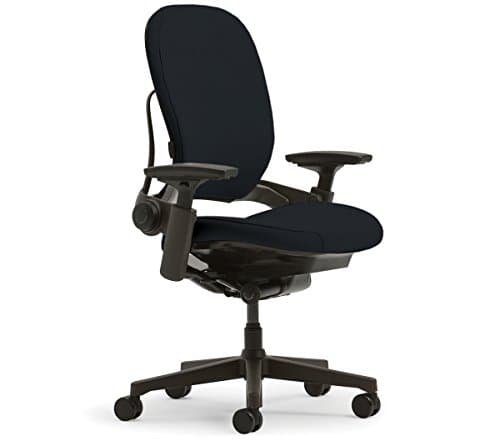
This is the shape of the category: a compact shell, a mid-height back that stops at 25 in rather than running past your head, and adjustment everywhere the body varies. Steelcase publishes seat height 16 to 20.5 in, armrest height 7 to 11 in, a height-adjustable lumbar with a separate firmness dial, a 400 lb rating and a 12-year multi-shift warranty. Nothing about it is built to look impressive, which is exactly the difference from an executive chair - the money went into the mechanism.
Who it fits
Anyone working a full day at a desk who wants the adjustment list rather than the padding.
Who it does not fit
Anyone who wants a chair that reads as formal in a video call, and long-thighed sitters - the 15.75 in pan is fixed.
Published specifications
Seat height
16"–20.5"
Seat depth
15.75"
Seat width
19.25"
Back height
25"
Arm height
7"–11"
Weight capacity
400 lb
Lumbar
Height-adjustable lumbar plus a lower-back firmness dial
2. Best for The task chair most people should actually buy
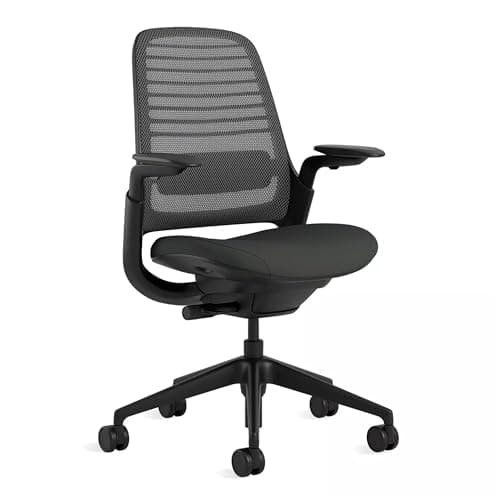
Steelcase Series 1
Mid-tier price, premium-tier structure. A 16.5 in minimum seat height, a functional seat depth published at 15.5 to 17.75 in so the pan really moves, a 400 lb rating and the same 12-year multi-shift warranty as the chair above it. It is unmistakably a task chair rather than an executive chair: no headrest, no winged upholstery, no attempt to look like furniture. Worth knowing before you order that the adjustable lumbar is an option rather than standard, and that Steelcase publishes overall height but not backrest height.
Who it fits
Anyone who wants the task-chair feature set without stepping up to the premium row.
Who it does not fit
Anyone who needs lumbar height adjustment included as standard.
Published specifications
Seat height
16.5"–21.5"
Seat depth
15.5"–17.75"
Weight capacity
400 lb
Lumbar
Optional adjustable lumbar; weight-activated tension as standard
3. Best for The budget chair that behaves like a task chair
Sihoo Doro C300
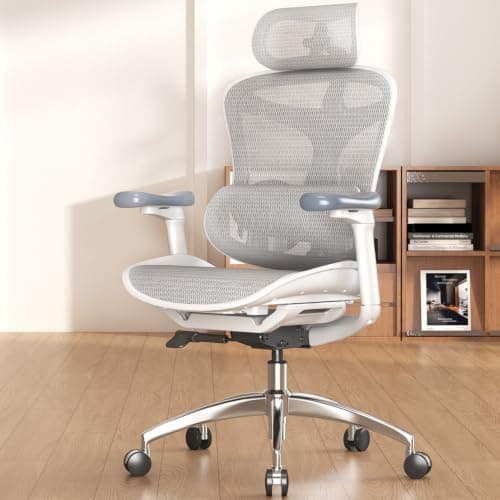
Most budget chairs imitate the executive look - big back, headrest, thick padding - and skip the adjustments. This one does the opposite. Sihoo publishes an 18.11 in pan with depth adjustment, a backrest that moves through 18.11 to 21.65 in of height, a self-adapting dynamic lumbar, a 20.28 in seat width, a 330 lb rating and a three-year warranty. Depth adjustment plus backrest height adjustment at this money is the useful test of whether a cheap chair is a task chair or an executive chair wearing mesh. Sihoo publishes overall height, 42 to 49 in, and no seat height.
Who it fits
Anyone on a budget who wants the task-chair adjustment list rather than the executive-chair look.
Who it does not fit
Anyone over 330 lb, and anyone who needs a confirmed seat height before ordering.
Office chair is the umbrella term; task chair is a specific design inside it. A task chair is compact, has a mid-height back and carries a long list of adjustments because it is meant to be set up once by one person and sat in all day.
Is an executive chair bad for your back?+
Not inherently, but it is usually the wrong tool for a typing day. The common failures are a headrest that pushes your head forward while you are upright, armrests fixed at a height that holds your shoulders up, and a deep soft seat that lets you slide forward. If you already own one, can office chairs cause back pain covers what to change first.
Does ergonomic chair mean anything on a product listing?+
Not on its own. There is no certification behind the word at retail. Treat it as a prompt to read the specification table: a published seat height range, seat depth range, armrest height range and a named lumbar mechanism is a checkable claim, and overall height plus foam thickness is not.
What is the difference between a desk chair and an office chair?+
Nothing, as a design. Desk chair and computer chair are shopping phrases for the same products - our own search data shows readers using them interchangeably with office chair. Compare the specifications and ignore the noun.
Do I need a headrest on a task chair?+
Usually not. A headrest only does anything when you are reclined far enough for your head to rest into it, which is a small part of a typing day - the headrest page sets out the full case.