Picked on published fit specifications, each linked to its source. How we pick.
The short answer
Four options, in order of how much height they add. A longer gas cylinder is the real fix and adds the most. Larger casters add roughly an inch. A firm cushion adds its own thickness but leaves the armrests behind. Risers under the base are a last resort and reduce stability.
We earn a commission if you buy through our links. It does not change your price, and it does not change our ranking. Prices are pulled from Amazon's own API and stamped with the date we fetched them — where we have no live figure, the button opens the current price on the retailer's page instead. Full disclosure.
Ranked picks with published seat height, seat depth and weight capacity
#ad Seat height and capacity are the manufacturer's published figures, sourced under each pick. Prices come live from Amazon's own API and carry the date we fetched them; where a figure is missing the button opens the current price instead. Seat depth for every pick is in the spec block below. Seat depth summary: HÅG Capisco 8106 13.4"–16.5" · HON Ignition 2.0 Big and Tall 18.74" · ComfiLife Premium Comfort Seat Cushion —
First, check it is actually too low
The test takes ten seconds. Sit back in the chair with your feet flat. If your knees are level with or above your hips, the seat is too low for you - and that matters more than it sounds, because a seat below your hip height rolls the pelvis backward and flattens the lumbar curve no matter what the backrest is doing. Is your chair too high or too low runs the full check, and the seat height lookup table gives the target number from published anthropometric data rather than from feel.
Also check the lever actually works. A chair that will not rise with no weight on it has a dead gas cylinder rather than a range problem - office chair keeps sinking has the test, and the fix is the same part discussed below.
The four methods, by how much they add
What each method adds, and what it costs you
Method
Roughly how much
What it costs you
Longer gas cylinder
3 to 6 in, depending on the cylinder
Fitting effort; may void a warranty; needs the right diameter
Larger casters
About 0.5 to 1.5 in
Little - but check the stem diameter matches the base
A firm seat cushion
Most of its own thickness, so 1 to 3 in
Armrests stay put, so your elbows end up above them
Risers or blocks under the base
Whatever you build
Stability, and the ability to roll - a genuine safety trade
The gas cylinder, which is the real answer
Replacement cylinders are a standard part sold by two measurements: the stem diameter (most office chairs use the same one, but confirm yours) and the extended length. An extended-height cylinder adds several inches to both ends of the range, which is a far bigger change than anything else on this list.
Two things to know before buying one. The job requires driving the old cylinder out of the base, which usually means a rubber mallet and some patience - the taper is friction-fit and it does not want to move. And fitting a non-original part may end your warranty, which is worth weighing against the chair's remaining term. On a cheap out-of-warranty chair that otherwise fits you, it is clearly worth it; on a chair with eight years of a twelve-year multi-shift term left, it is not.
Casters, cushions and risers
Larger casters are the low-effort option. Going from a 50 mm to a 75 mm wheel adds roughly an inch at the seat and tends to roll better on carpet as a bonus. Confirm the stem diameter and length against your base before ordering, because they are not universal.
A firm cushion adds most of its thickness and costs the least, but it has one consequence people miss: the armrests do not come up with you. If your arms were already at the right height, raising the seat two inches puts your elbows above them and the arms become something you reach down to rather than rest on. On a chair with height-adjustable arms that is a non-issue; on fixed arms it is a real cost. Do you need armrests is worth reading if the answer is that yours cannot move.
Risers under the base work and we would avoid them. A five-star base is designed around a specific center of gravity, and blocks under the castors raise that while removing the ability to roll. It is the one method on this page that trades away stability, and stability is the thing a chair base exists for.
Why you might want a higher seat at all
Three common reasons, and they point to different answers. If the desk is too high and the chair is the only adjustable part, the better fix is usually the desk - what to do if your desk is too high runs through keyboard trays and risers, which cost less than a cylinder and work better.
If you are tall and the chair simply does not have the range, the 6 ft 4 in page lists which chairs publish seat heights above 21 in and which stop short. And if the reason is a hip-angle precaution after surgery, seat height is the primary spec rather than a convenience - the page on chairs after a hip replacement ranks our registry on exactly that figure.
When the honest answer is a different chair
If you need more than about three inches, if your armrests are fixed, or if the chair is also the wrong pan length for you, modification is money spent on the wrong object. A cylinder does not change seat depth, seat width or backrest height, and those do not adjust on most chairs either. What size office chair you need is the five-minute check that tells you whether you are one modification away or one purchase away, and common office chair problems sorts the rest of the complaints into fixable and not.
The picks in full
1. Best for When you need genuinely high, not slightly higher
HÅG Capisco 8106
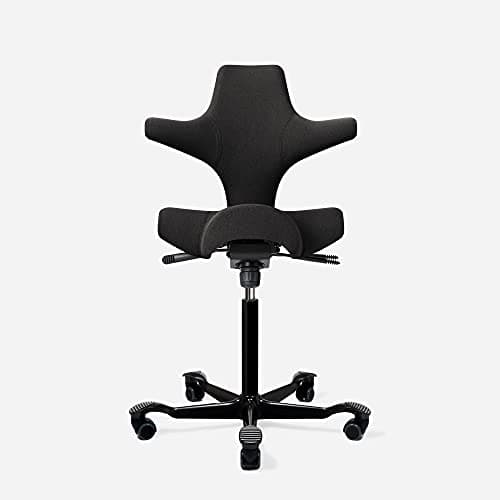
If the reason you are reading this is that you work at a raised surface, a kitchen counter or a standing desk set part-way down, no modification to a conventional chair gets you there and this is the chair that already does. Flokk publishes a seat height range of 18.5 to 25.8 in - more than three inches above anything else in our registry - with an 18.5 in seat width, an adjustable pan of 13.4 to 16.5 in, a 300 lb rating, and a 10-year warranty against production defects with lifetime cover on the gas lifts. The saddle seat is designed to be perched on as well as sat in, which is what makes the high position usable rather than precarious. The trade is stated by the design: in the saddle position there is no backrest to lean into.
Who it fits
Anyone working at a counter, a raised desk, or with a hip-angle reason to sit high.
Who it does not fit
Anyone over 300 lb, anyone needing full back support all day, and anyone with a fixed low desk.
Published specifications
Seat height
18.5"–25.8"
Seat depth
13.4"–16.5"
Seat width
18.5"
Weight capacity
300 lb
Lumbar
None in the saddle position; the back support is a perch rest
Warranty
10-year against production defects; lifetime on gas lifts
2. Best for A high seat floor with a conventional back
HON Ignition 2.0 Big and Tall
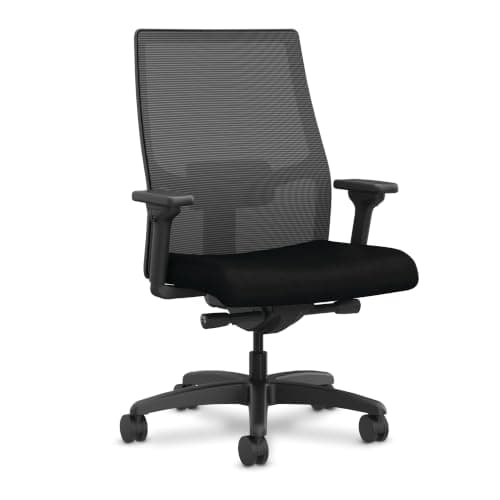
The conventional-chair answer when the problem is that your chair runs out at 19 or 20 in. Office Depot publishes a pneumatic seat height of 17 to 21.5 in on the Ignition 2.0 Big and Tall, with a 23.5 in seat width, a usable seat depth of 17.75 to 19.5 in, a back 22.75 in wide by 24.75 in high, adjustable lumbar, synchro-tilt with tilt tension and tilt lock, all-adjustable arms with pivot, a 450 lb capacity and HON's Full Lifetime Warranty. It is listed at 6 to 8 hours of daily use. The 17 in floor that makes it wrong for short sitters is exactly what makes it right here, and the arms rise with the seat rather than being left behind by a cushion.
Who it fits
Anyone who needs 21 in of seat height with a full backrest and armrests that come with it.
Who it does not fit
Short sitters. Anyone short of floor space - the base is wide.
3. Best for Two or three inches for almost nothing
ComfiLife Premium Comfort Seat Cushion
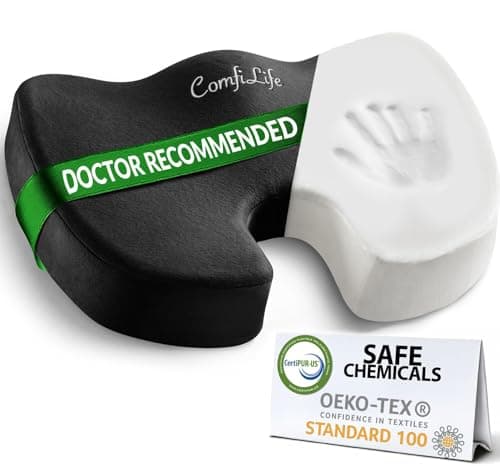
The cheapest of the four methods on this page, and the right one if you are two or three inches short rather than six. ComfiLife publishes a 17.7 by 13.7 by 2.8 in memory foam cushion with a U-shaped cutout, under a stated lifetime replacement guarantee. Sat on, a firm foam cushion gives you most of its thickness back as seat height, and the cutout takes the tailbone off the pan as a side benefit. Two honest limits, both of which matter: the armrests stay where they were, so raising the seat moves your elbows above them, and a soft cushion compresses to almost nothing under load - firmness is what makes this work, not thickness alone.
Who it fits
Anyone two or three inches short of the right seat height whose armrests already sit low or move.
Who it does not fit
Anyone needing more than about three inches, and anyone whose armrests are fixed and already high.
Four ways, in order of how much they add: a longer gas cylinder adds three to six inches, larger casters add half an inch to an inch and a half, a firm cushion adds most of its own thickness, and risers under the base add whatever you build at the cost of stability.
Can you replace an office chair gas cylinder with a taller one?+
Yes - extended-height cylinders are a standard part sold by stem diameter and extended length. Confirm the diameter against your base, expect to drive the old one out with a mallet, and check whether fitting a non-original part ends your warranty.
Do bigger casters make a chair taller?+
A little - moving from a 50 mm to a 75 mm wheel raises the seat by roughly an inch and usually rolls better on carpet. Check the stem diameter and length against your base first, because caster stems are not universal.
Will a cushion raise my chair enough?+
If you are two or three inches short, yes, provided it is firm - a soft cushion compresses to almost nothing under load. The catch is that the armrests stay where they were, so your elbows end up above them unless the arms adjust.
Is it safe to put blocks under an office chair?+
It works but we would not. A five-star base is engineered around a specific center of gravity, and raising it on blocks while removing the ability to roll trades away the stability the base exists to provide.