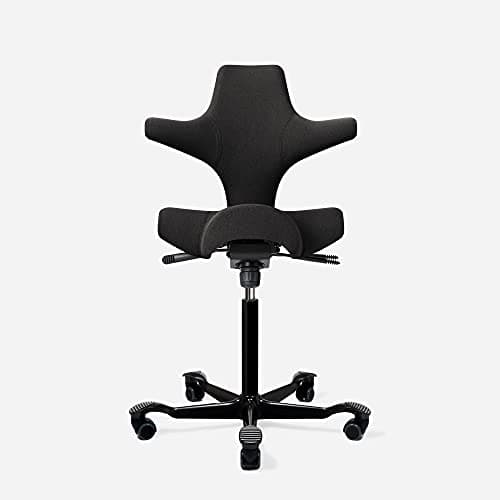
It is the chair every standing-desk thread recommends and almost nobody mentions the one specification that decides whether it will work at your desk at all.
Picked on published fit specifications, each linked to its source. How we pick.
The short answer
The Capisco is a saddle chair you can sit on forwards, backwards or perched, and it is genuinely good at that. The figure that decides it for you is the seat height: Flokk publishes 18.5 to 25.8 inches, so the chair starts higher than most people's desks want and is built for a raised or sit-stand surface.
We earn a commission if you buy through our links. It does not change your price, and it does not change our ranking. Prices are pulled from Amazon's own API and stamped with the date we fetched them — where we have no live figure, the button opens the current price on the retailer's page instead. Full disclosure.
The verdict
Buy it if your desk goes up. The Capisco is excellent at what it is for, and what it is for is a raised or sit-stand working surface where you want to move between sitting, perching and standing without changing furniture. Flokk says as much in the listing: the chair is recommended for working surfaces of 72 cm - about 28.3 inches - and higher, and a longer 265 mm gas lift is sold for taller desks still.
Do not buy it as a replacement task chair at a fixed desk. The published seat height floor is 18.5 inches. Every other chair in our registry starts lower, and most people at a standard 29 to 30 inch desk want a seat somewhere between 16 and 19 inches. At 18.5 you are already perching, which is the point of this chair and the reason it is the wrong one if perching is not what you came for.
What a saddle chair is actually doing
A conventional chair puts your hips at roughly ninety degrees and asks the backrest to hold your lumbar curve in place. A saddle seat opens that hip angle - you sit astride it, thighs sloping down - and the claim is that the open angle lets the pelvis sit upright on its own, so the lower back keeps its natural curve without anything pushing it there.
That is the same argument a kneeling chair makes, reached by a different route: a kneeling chair transfers some weight to the shins, a saddle chair does not. Which matters, because shin pressure is the usual reason people stop using a kneeling chair, and the Capisco has none of it.
The Capisco then adds something neither a kneeling chair nor a task chair offers: it is designed to be sat in facing either direction. Turned around, with your chest against the narrow backrest, it supports a forward-leaning posture - which is what you actually adopt when you are reading something on the desk or working with your hands. Flokk calls the seat lockable and the tilt "inBalance", a flowing tilt with adjustable backward tension rather than a fixed recline.
The published figures
HAG Capisco 8106 as published by Flokk, with the metric originals
Specification
Published figure
Seat height
18.5-25.8 in (470-655 mm), 200 mm lift
Optional lift
265 mm, for higher desks
Seat width
18.5 in (470 mm)
Seat depth
13.4-16.5 in (340-420 mm), adjustable
Back height
Adjustable (range not published)
Base
Five-star aluminum footbase, 28.7 in (730 mm) diameter
Tilt
HAG inBalance, adjustable backward tension, lockable seat
Weight capacity
300 lb (136 kg) per the Flokk US listing
Warranty
10-year on production defects; lifetime on gas lifts
Recommended desk
72 cm (28.3 in) and higher
Lumbar
None in the saddle position - the backrest is a perch rest
Source: the Flokk US store listing for the HAG Capisco, checked in October 2026. One caution worth printing: European retailer listings for the same model number state a 120 kg maximum rather than 136 kg. We have kept the Flokk US figure because it is the manufacturer's own, but if you are near the top of that range, confirm the rating with your seller before ordering - this is the one specification on this page where published sources disagree.
Fit, mapped to your body
Seat height is the gate, and it is covered above. Above roughly 6 ft 2 in the Capisco is one of very few chairs that still has range left at the top - 25.8 inches is higher than anything else here by a wide margin. Below about 5 ft 9 in at a fixed desk it is the wrong chair unless you specifically want to perch.
Seat depth works differently from a conventional chair and the number looks alarming until you understand why. The Capisco publishes 13.4 to 16.5 inches, which would be far too shallow on a task chair. On a saddle you straddle the seat rather than sitting back into it, so the pan is not carrying your thigh along its length - it is carrying your sit bones. Do not compare this figure to the one you calculate in the seat depth guide; that method assumes a conventional seated posture.
Seat width is 18.5 inches, which is narrower than a standard task chair pan and for the same reason. If width across the hips is your constraint, a saddle is structurally the wrong shape and chairs for wide hips is the better page.
Where it is strong
Posture variety, genuinely. Forward astride, perched high, or turned around leaning on the backrest. Most chairs offer one posture adjusted slightly. This offers three that are mechanically different, which is the most honest answer anyone sells to the problem described in what happens when you sit all day.
Range at the top end. 25.8 inches as standard and a longer lift available. Nothing else in our registry reaches that, which makes it the default recommendation on our standing-desk page.
No shin pressure. The open hip angle of a kneeling chair without the mechanism that makes kneeling chairs uncomfortable after an hour. If you liked the idea of a kneeling chair and your knees ended the experiment, this is the alternative.
Adjustable seat depth and back height. Unusual on alternative seating, where most products adjust height and nothing else.
The warranty. Ten years on production defects and a lifetime warranty on the gas lift. A gas lift is the single most common failure point on any office chair - see why chairs keep sinking - so covering it for life is a more meaningful commitment than the headline number suggests.
Where it is weak
The 18.5-inch seat height floor. This is the chair's defining limitation and it is not a flaw so much as a scope: the Capisco assumes your desk goes up, and if yours does not, nothing about the chair adapts.
No lumbar support in the forward position. The backrest is a perch rest, not a lumbar system. The chair's whole argument is that an open hip angle makes lumbar support unnecessary - which is a reasonable argument and is not the same thing as providing it. If your pain is specifically lumbar and specifically located, read the lumbar support picks instead.
300-pound ceiling, with a published disagreement. Covered above. Verify before ordering if it is close.
No published back height range or armrest figures. Flokk lists back height as adjustable without saying over what range, and the Capisco is normally sold without arms at all.
A learning period, and a real one. A saddle posture uses the hip and core muscles differently from a conventional chair and most people are sore for the first week. That is normal and it is also a reason not to buy one two days before a busy month - how long it takes to adapt to a new chair covers the timeline.
Price. It is a premium chair, priced against the Aeron and the Leap rather than against the kneeling chairs it is functionally closer to.
Who should not buy one
Anyone at a fixed standard-height desk. The most important line on this page. Buy a chair that reaches your desk, or raise the desk first.
Anyone who wants one chair for eight hours. Perching is excellent in stretches and tiring as a default. Most people who get on with a Capisco use it alongside standing, not instead of a conventional chair all day.
Anyone whose back needs active support. Sciatica, a herniated disc or stenosis all want specific, adjustable support behind you - the sciatica roundup is the right page.
Anyone who wants to recline. The inBalance tilt is a flowing, weight-balanced movement, not a chair you lean back in to take a call.
Alternatives worth reading
Best saddle stools - the full category, with what a saddle does and does not fix.
Steelcase Leap v2 - if what you actually want is a conventional chair that is very good at supporting a lower back.
This review is built on Flokk's published figures with the source linked, and it prints the one place published sources disagree rather than quietly picking a side. We did not sit in this chair and we do not claim to have. Our method is set out in full in how we pick.
The published specifications
A sit-stand desk, not a standard one
HÅG Capisco 8106
The Capisco is the only chair in our registry designed to be sat in more than one way - astride the saddle facing forward, perched high with the seat tilted, or turned around with your chest against the backrest. That is a real answer to the problem of holding one posture for eight hours, and the published seat height range of 18.5 to 25.8 inches is what makes the perched positions reachable. Flokk also publishes seat depth and back height adjustment, a lockable seat and the HAG inBalance tilt with adjustable backward tension.
Who it fits
Anyone working at a sit-stand desk or a raised surface, anyone who physically cannot settle into one posture, and anyone who already knows they sit better astride than seated back.
Who it does not fit
Anyone at a fixed 29-inch desk who wants one chair for the whole day - the seat starts at 18.5 inches, higher than every other chair here. Anyone who needs lumbar support, which the saddle position does not provide.
Published specifications
Seat height
18.5"–25.8"
Seat depth
13.4"–16.5"
Seat width
18.5"
Weight capacity
300 lb
Lumbar
None in the saddle position; the back support is a perch rest
Warranty
10-year against production defects; lifetime on gas lifts
Not comfortably as a seated chair. The published seat height starts at 18.5 inches, which is higher than most people want at a fixed 29 to 30 inch desk, and there is no adjustment below that. Flokk recommends the chair for working surfaces of 28.3 inches and higher. At a standard desk you will be perching, which is fine if that is what you want and uncomfortable if it is not.
Does the Capisco have lumbar support?+
Not in the saddle position. The backrest is a perch rest you can lean on or turn around and lean against, and the chair's design argument is that an open hip angle keeps the pelvis upright so a lumbar pad is not needed. If you want an adjustable lumbar pad, this is the wrong chair - adjustable versus fixed lumbar explains what you would be giving up.
Is the Capisco good for back pain?+
It can help the specific case where sitting at ninety degrees for hours is what aggravates you, because it changes the hip angle and makes moving between postures easy. It is a poor choice for pain that needs targeted lumbar support, and it is not something we can promise will work for any particular condition. See the back pain roundup for chairs that support rather than reposition.
How long does it take to get used to a saddle chair?+
Expect soreness through the first week while your hips and core adapt to a posture they do not usually hold. That is widely reported across saddle seating and it is the main reason people return them early. Build up over several short sessions a day rather than switching to it for a full workday immediately.
What is the weight limit on the Capisco 8106?+
Flokk's US store listing publishes 136 kg, which is 300 pounds. Some European retailer listings for the same model state 120 kg. That is a genuine disagreement between published sources and we are not going to resolve it for you - if you are near either figure, confirm it with the seller before ordering.