Something is wrong with your setup, you suspect the chair height, and you cannot tell which direction to move it - so you nudge it up and down all week and nothing improves.
Picked on published fit specifications, not on hands-on testing. How we pick.
The short answer
Too high gives you dangling feet, pressure behind the knees and a habit of crossing your legs. Too low gives you knees above hips, a rounded lower back and shoulders held up to reach the desk. Read your feet first: unsupported feet means too high.
We earn a commission if you buy through our links. It does not change your price, and it does not change our ranking. Prices are pulled from Amazon's own API and stamped with the date we fetched them — where we have no live figure, the button opens the current price on the retailer's page instead. Full disclosure.
Ranked picks with published seat height, seat depth and weight capacity
#ad Seat height and capacity are the manufacturer's published figures, sourced under each pick. Prices come live from Amazon's own API and carry the date we fetched them; where a figure is missing the button opens the current price instead. Seat depth for every pick is in the spec block below. Seat depth summary: Steelcase Series 1 15.5"–17.75" · Herman Miller Aeron 16"–18.5" · Sihoo Doro C300 18.11"
Read your feet first
One observation settles the direction in about three seconds. Sit back in the chair and look down. If your feet are not resting flat on the floor - dangling, on tiptoe, tucked under you, or wrapped around the chair base - the seat is too high. If they are flat but your knees sit noticeably higher than your hips, the seat is too low. That is the test, and everything below is confirmation.
OSHA's workstation guidance and Cornell's ergonomics group both describe the target as feet supported flat with thighs roughly level and open angles at the hips and knees. Those are the two ends of the correct window, and both directions out of it produce distinct complaints.
Six signs, three each way
Which direction your chair is wrong, by symptom
What you notice
Direction
Why it happens
Feet dangling, on tiptoe, or hooked on the chair base
Too high
Your legs have nowhere to rest, so their weight hangs from your thighs and hips
Pressure or numbness along the back of the thighs
Too high
The front edge of the seat is taking your leg weight instead of the floor
You cross your legs without deciding to
Too high
Folding a leg up is the body finding somewhere to put it
Knees sitting higher than your hips
Too low
The hip angle closes, which rolls your pelvis back and flattens your lumbar curve
Lower back rounds the moment you sit, however hard you try
Too low
A closed hip angle makes an upright pelvis almost impossible to hold
Shoulders shrugged or wrists bent up to reach the keyboard
Too low
You are below the desk, so your arms reach up and your shoulders follow
The third row is worth flagging because it gets read as a personality trait rather than a symptom. Habitually crossing your legs at a desk is very often a seat that is too high or a pan that is too deep - our cross-legged page covers both readings. And the sixth row is the one that produces upper-back and neck complaints rather than lower-back ones, because a chair that is too low for the desk sends the problem up into your shoulders - best office chairs for upper back pain picks that thread up.
The number your height calls for
You do not have to guess. The BIFMA-derived anthropometric tables give popliteal height - floor to the underside of the knee - as a ratio of standing height, running from 0.249 at the 5th percentile female to 0.271 at the 95th percentile male. We use 0.25 for the minimum the chair must reach and 0.27 for the height you want available.
Seat height target by standing height, from the published ratios
Your height
Minimum the chair must reach (in)
Height you want available (in)
5 ft 0 in
15.0
16.2
5 ft 4 in
16.0
17.3
5 ft 8 in
17.0
18.4
6 ft 0 in
18.0
19.4
6 ft 4 in
19.0
20.5
Compare that against your chair's published range and the conversation often ends there: a lot of chairs simply cannot reach the low end. The full lookup table has every two-inch step, and how to measure yourself gets you your real popliteal height rather than an estimate from the ratio, which is better if your proportions are unusual.
When it is not the height at all
Two other things produce symptoms that masquerade as seat height, and checking them saves you from chasing the lever.
Seat depth. Pressure behind the knees appears on the too-high list above, but it is also the signature symptom of a pan that is too long for your thighs - and the two have opposite fixes. The distinguishing question is whether your feet are flat: if they are flat and the pressure is still there, the pan is too deep, not the seat too high. The seat depth guide settles it in two minutes.
Armrest height. Shrugged shoulders are on the too-low list, but armrests set too high produce the identical feeling with the seat at a perfect height. Check by dropping your arms to your sides and seeing where your forearms naturally land - do you need armrests covers the case for lowering them out of the way.
What to do when the chair will not reach
If the number you need is below your chair's minimum, your options are a footrest, a lower-reaching chair, or a taller desk - in that order of cost. A footrest is not a compromise: the purpose of seat height is to get your feet supported flat with your thighs level, and a footrest achieves exactly that. OSHA treats it as a legitimate solution rather than a workaround.
If the number you need is above your chair's maximum, that is rarer and usually means the desk is unusually tall. A gas lift cannot be extended; a longer cylinder can sometimes be fitted, but you are then into replacement-part territory with a chair whose warranty probably will not cover it. And if the lever works but the chair will not hold the height you set, that is a sinking chair rather than a height problem - a different page and a different fix. If your chair has no working lever at all, adjusting height without a lever covers that case.
The picks in full
1. Best for The widest useful seat height range here
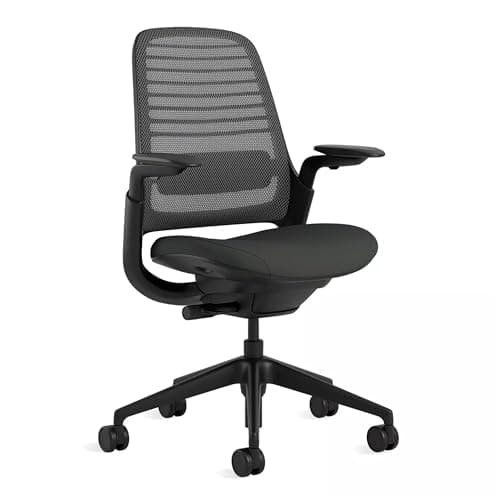
Steelcase Series 1
If your chair cannot reach the number your body needs, no amount of diagnosis helps - and five inches of published travel is the most practical range in our registry. Steelcase publishes 16.5 to 21.5 in of seat height, which covers the figures the anthropometric tables give for roughly 5 ft 6 in through 6 ft 6 in. It also publishes a functional seat depth of 15.5 to 17.75 in, which matters because seat height and seat depth produce overlapping symptoms and fixing one without the other leaves you guessing. A 400 lb rating and a 12-year multi-shift warranty at mid-tier money. The adjustable lumbar is an option rather than standard.
Who it fits
Anyone from about 5 ft 6 in up whose current chair runs out of travel in either direction.
Who it does not fit
Anyone under about 5 ft 4 in - 16.5 in is still too high to get your feet flat.
Published specifications
Seat height
16.5"–21.5"
Seat depth
15.5"–17.75"
Weight capacity
400 lb
Lumbar
Optional adjustable lumbar; weight-activated tension as standard
2. Best for When the number you need is below 16 inches
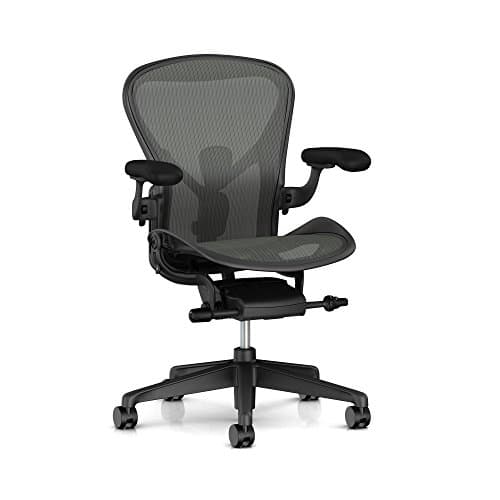
Herman Miller Aeron
The short-sitter answer, and the only one in our registry that is a chair rather than an accessory. Herman Miller sells the Aeron in three shells: size A runs 14.4 to 19.3 in of seat height with a 16 in pan, size B runs 14.8 to 22.8 in with a 17 in pan, size C runs 15.8 to 22.8 in with an 18.5 in pan. That 14.4 in minimum is the lowest published seat height on this site, which is what a sitter around 5 ft 0 in actually needs. The size choice is the entire advantage, so ordering the wrong shell undoes it - and Herman Miller publishes no backrest height for any of them.
Who it fits
Sitters at either extreme of the height range, where one-size chairs run out of adjustment.
Who it does not fit
Anyone who will not confirm the shell size before ordering.
Published specifications
Seat height
14.4"–22.8"
Seat depth
16"–18.5"
Weight capacity
400 lb
Lumbar
PostureFit SL or adjustable lumbar pad, both height-adjustable
Sizes
A (seat height 14.4-19.3 in, seat depth 16 in, warrantied to 300 lb), B (14.8-22.8 in, 17 in, 350 lb), C (15.8-22.8 in, 18.5 in, 400 lb)
3. Best for The budget route, with the caveat stated
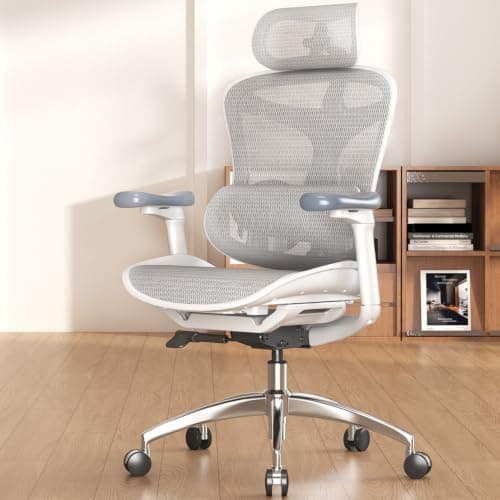
Sihoo Doro C300
Included with an honest warning attached, because this page is about a measurement its maker does not publish. Sihoo gives overall height of 42 to 49 in and no seat height from the floor at all, so you cannot check the deciding figure before ordering - you measure it on delivery. What it does publish is genuinely useful for the symptoms on this page: an 18.11 in pan with depth adjustment, which separates the too-high symptoms from the too-deep ones, plus a backrest that moves through 18.11 to 21.65 in of height, a self-adapting dynamic lumbar, a 330 lb rating and three years of warranty.
Who it fits
Anyone on a budget who will measure the delivered seat height and send it back if it is wrong.
Who it does not fit
Anyone who needs a confirmed seat height before ordering, and anyone over 330 lb.
Your feet are the test. If they are not resting flat on the floor - dangling, on tiptoe, or hooked around the chair base - it is too high. Supporting signs are pressure along the backs of the thighs and a habit of crossing your legs.
How do I know if my office chair is too low?+
Your knees sit higher than your hips, your lower back rounds the moment you sit however hard you try, and you shrug your shoulders or bend your wrists upward to reach the keyboard. A closed hip angle rolls your pelvis back and flattens the lumbar curve.
What height should my office chair be?+
About a quarter of your standing height as the minimum it must reach, and about 0.27 of it available above that - so 15.0 to 16.2 in at 5 ft 0 in, 17.0 to 18.4 in at 5 ft 8 in, 19.0 to 20.5 in at 6 ft 4 in. Those come from the BIFMA-derived ratios, not from preference.
Should my chair match my desk or my body?+
Your body. Set the chair so your feet are flat and your thighs level, then deal with the desk separately - with a keyboard tray, a lowered desk, or by accepting a raised chair plus a footrest. Raising the chair to meet a tall desk costs you your foot support, which is the more important of the two.
Is it better for a chair to be slightly too high or slightly too low?+
Slightly too high, provided you support your feet on something. A seat that is too low closes your hip angle and makes an upright pelvis nearly impossible to hold, and nothing you add to the room fixes that - whereas a footrest genuinely fixes dangling feet.