You cross your legs in the chair without thinking about it, the armrests are in the way, and every ergonomics page tells you to stop rather than telling you which chair makes it work.
Picked on published fit specifications, not on hands-on testing. How we pick.
The short answer
The Hbada E3 Pro is the pick on the one number that decides this: a published 25.6 inch seat width, the widest here. Sitting cross-legged needs a wide flat pan with clear space between the armrests - and it needs you to change position regularly, because one crossed leg all day is its own problem.
We earn a commission if you buy through our links. It does not change your price, and it does not change our ranking. Prices are pulled from Amazon's own API and stamped with the date we fetched them — where we have no live figure, the button opens the current price on the retailer's page instead. Full disclosure.
Ranked picks with published seat height, seat depth and weight capacity
#ad Seat height and capacity are the manufacturer's published figures, sourced under each pick. Prices come live from Amazon's own API and carry the date we fetched them; where a figure is missing the button opens the current price instead. Seat depth for every pick is in the spec block below. Seat depth summary: Hbada E3 Pro — · Branch Ergonomic Chair — · HON Ignition 2.0 Big and Tall 18.74" · HÅG Capisco 8106 13.4"–16.5"
Why you do it, and why it is not simply a bad habit
People cross their legs in an office chair for three reasons, and only one of them is preference. The first is that it is a position change, and your body wants one - sitting still is the actual problem, and shifting a leg up is the cheapest available fix. The second is that the seat is too deep, so sitting all the way back puts the front edge into the back of your knees, and folding a leg up takes it off that edge. The third is that the seat is too high for your legs to hang comfortably, so there is nowhere good to put your feet.
Two of those three are fit problems with their own fixes, and it is worth knowing which one you have before you buy a wider chair. The seat depth guide settles the second in about two minutes, and whether your chair is too high or too low settles the third. If it turns out to be the first - you want to move - then a wide pan is a real answer rather than a workaround, and that is what this page ranks.
The one number that decides it: seat width
Published seat width across the registry, widest first
Chair
Seat width (in)
Pan length (in)
Hbada E3 Pro
25.6
Not published
Branch Ergonomic Chair
25
Not published
HON Ignition 2.0 Big and Tall
23
18.74 fixed
Herman Miller Embody
21.25
15-18 adjustable
Sihoo Doro C300
20.28
18.11 depth-adjustable
Sihoo M57
20.08
18.11
Steelcase Leap v2
19.25
15.75 fixed
Autonomous ErgoChair Pro
19
19-21.5 adjustable
HAG Capisco 8106
18.5
13.4-16.5 adjustable
Herman Miller Aeron
Not published
16 / 17 / 18.5 by size
Steelcase Series 1
Not published
15.5-17.75 adjustable
A gap of six and a half inches separates the top and bottom of that table, which is a lot of pan. Note the two blanks at the bottom: Herman Miller publishes no seat width for the Aeron, and Steelcase publishes none for the Series 1, so neither can be ranked on this page's deciding figure and neither is picked. We would rather leave a well-regarded chair off a page than estimate a number for it. The general version of this table is in the seat width guide.
The honest case against doing it all day
We are not going to pretend this is a neutral choice. Sitting with one leg folded under or across loads your pelvis asymmetrically - one side higher than the other for as long as you hold it - and your lower back takes that tilt. OSHA's workstation guidance and Cornell's ergonomics group both describe the target seated position as feet supported with thighs roughly level and hips, knees and ankles at open angles, which a crossed leg is not.
The practical reading, though, is not stop - it is swap. NIAMS' guidance for prolonged sitting is to get up, move around and switch positions frequently, and a crossed leg is a position change. Held for ten minutes and then swapped, it is movement. Held for three hours on the same side every day, it is a one-sided load, and that shows up as hip pain or a lower back that aches on one side. If you are already getting leg or hip symptoms, how to sit to prevent leg pain is the page to read before this one.
Two chairs that solve it differently
There are really two answers on this page and they point in opposite directions. The wide pan answer - Hbada, Branch, HON - gives you room to do what you already do, comfortably, with arms out of the way. The saddle answer gives you something better to do instead: several genuinely different positions, rotated through, with no need to fold a leg anywhere.
Which one is right depends on why you cross your legs. If it is for room, buy width. If it is because you cannot bear sitting in one position, buy a chair built for several - best saddle stools covers that category properly, and kneeling chair versus office chair is the wider comparison.
Setting up a wide chair so it works
Drop the armrests to their lowest, or remove them. The usable width is the gap between the arms, not the figure in the spec table.
Shorten the pan if it adjusts. A long pan with a crossed leg pushes you further forward, away from the backrest.
Set a timer and swap sides. Whichever leg is on top, it should not be the same one for three hours.
Check your feet when you uncross. If they do not reach the floor flat, the seat is too high and crossing your legs is a symptom - see whether you need a footrest.
The picks in full
1. Best for The widest published pan here
Hbada E3 Pro
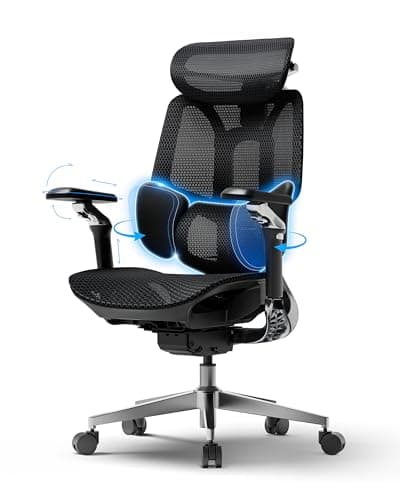
Crossing your legs needs lateral room on the pan, and this is the most of it anyone in our registry publishes: 25.6 in of seat width. It also claims an unusually wide fit range - Hbada states 5 ft 1 in to 6 ft 5 in - and carries a three-zone dynamic lumbar with 3.15 in of backrest height adjustment, a 330 lb rating, five years on the base, gas lift and casters and three years elsewhere. Two honest gaps: Hbada publishes no seat height, only an overall height of 43.7 to 51.8 in, and no pan length - the 1.97 in figure in its table is slide travel, not seat depth.
Who it fits
Anyone who sits cross-legged by habit and wants the most pan width available.
Who it does not fit
Anyone who needs a confirmed seat height before ordering, and anyone over 330 lb.
Published specifications
Overall height
43.7"–51.8" (seat height not published)
Seat width
25.6"
Weight capacity
330 lb
Lumbar
Three-zone dynamic lumbar, 3.15 in of backrest height adjustment
Maker's fit range
5 ft 1 in to 6 ft 5 in, per Hbada
Warranty
5-year on base, gas lift and casters; 3-year on other components
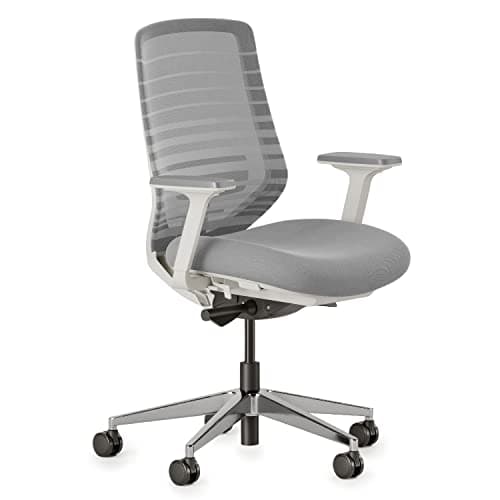
2. Best for Wide pan with arms that move out of the way
Branch Ergonomic Chair
A quarter of an inch behind on width and ahead on the thing width alone does not solve: the armrests. Branch publishes eight adjustments and a removable lumbar pad, and the arms are the usable kind rather than fixed blocks - which matters because on a wide pan the arms are what your crossed knee actually hits. Published seat height is 17 to 21 in on a 275 lb rating with a seven-year warranty. The honest caveats are two: 17 in is the floor, which is too high for a sitter under about 5 ft 6 in to keep both feet down, and Branch publishes no seat depth figure at all.
Who it fits
Anyone who wants pan width plus armrests that get out of the way, and anyone over about 5 ft 6 in.
Who it does not fit
Anyone under about 5 ft 6 in wanting feet flat on the floor, and anyone over 275 lb.
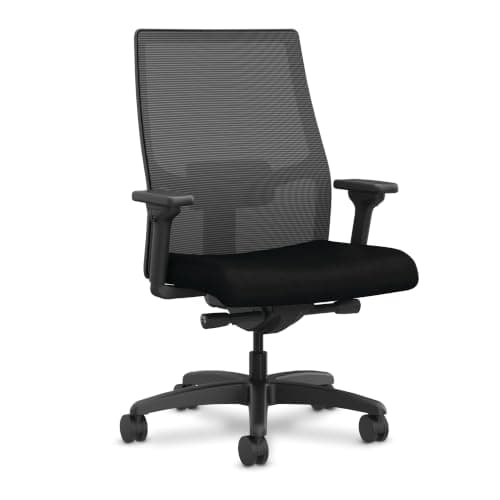
Crossing your legs loads the pan unevenly - all your weight onto one side, then the other - and a frame rated higher than you need is how that stops being a durability question. HON publishes a 23 in seat width on an 18.74 in pan with a 24.75 in backrest, rated to 450 lb behind the HON Full Lifetime Warranty, with a published seat height of 17 to 21.5 in. The 18.74 in pan is the deepest fixed pan here, which cuts both ways: more surface to fold a leg onto, and too much length for a shorter sitter to use with both feet down.
Who it fits
Larger and taller sitters who cross their legs, and anyone who wants the frame over-specified.
Who it does not fit
Anyone under about 5 ft 5 in - the 17 in seat and 18.74 in pan are both too much.
4. Best for A chair designed to be sat in several ways
HÅG Capisco 8106
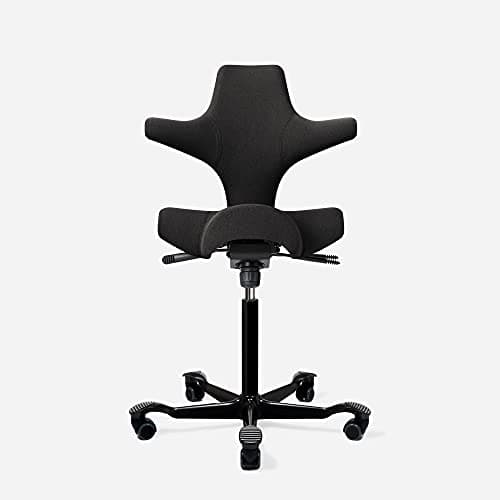
The outlier, and worth considering if what you actually want is to stop sitting one way. The Capisco saddle is built to be sat on facing forward, sideways, backwards against the perch rest, or perched high with a foot down, and Flokk publishes a seat height range of 18.5 to 25.8 in - the widest here - which is what makes the high perch work at a normal desk. It is 18.5 in wide and 13.4 to 16.5 in deep, rated to 300 lb, with a 10-year warranty and lifetime cover on the gas lift. Read the width honestly: you cannot fold both legs onto a saddle. What you get instead is five positions to rotate through.
Who it fits
Anyone who crosses their legs because sitting still is the real problem, not because they need the room.
Who it does not fit
Anyone who wants to actually sit cross-legged on the pan - a saddle will not take it.
Published specifications
Seat height
18.5"–25.8"
Seat depth
13.4"–16.5"
Seat width
18.5"
Weight capacity
300 lb
Lumbar
None in the saddle position; the back support is a perch rest
Warranty
10-year against production defects; lifetime on gas lifts
A wider seat removes an obstacle. It does not treat a nerve, a joint or a disc, and a habitual crossed leg can mask a symptom worth looking at. Stop shopping and get assessed if you have:
Pain that runs below the knee, or numbness and tingling in the foot
Weakness in a leg or foot, or a foot that catches when you walk
Pain that wakes you at night, or that is worse lying down than sitting
Sudden onset after a fall, a lift, or an impact
Any change in bladder or bowel control, or numbness around the groin - this one is urgent
Pain with unexplained weight loss, fever, or a history of cancer
Specific to this page: numbness or pins and needles in the leg you cross, or a foot that goes dead and stays dead after you uncross, is worth raising with a clinician rather than solving with a wider pan.
We are not doctors, physical therapists or certified ergonomists, and nothing here is medical advice. If you are in real pain, see someone who is qualified to look at it.
Questions people actually ask
What is the best office chair for sitting cross-legged?+
The Hbada E3 Pro, on the figure that decides it: a published 25.6 in seat width, the widest in our registry. The Branch Ergonomic Chair at 25 in is close behind and has armrests that get further out of the way, which matters as much as the pan itself.
Is sitting cross-legged in an office chair bad for you?+
Held for hours on the same side, yes - it tilts your pelvis and your lower back takes the asymmetry. Held for ten minutes and swapped, it is a position change, which is what the guidance on prolonged sitting actually asks for. The problem is duration and one-sidedness, not the position.
How wide does a seat need to be to sit cross-legged?+
Wider than the published figure suggests, because what you actually use is the gap between the armrests and nobody publishes that. In our registry only three chairs publish 23 in or more of pan: the Hbada E3 Pro at 25.6, the Branch at 25 and the HON Ignition Big and Tall at 23.
Why do I keep crossing my legs at my desk?+
Usually one of three reasons: you want a position change, the seat is too deep so the front edge presses behind your knees, or the seat is too high so your feet have nowhere good to go. Two of those are fit problems with their own fixes - seat depth and seat height.
Would a saddle chair be better?+
If you cross your legs because you cannot stand sitting one way, yes - a saddle chair is built for several positions and the Capisco publishes the widest seat height range here at 18.5 to 25.8 in. If you cross your legs because you want the room, no: you cannot fold a leg onto a saddle.