At 6 ft 4 in the backrest stops below your shoulder blades, the seat edge cuts across the middle of your thigh, and the chair that every review loves was designed for someone eight inches shorter.
Picked on published fit specifications, each linked to its source. How we pick.
The short answer
Three published numbers decide it: a seat that reaches about 21 in, a pan of 18 in or more, and a back of 25 in or more. The Herman Miller Aeron in size C clears all three at 22.8 in, 18.5 in and three shell sizes - the only chair here sold in a size made for you rather than for the average.
We earn a commission if you buy through our links. It does not change your price, and it does not change our ranking. Prices are pulled from Amazon's own API and stamped with the date we fetched them — where we have no live figure, the button opens the current price on the retailer's page instead. Full disclosure.
Ranked picks with published seat height, seat depth and weight capacity
#ad Seat height and capacity are the manufacturer's published figures, sourced under each pick. Prices come live from Amazon's own API and carry the date we fetched them; where a figure is missing the button opens the current price instead. Seat depth for every pick is in the spec block below. Seat depth summary: Herman Miller Aeron 16"–18.5" · HON Ignition 2.0 Big and Tall 18.74" · Autonomous ErgoChair Pro 19"–21.5" · Hbada E3 Pro —
Three numbers, and most chairs fail at least one
At 6 ft 4 in you are at roughly the 97th percentile of adult male stature in the US population, which is well outside the range the average task chair is dimensioned for. The published anthropometric tables in the BIFMA-derived Allsteel reference guide make the problem concrete: chair makers design around the 5th to 95th percentile, and you are not in it.
That shows up as three specific failures, each with a number attached:
What a 6 ft 4 in sitter needs, and where our registry lands
The figure
What you need
Which chairs clear it
Maximum seat height
About 21 in or more, so your knees are not above your hips
Capisco 25.8 in; Aeron B/C 22.8 in; ErgoChair Pro 22 in; HON Ignition BT and Series 1 21.5 in
Seat depth (pan length)
18 in or more for a long femur
ErgoChair Pro 19-21.5 in; Aeron C 18.5 in; HON Ignition BT to 19.5 in; Sihoo 18.11 in; Embody to 18 in
Backrest height
25 in or more, so the top lands above the shoulder blades
ErgoChair Pro 28-31 in; Leap v2 25 in; HON Ignition BT 24.75 in
Weight capacity
Whatever you actually weigh, with margin
HON Ignition BT 450 lb; Aeron C, Leap v2 and Series 1 400 lb
Read down that table and the shortlist builds itself. Only three chairs in our registry publish a backrest height of 25 in or more, and only one of those also publishes a pan longer than 18 in. The rest of the market is not hiding anything from you - it simply was not drawn for your frame.
Why seat depth matters more than seat height at your size
Height is easy to fix: gas cylinders have range, and a chair an inch too low can usually be lived with. Pan length is not adjustable on most chairs, and a pan that is too short leaves the front third of your thigh unsupported, which forces you forward out of the backrest and loads the sit bones instead of spreading weight along the thigh. It is the single complaint we would expect you to have about a chair that otherwise reviews well.
Worth naming, because they are the ones you will be recommended. The Steelcase Leap v2 publishes a 25 in back - good - but a fixed 15.75 in pan, which is short for a long femur and cannot be changed. The Herman Miller Embody tops out at a 20.5 in seat with a 15 to 18 in pan and is sold in one size only. The Branch Ergonomic reaches 21 in of seat height but is rated to 275 lb. And the HAG Capisco 8106 has the highest seat here at 25.8 in with a pan of only 13.4 to 16.5 in, because it is designed to be perched on rather than sat back in.
None of those is a bad chair. They are chairs whose published numbers do not match your published numbers, which is a different thing and a far more useful thing to know.
Set it up for your height once it arrives
A tall sitter in a correctly sized chair can still end up with the same complaints if the desk is wrong. At 6 ft 4 in a standard 29 in desk is usually too low, which drops your shoulders and rounds the upper back no matter what the chair is doing - the desk height page covers both directions, and how to adjust your chair runs the controls in order. If the upper back is where it hurts, the upper back pain roundup is the more specific page.
How we picked these four
On four published figures - maximum seat height, seat depth, backrest height and weight capacity - sourced from each maker or an authorized retailer and listed below. We did not sit in any of them and we are 5 ft 10 in anyway; how we pick sets out exactly what this site does. For a chair chosen by stature, published dimensions beat impressions, and that is the whole method.
At the far end of the range the shortlist narrows again. If you are 6 ft 3 in or above, the 6 ft 4 in page works through the three published figures - seat height, pan length and backrest height - that most well-reviewed chairs quietly fail at that stature, and names the ones that clear all three.
Worth separating the two halves of that category name before you buy. If your issue is stature rather than weight - a backrest that stops at your shoulder blades, a pan that is short for your femur - the 6 ft 4 in page ranks on back height and pan length instead of on capacity, and several big-and-tall chairs do not come out well on those.
Once you have the four numbers, the next question is what to do with them. What size office chair do I need is the decision table: which published figure each measurement has to be checked against, which listings give you a different measurement instead, and what the answer looks like for four common bodies.
Width is one of four measurements that together decide whether a chair fits you at all. What size office chair do I need puts all four in one table alongside the published figures to check each against. And if the outside of your hips is where it hurts, why your office chair hurts your hips confirms whether width is genuinely the cause before you spend anything.
The picks in full
1. Best for The only chair here sold in your size
Herman Miller Aeron
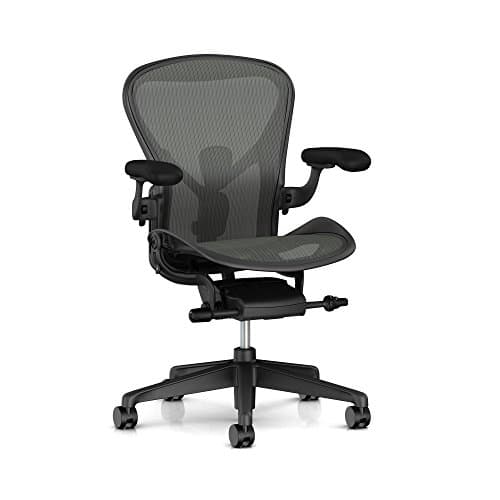
The Aeron is the only mainstream chair sold in three shell sizes, and at 6 ft 4 in that is the entire argument. Herman Miller publishes size C at a seat height of 15.8 to 22.8 in with an 18.5 in seat depth and a 400 lb warranty rating - the highest seat and the longest pan in our registry outside the saddle chair. Size B reaches the same 22.8 in with a 17 in pan and a 350 lb rating, which suits a tall sitter with shorter thighs. Size A tops out at 19.3 in and is simply the wrong chair for you regardless of brand loyalty. Lumbar is PostureFit SL or an adjustable pad, both height-adjustable; warranty is 12-year, 3-shift. The one thing to get right is ordering the correct shell, because a size A Aeron is a worse chair for you than a budget chair that fits.
Who it fits
Anyone 6 ft 2 in and up who will deliberately order size C, and who wants a pan long enough for a long femur.
Who it does not fit
Anyone who buys secondhand without confirming the shell size. Anyone shopping below the premium band.
Published specifications
Seat height
14.4"–22.8"
Seat depth
16"–18.5"
Weight capacity
400 lb
Lumbar
PostureFit SL or adjustable lumbar pad, both height-adjustable
Sizes
A (seat height 14.4-19.3 in, seat depth 16 in, warrantied to 300 lb), B (14.8-22.8 in, 17 in, 350 lb), C (15.8-22.8 in, 18.5 in, 400 lb)
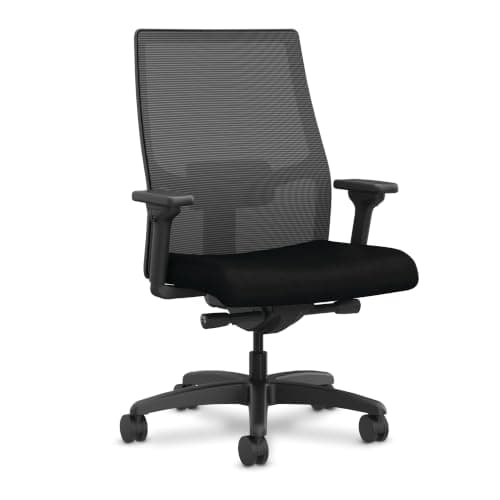
The chair that solves the backrest problem rather than the seat height problem. Office Depot publishes a back 22.75 in wide by 24.75 in high - tall enough that the top of the backrest lands above the shoulder blades rather than in the middle of them - with a 23.5 in seat width, a usable seat depth of 17.75 to 19.5 in, a 17 to 21.5 in seat height, adjustable lumbar, synchro-tilt with tilt tension and tilt lock, all-adjustable arms with pivot, a 450 lb capacity and HON's Full Lifetime Warranty. It is listed at 6 to 8 hours of daily use. The 17 in seat floor is a problem for short sitters and irrelevant to you; the footprint is large, which is the real trade.
Who it fits
Tall sitters who are also broad, and anyone whose complaint is the backrest ending too low.
Who it does not fit
Anyone short of floor space. Anyone who wants a seat above 21.5 in.
On published numbers alone this is the best-specified chair here for a 6 ft 4 in body, and we are listing it with that said plainly. Autonomous publishes a seat height of 18.5 to 22 in, a seat depth of 19 to 21.5 in - the longest pan in our registry by a clear margin - a backrest 21 in wide by 28 to 31 in high, armrests 11 to 14 in above the seat, nine adjustment points, a 300 lb rating and a stated fit range of 5 ft 4 in to 6 ft 6 in. The catch is commercial rather than physical: Autonomous sells direct only, there is no live Amazon listing for it and no affiliate program we have joined, so this site earns nothing from it and shows no buy button. We have left it in because leaving it out would make the shortlist less honest, not more.
Who it fits
Long-femured sitters who want the longest published pan and a back that reaches past the shoulders.
Who it does not fit
Anyone over 300 lb - the lowest capacity here. Anyone who wants to buy through Amazon.
Published specifications
Seat height
18.5"–22"
Seat depth
19"–21.5"
Seat width
19"
Back height
28"–31"
Arm height
11"–14"
Weight capacity
300 lb
Lumbar
Adjustable lumbar with a stated 6 in of height range
Illustrative photo, not a picture of this exact model - we label stock imagery as stock rather than passing it off.
Sold direct only. Autonomous does not sell this model through Amazon and we are not in their affiliate program, so we have no link that pays us and we are not going to pretend otherwise. The published figures above are sourced in how we pick, and the maker's own page is listed under Sources.
4. Best for A published fit range on a budget
Hbada E3 Pro
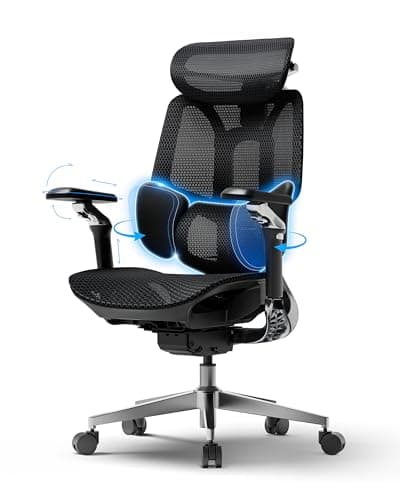
The budget entry, and one of very few chairs at this money that publishes a fit range at all - Hbada claims 5 ft 1 in to 6 ft 5 in, which puts you inside it with an inch to spare. It also publishes a 25.6 in seat width, the widest here, a three-zone dynamic lumbar with 3.15 in of backrest height adjustment, a 330 lb rating, and a warranty that gives five years on base, gas lift and casters against three on other components. The limits are real and they matter at your height: Hbada publishes overall height of 43.7 to 51.8 in but no seat height, and no pan length - only 1.97 in of slide travel - so the two figures that decide this page cannot be checked before the box arrives.
Who it fits
Tall sitters on a budget who are willing to buy on the fit range and check the numbers afterwards.
Who it does not fit
Anyone over 330 lb, and anyone who wants the seat height and pan length confirmed before ordering.
Published specifications
Overall height
43.7"–51.8" (seat height not published)
Seat width
25.6"
Weight capacity
330 lb
Lumbar
Three-zone dynamic lumbar, 3.15 in of backrest height adjustment
Maker's fit range
5 ft 1 in to 6 ft 5 in, per Hbada
Warranty
5-year on base, gas lift and casters; 3-year on other components
What is the best office chair for someone 6 ft 4 in?+
The Herman Miller Aeron in size C, which publishes a 15.8 to 22.8 in seat height, an 18.5 in seat depth and a 400 lb rating - the only mainstream chair sold in a shell made for your frame rather than the average one. Order size C deliberately; size A is wrong for you.
How high should a chair be for a 6 ft 4 in person?+
Around 20 to 21 in of seat height for most people at that stature, set so your knees are level with or slightly below your hips with your feet flat. The seat height table works it out from published anthropometric data rather than a rule of thumb.
Do I need a big and tall chair if I am 6 ft 4 in?+
Not necessarily. Big-and-tall chairs are engineered mainly for weight capacity and seat width; many have a backrest no taller than a standard chair. If your complaint is that the backrest ends at your shoulder blades, check the published back height instead of the category name.
Why does the seat edge cut into my thighs?+
Because the pan is shorter than your femur, so your weight lands on the sit bones and the front edge rather than spreading along the thigh. You want a published seat depth of about 18 in or more at your height.
Is the Steelcase Leap v2 good for tall people?+
Partly. The 25 in back height is genuinely tall and the 400 lb rating is generous, but the seat pan is a fixed 15.75 in and does not slide, which is short for a long femur. It is a better chair for a tall sitter with short thighs than for a long-legged one.