Picked on published fit specifications, each linked to its source. How we pick.
The short answer
Four causes, and the location tells you which. Pain on the outside of the hips is almost always a seat that is too narrow for your sitting width. Deep joint pain points at a seat set too low. Pain under the sit bones is seat firmness. Pain with shoulder tension points at armrests set too close.
We earn a commission if you buy through our links. It does not change your price, and it does not change our ranking. Prices are pulled from Amazon's own API and stamped with the date we fetched them — where we have no live figure, the button opens the current price on the retailer's page instead. Full disclosure.
Ranked picks with published seat height, seat depth and weight capacity
#ad Seat height and capacity are the manufacturer's published figures, sourced under each pick. Prices come live from Amazon's own API and carry the date we fetched them; where a figure is missing the button opens the current price instead. Seat depth for every pick is in the spec block below. Seat depth summary: Hbada E3 Pro — · Branch Ergonomic Chair — · HON Ignition 2.0 Big and Tall 18.74"
Four causes, and the location tells you which
Hip pain from sitting is not one problem. It is four, they feel different, and they have different fixes costing anywhere from nothing to the price of a chair. Work out which one you have before you buy anything.
Where it hurts, what is usually causing it, and what the fix costs
Where it hurts
Usual cause
The fix
Outside of both hips, where the bone sits closest to the surface
Seat pan narrower than your sitting width - the raised edges press inward
A wider seat, or remove the arms and sit without pressing against them
Deep in the joint, front of the hip, worse the longer you sit
Seat set too low, closing the hip angle past comfortable
Raise the seat; a wedge cushion if the chair will not go higher - free to cheap
Directly under the sit bones, a bruised ache
Seat pan too firm, or too thin a cushion over a hard base
A seat cushion, or a chair with a longer published pan - cheap
Hips plus tight shoulders and neck
Armrests set too close or too high, clamping the elbows in
Widen or lower the arms; swing them out of the way - free
Note how many of those cost nothing. Three of the four are adjustment problems before they are purchase problems, which is why we would rather you read this page than the roundup.
Cause one: the seat is narrower than you are
Sitting width is not waist size and it is not what you wear. It is the distance across the widest part of your hips while seated, which is wider than standing because soft tissue spreads under load. Measure it with a tape across the widest point while you are sitting on a flat surface, then add about two inches of clearance. The seat width guide has the full method and the published widths across our registry.
Most task chairs are contoured, with the pan edges raised slightly to hold you centered. That is a feature when the pan is wide enough and a vice when it is not - the raised edges land exactly on the part of the hip that has the least padding over it. Published seat widths in our registry run from 16 in on the kneeling chairs up to 25.6 in on the Hbada E3 Pro, which is a spread of nearly ten inches on a figure most buyers never look at.
Cause two: the seat is too low
A low seat closes the hip angle. Held closed for hours, that loads the front of the joint and shortens the hip flexors, and it shows up as deep ache rather than surface pressure. The test is simple: if your knees sit higher than your hips when your feet are flat, the seat is too low for you. Our too-high-or-too-low check walks it through, and the seat height lookup table gives you the number to aim for from published anthropometric data rather than from feel.
If the chair is already at its top setting and your knees are still high, the chair is the wrong size for you and no cushion solves it properly. If the chair has room to go up but your desk then sits too low, that is a desk problem - the desk height page covers both directions.
Cause three: the pan is too firm, or too short
Pain directly under the sit bones is a pressure problem, not a joint problem, and it is the one most often misread as hip pain. Why an office chair seat feels too hard is the dedicated page. The short version is that the sit bones concentrate your upper body weight onto two small areas, and a thin or dense pan gives them nowhere to spread. A seat cushion is the cheap test; a longer, better-padded pan is the permanent one.
Cause four: the armrests
Arms set too close pull the elbows in and rotate the shoulders forward. That changes how you sit through the pelvis, and the compensation shows up at the hip as often as at the back. Arms set too high do the same thing by lifting the shoulders. The fix is free: widen them, drop them, or swing them out of the way entirely. Our page on whether you need armrests makes the case that for many sitters the honest answer is no.
When it is not the chair at all
Two patterns are worth separating out. The first is hip pain that is actually referred from the back - a nerve pattern that starts in the lumbar spine and is felt at the hip or buttock. The lower back and hip pain roundup covers that case, and the tell is usually that it extends down the leg rather than staying at the hip.
The second is joint disease. NIH describes osteoarthritis as commonly affecting the hips, with stiffness typically lasting less than thirty minutes after resting and pain on using the joint that may improve with rest, progressing to difficulty getting in and out of a chair. If that description fits better than anything in the table above, the chair is a comfort measure rather than a solution, and the arthritis roundup is the more relevant page.
The order to work through it
Name the location. Outside of the hip, deep in the joint, under the sit bones, or hip plus shoulders. Use the table above.
Fix the free things first. Seat height, armrest width and height, and whether you are sitting all the way back in the chair.
Measure your sitting width. If it is within two inches of your chair's published seat width, you have found the cause.
Try a cushion for a week before you try a chair. It is a tenth of the money and it answers the question.
Then shop on the one spec the location pointed at - width, height, or pan length - rather than on the overall review score.
The picks in full
1. Best for The widest published seat here
Hbada E3 Pro
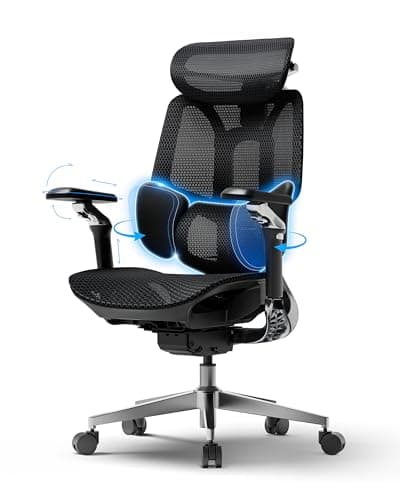
If the cause is a seat that is too narrow, this is the direct fix and it is the widest figure in our registry. Hbada publishes a 25.6 in seat width with a three-zone dynamic lumbar carrying 3.15 in of backrest height adjustment, a 330 lb rating, and a claimed fit range of 5 ft 1 in to 6 ft 5 in - one of very few chairs at this money that publishes a fit range at all. The warranty splits usefully: five years on base, gas lift and casters, three years on everything else. The honest gap for this page: Hbada publishes an overall height of 43.7 to 51.8 in and no seat height, so if your cause turns out to be a seat set too low you cannot check that figure before it arrives.
Who it fits
Anyone whose pain sits on the outside of both hips, where the pan edges are.
Who it does not fit
Anyone over 330 lb, and anyone who needs a published seat height before ordering.
Published specifications
Overall height
43.7"–51.8" (seat height not published)
Seat width
25.6"
Weight capacity
330 lb
Lumbar
Three-zone dynamic lumbar, 3.15 in of backrest height adjustment
Maker's fit range
5 ft 1 in to 6 ft 5 in, per Hbada
Warranty
5-year on base, gas lift and casters; 3-year on other components
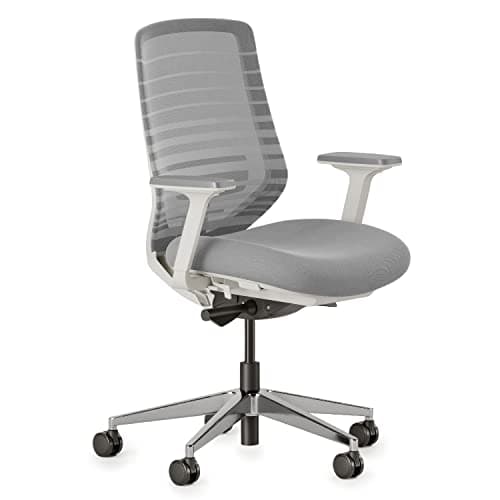
The chair that covers two of the four causes at once. Branch publishes a 25 in seat width - the second widest here - alongside a seat height of 17 to 21 in, which never drops low. If your pain is the outside-of-the-hip pattern and you also suspect the seat has been sitting too low, this addresses both without stepping into the premium band. Eight adjustments, a removable lumbar pad and a 7-year warranty. Rated to 275 lb, which is the lowest capacity in this group, and the 17 in floor makes it the wrong chair for a short sitter whose feet would leave the floor.
Who it fits
Broader sitters of average or above-average height with outside-hip pain.
Who it does not fit
Anyone over 275 lb. Short sitters - the pan does not drop below 17 in.
3. Best for Width, capacity and arms that move out of the way
HON Ignition 2.0 Big and Tall
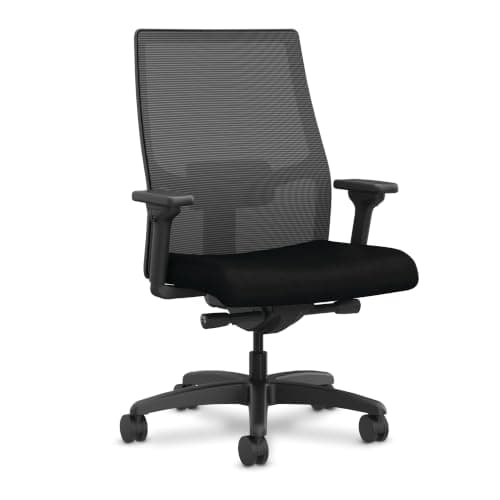
The answer when the cause is width and the current chair is also under-rated for your weight. Office Depot publishes a 23.5 in seat width with a usable depth of 17.75 to 19.5 in, a 17 to 21.5 in seat height, a 22.75 by 24.75 in back, adjustable lumbar, synchro-tilt with tilt tension and tilt lock, 450 lb capacity and HON's Full Lifetime Warranty. The all-adjustable arms with pivot matter for the fourth cause on this page specifically: arms that swing out stop you clamping your elbows inward and rotating the shoulders forward, which is the pattern that refers down into the hip.
Who it fits
Heavier sitters, and anyone whose hip pain comes with shoulder tension from narrow arms.
Who it does not fit
Short sitters without a footrest. Anyone short of desk space - the footprint is large.
Hip pain has causes a chair has nothing to do with. See a clinician rather than shopping if you have:
Pain that runs below the knee, or numbness and tingling in the foot
Weakness in a leg or foot, or a foot that catches when you walk
Pain that wakes you at night, or that is worse lying down than sitting
Sudden onset after a fall, a lift, or an impact
Any change in bladder or bowel control, or numbness around the groin - this one is urgent
Pain with unexplained weight loss, fever, or a history of cancer
Hip pain after a fall, pain that wakes you at night, a leg that gives way, or pain accompanied by fever or unexplained weight loss are not chair problems. Nor is pain that radiates below the knee, which is a nerve pattern - the sciatica page is the closer fit, and the Mayo Clinic overview linked below sets out which symptoms warrant prompt care.
We are not doctors, physical therapists or certified ergonomists, and nothing here is medical advice. If you are in real pain, see someone who is qualified to look at it.
Questions people actually ask
Why does my office chair hurt my hips?+
Most often because the seat pan is narrower than your sitting width, so the raised pan edges press into the outside of both hips. The other three causes are a seat set too low, a pan that is too firm, and armrests set too close. The location of the pain tells you which one you have.
How wide should an office chair seat be for me?+
Measure across the widest part of your hips while seated and add about two inches of clearance. Published seat widths in our registry run from 18.5 in on the Capisco to 25.6 in on the Hbada E3 Pro - see the seat width guide.
Will a cushion fix hip pain from sitting?+
It fixes the firmness cause and it partly fixes the too-low cause, because a wedge raises and tips the seat. It does nothing at all for a pan that is too narrow, which is the most common cause - a cushion on a narrow seat is still a narrow seat.
Should I remove the armrests?+
It is worth a week's trial, and it is free. Arms set too close clamp the elbows in and rotate the shoulders forward, which changes how you load the pelvis. If the hip pain eases without them, the arms were the cause.
Is hip pain from sitting the same as sciatica?+
No. Sciatica is a nerve pattern that typically runs from the low back down one leg and often below the knee. Hip pain from a chair stays at the hip and stops when you stand up. If it radiates down the leg, read the sciatica page instead.