Picked on published fit specifications, not on hands-on testing. How we pick.
The short answer
The Steelcase Leap v2 is the pick, because arthritis makes armrest height and getting out of the chair matter more than cushioning, and Steelcase publishes an armrest range of 7 to 11 inches alongside a 16 to 20.5 inch seat height - the two figures that decide both.
We earn a commission if you buy through our links. It does not change your price, and it does not change our ranking. Prices are pulled from Amazon's own API and stamped with the date we fetched them — where we have no live figure, the button opens the current price on the retailer's page instead. Full disclosure.
Ranked picks with published seat height, seat depth and weight capacity
#ad Seat height and capacity are the manufacturer's published figures, sourced under each pick. Prices come live from Amazon's own API and carry the date we fetched them; where a figure is missing the button opens the current price instead. Seat depth for every pick is in the spec block below. Seat depth summary: Steelcase Leap v2 15.75" · Steelcase Series 1 15.5"–17.75" · HÅG Capisco 8106 13.4"–16.5" · ComfiLife Premium Comfort Seat Cushion —
Arthritis changes the shopping list
Most back-pain chair advice optimizes for one thing: holding your spine in a good position for eight hours. That is still worth doing, but it is not the first problem arthritis presents at a desk. The first problems are getting into and out of the chair, keeping joints moving so they do not stiffen, and taking load off the joints that have to do the small precise work - hands, wrists, shoulders.
NIAMS lists the most commonly affected joints as the hands, knees, hips, neck and lower back, which is close to a map of everything a desk chair touches. It describes joint stiffness usually lasting less than 30 minutes in the morning or after resting for a period of time, and pain when using the joint that may improve with rest. It also names getting in and out of a chair explicitly as an activity that becomes difficult as symptoms worsen. That is the design brief, and it is not the same brief as a lumbar support page.
The four things to shop on, in order
What matters in a chair when joints are the problem
Priority
Why it matters with arthritis
The published figure to check
Armrest height, adjustable
The arms are what you push off to stand, and what takes your arms' weight off your shoulders while you type
Armrest height range, measured from the seat - rarely published
Seat height range, wide
The height that is easy to rise from is usually higher than the height that is comfortable to type at
Minimum and maximum seat height, in inches
Ability to change position
Joints stiffen with rest; a chair that allows several positions gets used in several positions
Hips and the lower back are commonly affected, and a firm pan concentrates load on them
Seat width and depth; cushion dimensions where one is used
The first row is the one that reorders the list. Almost nobody publishes an armrest height range - in our whole registry, two chairs do. The Leap v2 publishes 7 to 11 inches from the seat, and the Autonomous ErgoChair Pro publishes 11 to 14 inches. For a chair you will push yourself out of several times a day, an arm at a usable height is worth more than any amount of foam, and our armrest page makes the general case.
Getting out of the chair
This is the part most chair pages skip. Standing up from a seated position loads the knees and hips hardest at the start of the movement, when the knee is most bent - so the lower the seat, the harder the first few inches. Raising the seat an inch or two makes rising easier and typing slightly worse, which is a genuine trade-off rather than a trick. Two ways to resolve it honestly: set the chair for rising and raise the desk to match, or set the chair for typing and accept using the armrests to stand.
If you take the first route you will usually need a footrest, because the seat height that suits your knees will leave your feet short of the floor - do you need a footrest with an office chair works through when that is the right answer. If you take the second, the seat height lookup table gives you the typing figure to set against.
Keeping moving is part of the answer
NIAMS describes a cycle worth understanding: if you have joint pain you may be less active, and that can lead to muscle weakness, which may cause more stress on the joint. Sitting still all day at a desk is the office version of that cycle. Its own guidance for prolonged sitting is to get up, move around and switch positions frequently.
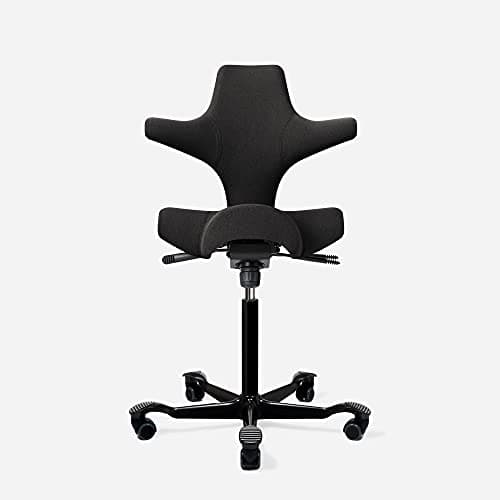
Which is why a chair you can sit in several ways earns its place on this page. The Capisco is the extreme version - a saddle seat designed for four or five distinct postures - but the same logic applies to a conventional chair with a wide recline range and a seat depth you can change mid-afternoon. How to adjust tilt and recline is the practical version, and how long you should sit has what the published guidance actually says about frequency. We do not prescribe a stretching routine here, because NIAMS is explicit that exercises should be added gradually and that a doctor should tell you which ones to avoid.
How this page differs from the hip pain and lower back pages
They overlap, and the honest distinction is the mechanism rather than the location. If your hip hurts after sitting and feels better when you move, start with best office chairs for hip pain, which is about hip angle and seat pressure. If the ache is in your lower back and runs across it, lower back pain is the page, and lumbar height adjustment is the specification. This page is for when the problem is the joints themselves - stiffness after rest, pain using the joint, difficulty rising - and it ranks armrests and exit height above lumbar support for that reason.
If what you have is nerve pain running down a leg rather than joint pain, the sciatica page is a different problem with a different answer.
Free changes worth making this week
Set the armrests so your shoulders drop. Forearms supported, shoulders relaxed down. If they will not go low enough, stop using them for typing - but keep them for standing up.
Stop the chair rolling as you rise. A mat, a rug, or casters matched to your floor.
Change position before you stiffen, not after. NIAMS puts morning and post-rest stiffness at usually under 30 minutes; moving before that window closes is easier than working through it.
Raise the screen to eye level. Neck is on the commonly-affected list, and a laptop flat on the desk holds your head forward all day.
The picks in full
1. Best for Armrests you can actually push off
Steelcase Leap v2
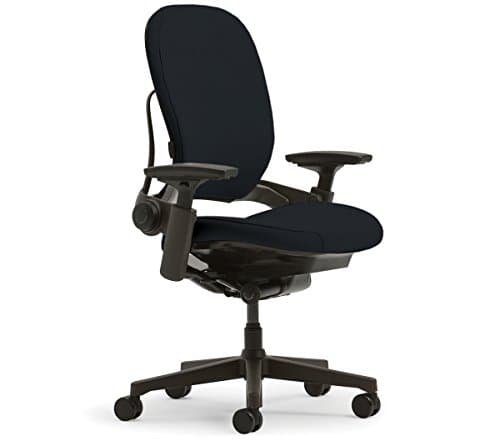
Arthritis moves armrests from a comfort feature to a structural one: they are what your hands and wrists push against to stand up, and they are what takes the weight of your arms off your shoulders and neck while you type. Steelcase publishes an armrest height range of 7 to 11 inches measured from the seat, which almost no other maker publishes at all, and a 16 to 20.5 inch seat height so you can set the exit height that works for your knees and hips. Add a height-adjustable lumbar with its own firmness dial, a 400 lb rating and a 12-year multi-shift warranty, and this is the chair with the most load-bearing adjustment on this site.
Who it fits
Anyone who uses the arms of a chair to stand up, and anyone with hand, wrist or shoulder involvement.
Who it does not fit
Long-thighed sitters - the 15.75 in pan is fixed - and anyone under about 5 ft 1 in.
Published specifications
Seat height
16"–20.5"
Seat depth
15.75"
Seat width
19.25"
Back height
25"
Arm height
7"–11"
Weight capacity
400 lb
Lumbar
Height-adjustable lumbar plus a lower-back firmness dial
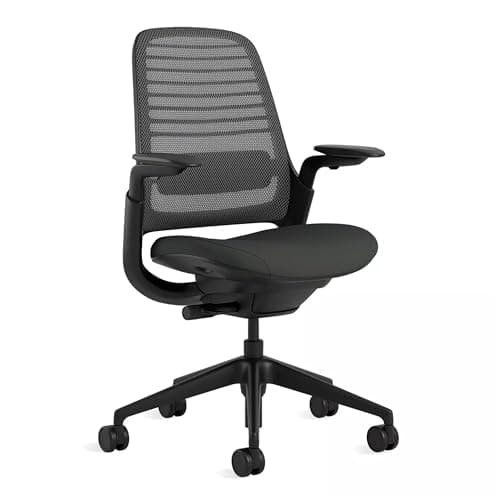
The seat height that is comfortable to sit in and the seat height that is easy to stand up from are often not the same number, and a wide published range is how you resolve that. Steelcase publishes 16.5 to 21.5 inches - five inches of travel - with a functional seat depth of 15.5 to 17.75 inches, a 400 lb rating and the same 12-year multi-shift warranty as the chair above it, at mid-tier money. Slightly higher is usually easier to rise from, because your knees start less bent; the published range is what lets you find your own figure rather than take the one the designer picked. The adjustable lumbar is an option rather than standard here.
Who it fits
Anyone whose main difficulty is getting up, and anyone who wants premium structure at mid-tier price.
Who it does not fit
Anyone who needs lumbar height adjustment as standard, or a published backrest height.
Published specifications
Seat height
16.5"–21.5"
Seat depth
15.5"–17.75"
Weight capacity
400 lb
Lumbar
Optional adjustable lumbar; weight-activated tension as standard
The guidance for arthritis is consistent on one point: joints stiffen with rest and the answer is to keep moving, which makes a chair you can sit in more than one way genuinely useful rather than a novelty. The Capisco saddle seat is designed to be sat on facing forward, sideways, backwards against the perch rest, or perched high with one foot down, and Flokk publishes a seat height range of 18.5 to 25.8 inches - the widest here - which is what makes the perched position possible at a normal desk. It is rated to 300 lb with a 10-year warranty and lifetime cover on the gas lift. It is also the most unusual chair on this page and asks the most of you.
Who it fits
Anyone whose worst symptom is stiffness from sitting still, and anyone who already fidgets between positions.
Who it does not fit
Anyone who needs a backrest to lean into - there is none in the saddle position - and anyone over 300 lb.
Published specifications
Seat height
18.5"–25.8"
Seat depth
13.4"–16.5"
Seat width
18.5"
Weight capacity
300 lb
Lumbar
None in the saddle position; the back support is a perch rest
Warranty
10-year against production defects; lifetime on gas lifts
4. Best for A hard seat under a painful hip or tailbone
ComfiLife Premium Comfort Seat Cushion
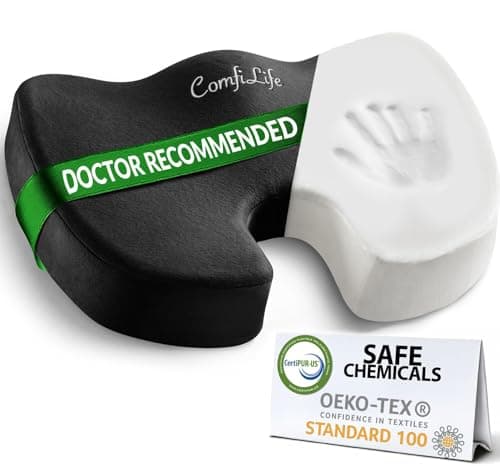
Added here because hips and the lower back are among the joints osteoarthritis most commonly affects, and a firm seat pan under an aching hip is a problem a chair upgrade does not always solve. ComfiLife publishes a 17.7 by 13.7 by 2.8 inch memory foam cushion with a U-shaped coccyx cutout, with a stated lifetime replacement guarantee. The cutout removes contact under the tailbone entirely rather than softening it, which is the whole mechanism. Note what it does not do: it raises your seat height by nearly three inches, so check your desk clearance first, and it provides no back support at all.
Who it fits
Anyone with hip or tailbone pain on a firm pan, and anyone testing whether pressure is the issue before replacing a chair.
Who it does not fit
Anyone whose desk is already too high, and anyone who needs lower-back support - this is a seat cushion only.
A chair redistributes load while you sit. It does not treat arthritis, and nothing on this page is medical advice - the published guidance we cite is about the condition, not about furniture. Arthritis is a diagnosis that belongs to a clinician, and treatment decisions, including which exercises are safe for you, belong there too. Stop shopping and get assessed if you have:
Pain that runs below the knee, or numbness and tingling in the foot
Weakness in a leg or foot, or a foot that catches when you walk
Pain that wakes you at night, or that is worse lying down than sitting
Sudden onset after a fall, a lift, or an impact
Any change in bladder or bowel control, or numbness around the groin - this one is urgent
Pain with unexplained weight loss, fever, or a history of cancer
Specific to joints: a single hot, swollen, intensely painful joint, a joint that will not bear weight, fever alongside joint pain, or morning stiffness lasting well over an hour are not patterns to manage with a new chair. NIAMS notes that less activity because of joint pain can lead to muscle weakness and more stress on the joint, which is a reason to get proper guidance early rather than later.
We are not doctors, physical therapists or certified ergonomists, and nothing here is medical advice. If you are in real pain, see someone who is qualified to look at it.
Questions people actually ask
What is the best office chair for arthritis?+
The Steelcase Leap v2. Arthritis makes armrest height and ease of rising matter more than cushioning, and it is one of only two chairs in our registry that publishes an armrest height range at all - 7 to 11 inches from the seat - alongside a 16 to 20.5 inch seat height and a 12-year multi-shift warranty.
Should the seat be higher or lower if I have arthritis in my knees?+
Usually slightly higher than the typing-optimal height, because rising from a seat is hardest when the knee starts most bent. The honest trade-off is that a higher seat means your feet may not reach the floor, so it comes with a footrest or a raised desk. Nothing here replaces advice from your own clinician.
Are armrests important for arthritis?+
More than for most conditions. They are what your hands and wrists push against to stand up, and what takes the weight of your arms off your shoulders while you type. Adjustable height is what makes them usable for both jobs - a fixed arm tends to be right for one and wrong for the other.
Is a mesh or a padded seat better with arthritis?+
Neither wins on principle. What matters is pressure distribution under the hips and tailbone, which is decided by the shape and firmness of the pan rather than the material. If a firm pan is the problem, a cutout cushion addresses it directly - mesh versus foam has the full trade-off.
Will a kneeling chair help arthritis?+
Probably not, and it may make rising harder. A kneeling chair loads the knees and shins directly and has no arms to push off. The alternative-seating idea that does translate is a chair you can sit in several ways, like a saddle chair - are kneeling chairs bad for your knees covers the knee question directly.