Both are sold as the alternative to a normal office chair, both promise a better hip angle, and nobody explains that they load completely different parts of you.
Picked on published fit specifications, each linked to its source. How we pick.
The short answer
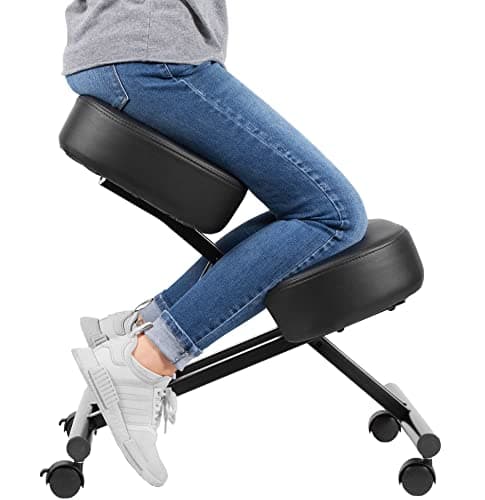
They solve the same problem differently. A kneeling chair tips the pelvis forward and sends the balance of your weight through the shins. A saddle keeps the weight on the seat and lets you sit far higher - 25.8 in on the HAG Capisco 8106 against about 20.5 in on a kneeling chair. If your desk is fixed and low, the kneeling chair; if it can be raised, the saddle.
We earn a commission if you buy through our links. It does not change your price, and it does not change our ranking. Prices are pulled from Amazon's own API and stamped with the date we fetched them — where we have no live figure, the button opens the current price on the retailer's page instead. Full disclosure.
Ranked picks with published seat height, seat depth and weight capacity
#
Product
Best for
Seat height
Capacity
Price
1
HÅG Capisco 8106
18.5-25.8 in seat height, 13.4-16.5 in pan, lifetime gas lift cover
The saddle case, and the only one you can sit in all day
#ad Seat height and capacity are the manufacturer's published figures, sourced under each pick. Prices come live from Amazon's own API and carry the date we fetched them; where a figure is missing the button opens the current price instead. Seat depth for every pick is in the spec block below. Seat depth summary: HÅG Capisco 8106 13.4"–16.5" · Varier Variable Balans 12" · Sleekform Austin Kneeling Chair — · DRAGONN by VIVO Adjustable Kneeling Chair 12"
They look like alternatives to each other and they are not
Both formats start from the same observation: sitting on a flat pan with your thighs horizontal closes the hip to about ninety degrees, which rolls the pelvis backward and flattens the lumbar curve. Open that angle and the pelvis sits upright on its own, without a lumbar pad pushing it there.
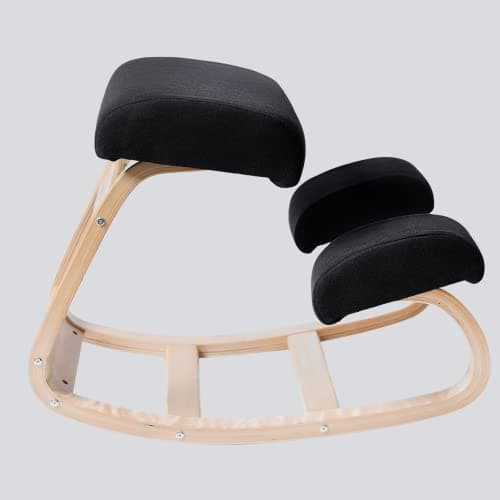
A kneeling chair does not transfer all of your weight to your knees - most of it stays on the seat - but it moves enough that the shin pads become a pressure point within an hour or two. That is the format's limiting factor, and it is why cushion depth is the spec worth comparing: four inches against the usual two and three-quarters is the difference between an hour and an afternoon.
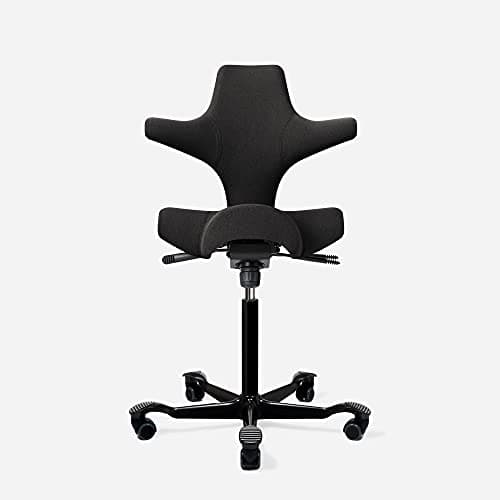
A saddle's advantage is seat height - the Capisco reaches 25.8 in, which is five inches above any kneeling chair here and more than three inches above the tallest conventional task chair in our registry. That height is what makes the open hip angle sustainable: you are not folded into anything, and standing up is closer to stepping forward than climbing out.
But a seat at 23 in needs a surface at roughly 32 to 34 in, and a standard desk is about 29 in. If your desk does not raise, the saddle's main advantage is unusable and you are buying a 300 lb-rated stool with no backrest for no reason. The desk height page runs through risers and trays in both directions, and how to make an office chair taller covers the conventional-chair version of the same problem.
Which one, by situation
Pick by what is actually true of your setup
If this describes you
Start with
Why
Fixed-height desk at about 29 in
Kneeling chair
The only format that works at a standard desk height
Height-adjustable or standing desk
Saddle
The 25.8 in seat is the point, and a low desk wastes it
Existing knee problems
Saddle
Weight stays on the seat rather than moving onto the shins
Want one chair, not two
Saddle
Usable for most of a day; a kneeling chair is not
Testing whether the position suits you at all
The cheapest kneeling chair with height range
Ten inches of adjustment, low outlay, easy to resell
Over 265 lb
Neither - a conventional chair
Published capacities in both formats top out at 300 lb
That last row matters more than it looks. Both formats are rated well below conventional task chairs - the HON Ignition 2.0 Big and Tall publishes 450 lb and the Steelcase chairs 400 lb, against 240 to 300 lb here. Office chairs rated to 400 lb and above is the page to read instead if that is your constraint.
If neither sounds right
The honest third option is a conventional chair set up properly, which is free if you already own one. Kneeling chair versus office chair takes that comparison directly, and the setup order covers getting the hip angle right on a normal chair - seat height first, then the desk, which solves the original complaint for a lot of people without a new purchase at all.
There is a third format in this argument that neither side usually mentions. Kneeling chair versus saddle chair compares the two alternative-seating options against each other on published seat height, capacity and where your weight actually ends up - which is the comparison to read if you have already decided a conventional chair is not the answer.
If you are weighing a saddle against the other way of opening the hip angle, kneeling chair versus saddle chair sets the two formats side by side on published seat height, seat depth, capacity and warranty - and on the one thing that usually decides it, which is whether your desk can be raised.
The picks in full
1. Best for The saddle case, and the only one you can sit in all day
HÅG Capisco 8106
The saddle side of this comparison, and the only chair here that is plausible as a sole chair rather than a second one. Flokk publishes a seat height of 18.5 to 25.8 in - more than five inches above any kneeling chair in our registry - with an 18.5 in seat width, an adjustable pan of 13.4 to 16.5 in, a 300 lb capacity, and a 10-year warranty against production defects with lifetime cover on the gas lifts. The saddle holds the pelvis more upright than a flat pan, which maintains the lumbar curve by geometry rather than by a pad, and it can be sat on forwards, backwards or perched - three positions instead of one. The honest cost is twofold: in the saddle position there is no backrest to lean into, and a seat set at 23 in needs a desk to match.
Who it fits
Anyone with a height-adjustable or raised work surface who wants one chair rather than two.
Who it does not fit
Anyone over 300 lb, anyone with a fixed low desk, and anyone who needs to lean back.
Published specifications
Seat height
18.5"–25.8"
Seat depth
13.4"–16.5"
Seat width
18.5"
Weight capacity
300 lb
Lumbar
None in the saddle position; the back support is a perch rest
Warranty
10-year against production defects; lifetime on gas lifts
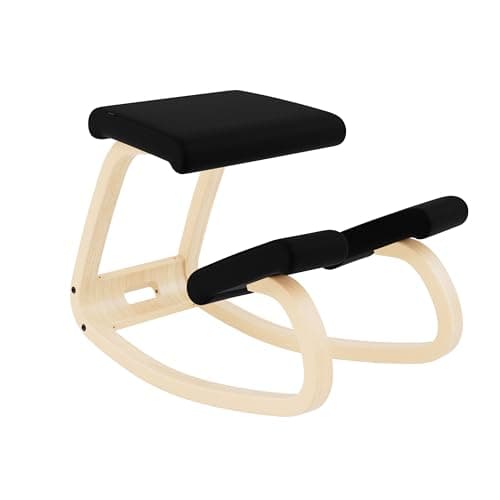
The original kneeling chair and the reference point for the format. Varier publishes a seat height of 18 to 20.5 in, a 16 in seat width, a 12 in seat depth and a 240 lb capacity, under a 7-year warranty on wood parts and 5 years on mechanical parts. What separates it from the rest of the category is that it rocks: the curved runners mean the position is never completely static, which is the single biggest objection to kneeling chairs answered in the design rather than in the marketing. There is nothing to adjust and nothing to break. The costs are the ones the format always carries - weight through the shins, no backrest, and a 240 lb capacity that is the lowest figure in our registry.
Who it fits
Anyone who wants the kneeling position with movement built in, under 240 lb.
Who it does not fit
Anyone with knee problems, anyone over 240 lb, and anyone who needs a height-adjustable seat.
3. Best for The longest a kneeling chair stays comfortable
Sleekform Austin Kneeling Chair
The kneeling chair that addresses the format's real failure mode, which is not the position but the padding. Sleekform publishes four inches of cushion rather than the usual two and three-quarters, a 120-degree seat angle in place of a backrest, a 265 lb capacity and a stated fit range of 5 ft 2 in to 6 ft 6 in - one of the few kneeling chairs that publishes one at all. On the shin pads specifically, cushion depth is the figure that decides whether the chair is usable for an hour or an afternoon. What Sleekform does not publish is a seat height, which matters here because matching a kneeling chair to a desk you already own is the whole installation problem.
Who it fits
Anyone who has tried a kneeling chair and given up on the shin pressure rather than the posture.
Who it does not fit
Anyone over 265 lb, and anyone who needs a confirmed seat height to match a fixed desk.
Published specifications
Weight capacity
265 lb
Lumbar
None - 120-degree seat angle in place of a backrest
The only chair on this page with enough height range to be fitted to an existing desk rather than the other way round. VIVO publishes 21 to 31 in of overall height adjustment - ten inches of travel - with a 16 in seat width, a 12 in seat depth, a 250 lb capacity and a one-year warranty. On a page about two formats that both change your height relative to the desk, that range is the most practically useful figure here, and it is the reason this is the sensible way to find out whether you get on with kneeling at all before committing to a Varier or a Capisco. The limits are the price showing: a one-year warranty against seven, and an overall height figure rather than a seat height.
Who it fits
Anyone testing the kneeling position for the first time, or matching one to a fixed desk.
Who it does not fit
Anyone over 250 lb, and anyone who wants a warranty longer than a year.
Alternative seating changes a posture. It does not treat a joint, a disc or a nerve. Stop and see a clinician rather than buying either format if you have:
Pain that runs below the knee, or numbness and tingling in the foot
Weakness in a leg or foot, or a foot that catches when you walk
Pain that wakes you at night, or that is worse lying down than sitting
Sudden onset after a fall, a lift, or an impact
Any change in bladder or bowel control, or numbness around the groin - this one is urgent
Pain with unexplained weight loss, fever, or a history of cancer
Existing knee pain is a specific reason not to buy a kneeling chair, and existing hip joint disease is a reason to be careful with both - a saddle straddles, which is a position some hips do not tolerate. If a surgeon has given you a hip-flexion precaution, seat height is the spec that matters and the chairs-after-hip-replacement page ranks our registry on it.
We are not doctors, physical therapists or certified ergonomists, and nothing here is medical advice. If you are in real pain, see someone who is qualified to look at it.
Questions people actually ask
What is the difference between a kneeling chair and a saddle chair?+
Both open the hip angle, but a kneeling chair tips the seat forward and moves part of your weight onto your shins, while a saddle keeps the weight on the seat and lets you sit much higher - 25.8 in on the Capisco against about 20.5 in on a Varier.
Which is better for a standard desk?+
A kneeling chair. A saddle's advantage is its seat height, and a 29 in desk cannot use it - you end up with a backless stool set low, which is the worst of both formats.
Can you sit in a saddle chair all day?+
More plausibly than in a kneeling chair, because the weight stays on the seat and the Capisco can be turned around to use the perch rest as a back support. Most people still alternate with a conventional chair.
Do kneeling chairs hurt your knees?+
The shins take the pressure rather than the kneecaps, and cushion depth is what decides how long that stays tolerable - four inches against the usual two and three-quarters is a real difference. Existing knee problems are a reason to choose a saddle instead.
Which one is better for lower back pain?+
Neither is a treatment. Both maintain the lumbar curve by geometry rather than by a pad, which some people find helps; neither gives you anything to lean back into, which over a full day produces its own fatigue. A conventional chair with adjustable lumbar height remains the more reliable answer.