Picked on published fit specifications, each linked to its source. How we pick.
The short answer
The phrase covers three different products. Only one of them is a control you can set: a pad that moves up and down the backrest, and ideally a second control for how hard it pushes. The Steelcase Leap v2 is the only chair in our registry that ships with both as standard. On several others, including two Herman Millers, adjustable lumbar is a paid configuration option you can miss at checkout.
We earn a commission if you buy through our links. It does not change your price, and it does not change our ranking. Prices are pulled from Amazon's own API and stamped with the date we fetched them — where we have no live figure, the button opens the current price on the retailer's page instead. Full disclosure.
Ranked picks with published seat height, seat depth and weight capacity
#
Product
Best for
Seat height
Capacity
Price
1
Steelcase Leap v2
Height-adjustable pad plus a separate firmness dial, in the box
#ad Seat height and capacity are the manufacturer's published figures, sourced under each pick. Prices come live from Amazon's own API and carry the date we fetched them; where a figure is missing the button opens the current price instead. Seat depth for every pick is in the spec block below. Seat depth summary: Steelcase Leap v2 15.75" · Sihoo M57 18.11" · HON Ignition 2.0 Big and Tall 18.74" · Herman Miller Mirra 2 16.25"–18" · Steelcase Gesture 15.75"–18.5" · Steelcase Series 1 15.5"–17.75" · Everlasting Comfort Lumbar Support Pillow —
The three things "adjustable lumbar" is sold as
This page exists because one phrase covers three products that behave nothing alike, and the listing almost never tells you which one you are buying.
A control you set. A pad on a track that moves up and down the backrest, sometimes with a second control for firmness. You decide where the support lands and how hard it pushes. This is the thing the search term means.
A paid configuration option. The chair can be built with that control, and the one in front of you probably was not. Steelcase sells adjustable lumbar as an option on the Gesture and the Series 1; Herman Miller sells the Mirra 2 in three back configurations, two of which adjust nothing. Same model name on all of them.
A dynamic system with nothing to adjust. Marketed as self-adapting, three-zone, or dynamic lumbar. These flex as you move, which is a real design and works for many people, but there is no height control and no firmness control to set. The Sihoo Doro C300 and the Hbada E3 Pro are both in this group, and both are good chairs that are not what this search term is asking for.
What we ranked on
Four criteria, applied in this order. Every figure below is a published manufacturer or authorized-dealer number with a source at the foot of the page. We have not sat in any of these chairs - how we pick sets out what that means and what it rules out.
Is the control standard, or an option? A feature you can fail to receive is worth less than the same feature in the box, so standard-equipment chairs rank above option chairs regardless of how good the option is.
How far does it travel, and in how many directions? Published travel only. Up-and-down is the common one; the Mirra 2 also publishes depth travel, which changes how far forward the pad sits rather than how high.
Is firmness separate from height? Almost nothing has this. It matters because the right position and the right pressure are independent problems, and a pad that is correctly placed but too hard still ends the day badly.
Does the rest of the chair fit you? Lumbar adjustment on a chair whose seat is two inches too high is a wasted control, because you will be perched forward and out of contact with the backrest anyway. Seat height and seat depth come first - the seat height lookup table and the seat depth guide are the two numbers to settle before any of this matters.
Published lumbar figures, side by side
What each chair's lumbar actually is, and whether you have to pay extra for it - manufacturer and authorized-dealer figures, checked November 2026
Chair
Lumbar as sold
Published travel
Standard or option
Steelcase Leap v2
Height-adjustable pad plus a firmness dial
Not published as a figure
Standard
Sihoo M57
Adjustable lumbar support
Not published
Standard
HON Ignition 2.0 Big and Tall
Adjustable lumbar
Not published
Standard
Herman Miller Mirra 2
Adjustable lumbar, or two non-adjustable backs
4.5 in height, 1 in depth
Option - three back configurations
Steelcase Gesture
Core Equalizer, or adjustable lumbar
4 in height
Option
Steelcase Series 1
Weight-activated tension, or adjustable lumbar
Not published
Option
Herman Miller Aeron
PostureFit SL or an adjustable lumbar pad, both height-adjustable
Not published as a figure
Choose one at order time
Sihoo Doro C300
Self-adapting dynamic lumbar
No lumbar control; back assembly lifts 18.11-21.65 in
Not adjustable
Hbada E3 Pro
Three-zone dynamic lumbar
No lumbar control; 3.15 in of backrest height travel
Not adjustable
Three rows say "not published" and that is not an omission on our part. Steelcase publishes that the Leap v2's lumbar is height-adjustable without stating the travel in inches; Sihoo and HON do the same. We would rather print the gap than convert a marketing sentence into a number that nobody published. The two figures that do exist - the Mirra 2's 4.5 in and the Gesture's 4 in - both belong to chairs where the control is an upgrade.
How to tell from a listing, before you buy
The retail page is where this goes wrong, so here is what to look for on one.
Look for a verb, not an adjective. "Lumbar support" is a noun phrase and means nothing. "Adjusts through 4 inches" or "height-adjustable lumbar" describes a mechanism. If the copy never says the thing moves, assume it does not.
Count the controls in the photos. A height-adjustable pad usually shows as a visible track or a pair of grips on the back of the backrest. A firmness dial is a separate knob, normally on the right-hand side under the seat.
On Steelcase and Herman Miller, find the configuration line. Those chairs are configured products sold through dealers and resellers, and the one spec that resale listings most often drop is which back option is fitted. Ask before ordering. A seller who cannot tell you is a seller who does not know.
Treat "dynamic" and "self-adapting" as the opposite of adjustable. Those words are doing real work - they describe a back that flexes with you - but they are describing the absence of a control, not a better one.
Check the warranty covers the mechanism. A lumbar track is a moving part. The chairs here with 12-year multi-shift cover will replace it; a one-year consumer warranty on a budget chair probably outlives the track by less than you would like. How long office chairs last goes through what the duty wording means.
Where the adjustment should end up
Having bought the control, most people set it wrong, and the common error is setting it too high. The lumbar curve sits at roughly belt height, well below the shoulder blades, and a pad placed where it feels most noticeable is usually two inches above where it should be. Where lumbar support should sit, and how it should feel walks through finding it on your own back; the short version is that correct support feels like contact rather than pressure, and you should stop noticing it within about a minute.
Set it with the chair at your working height, not at the height it arrived at, and set it after you have settled seat depth. Changing the pan depth moves your hips backward or forward, which moves your lumbar curve against the backrest, which changes where the pad needs to be. Doing those in the wrong order means doing the lumbar twice.
When the adjustment is not the thing that will help
Adjustable lumbar is genuinely useful and it is also over-prescribed. Three situations where buying it will not change your afternoon:
You slide forward and lose contact with the back. Then no backrest setting reaches you, because you are not against it. That is usually a seat angle or a seat height problem - how to stop sliding forward in your chair is the fix, and it is free.
Your seat is too deep for your thighs. A pan that ends past the back of your knee forces you to either perch forward or lose the backrest entirely. Depth first, lumbar second.
The pain is not at the lumbar curve. Pain between the shoulder blades, at the tailbone, or running down one leg has other causes and other answers - see upper back pain, coccyx and tailbone pain and sciatica respectively.
The short version
If adjustable lumbar is the reason you are shopping, buy the chair where it is standard equipment rather than the more expensive chair where it is an option. That is the Leap v2 in the premium band and the Sihoo M57 at the bottom of the market, with the HON Ignition 2.0 Big and Tall covering the heaviest sitters. If you want a Mirra 2, a Gesture or a Series 1 - all good chairs - confirm the back configuration with the seller in writing before you pay, because the model name will not tell you. And if your torso is short enough that every chair's travel stops above your curve, a strapped cushion places the support exactly where you want it for a fraction of any of this.
The picks in full
1. Best for Adjustable lumbar as standard equipment
Steelcase Leap v2
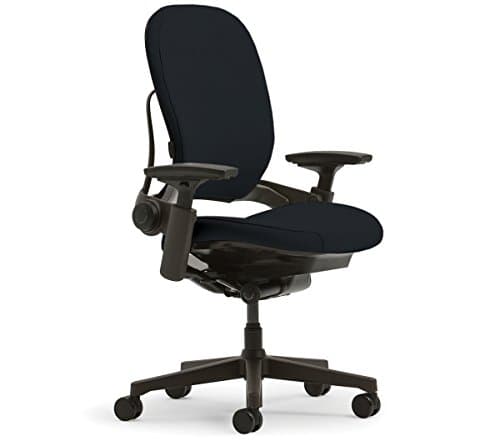
This is the only chair in our registry where both halves of the control are standard on every unit: a lumbar pad that slides up and down the backrest, and a separate dial that changes how firmly it pushes. Those are two different questions - where, and how hard - and every other chair here answers at most one of them. Nothing is a configuration option, so there is no version of this chair that arrives without the feature you bought it for. Steelcase and its dealers publish a 16 to 20.5 in seat height, a 19.25 in seat, a 25 in back, arms 7 to 11 in above the seat, 400 lb and a 12-year multi-shift warranty.
Who it fits
Anyone who can point at the spot that hurts, and anyone who has found lumbar pads either too soft or too sharp.
Who it does not fit
Long-thighed sitters - the pan is a fixed 15.75 in with no adjustment at all. Anyone shopping below the premium band.
Published specifications
Seat height
16"–20.5"
Seat depth
15.75"
Seat width
19.25"
Back height
25"
Arm height
7"–11"
Weight capacity
400 lb
Lumbar
Height-adjustable lumbar plus a lower-back firmness dial
2. Best for Adjustable lumbar at the bottom of the market
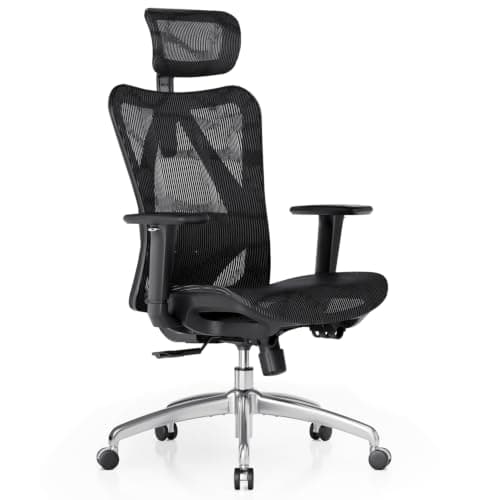
Sihoo M57
The cheapest chair on this site that lists adjustable lumbar support as standard rather than as an upgrade. Sihoo publishes an 18.11 in seat depth, a 20.08 in seat width, a 330 lb rating and a three-year warranty, which is a lot of specification for the money. Read the lumbar claim at its own level, though: Sihoo publishes that the support adjusts, not how far it travels, so you are buying the existence of a control rather than a known range.
Who it fits
Anyone who wants to find out whether placeable lumbar support helps them before committing premium money to the question.
Who it does not fit
Anyone who needs to know their seat height before ordering - Sihoo publishes overall chair height of 42 to 49 in and no seat height at all, which is the real weakness here.
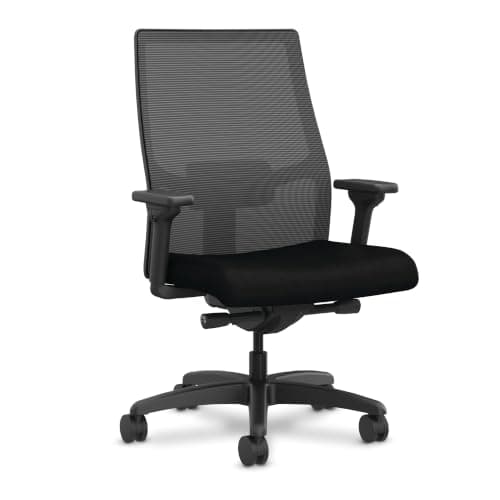
Big-and-tall chairs routinely drop the lumbar control to make room for the frame, and this one does not. Office Depot's listing for the HON Ignition 2.0 Big and Tall publishes adjustable lumbar as standard alongside a 450 lb capacity, a 17 to 21.5 in seat height, a 23.5 in seat width with a usable depth of 17.75 to 19.5 in, all-adjustable arms with pivot, and the HON Full Lifetime Warranty. It is the only chair in our registry that pairs a real lumbar control with a rating above 400 lb.
Who it fits
Sitters above 300 lb who have been told their only options have fixed backs, and anyone who needs a wide seat without losing the lumbar adjustment.
Who it does not fit
Anyone under about 5 ft 6 in - the seat floor is 17 in. HON also rates the chair for 6 to 8 hours of daily use rather than multi-shift.
4. Best for The most travel, if you configure it deliberately
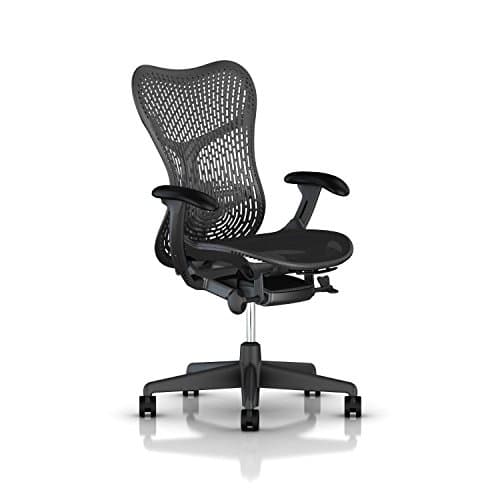
Herman Miller Mirra 2
Herman Miller sells the Mirra 2 in three back configurations: basic back support, non-adjustable lumbar, or adjustable lumbar with 4.5 in of height travel and 1 in of depth travel. That depth control is unusual - most adjustable lumbar moves up and down only - and the 4.5 in of height is the widest published travel on any chair in our registry. The catch is the one this whole page is about: two of the three configurations have no adjustment, they all ship under the same model name, and resale listings frequently do not say which one is in the box.
Who it fits
Anyone who wants Herman Miller's 12-year warranty and a genuinely adjustable back, and who will email the seller before ordering.
Who it does not fit
Anyone buying from a listing that does not name the back option. Anyone over 350 lb. Note also that Herman Miller's own two sources disagree on seat height - 16 to 20.5 in on the US store, 14.8 to 22.2 in on hermanmiller.com.
Published specifications
Seat height
16"–20.5"
Seat depth
16.25"–18"
Arm height
6"–11.5"
Weight capacity
350 lb
Lumbar
Three back-support options - basic back support, non-adjustable lumbar, or adjustable lumbar with 4.5 in of height and 1 in of depth travel
Sizes
One shell. Published seat height depends which Herman Miller source you read: 16-20.5 in on the US store listing (quoted above), 14.8-22.2 in on hermanmiller.com's product-details page. Seat depth is 16.25 in fixed, or 16.25-18 in with the FlexFront adjustable seat. Confirm the configuration with your seller.
5. Best for A sliding seat pan, with lumbar as the upgrade
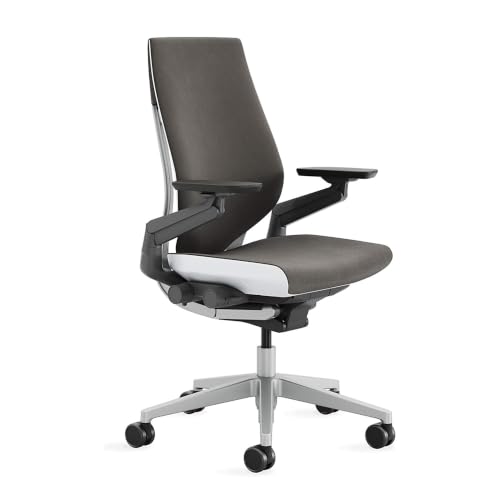
Steelcase Gesture
Worth buying for what it does below the lumbar rather than at it. The Gesture publishes a functional seat depth of 15.75 to 18.5 in, a 20 in seat, three seat-height cylinders spanning 14.5 to 22.5 in, 400 lb and a 12-year multi-shift warranty with 24/7 parts and labor. On lumbar specifically it is honest but limited: the standard build gets Steelcase's Core Equalizer, adjustable lumbar with 4 in of height travel costs extra, and there is no firmness control at any price.
Who it fits
Long-thighed sitters, anyone working across keyboard, tablet and phone all day, and sitters at the ends of the height range who need a cylinder choice.
Who it does not fit
Anyone whose single reason for shopping is lumbar - the base build is the weakest lumbar story of any premium chair here, and the upgrade still only matches half of a base Leap v2.
Published specifications
Seat height
16"–21"
Seat depth
15.75"–18.5"
Seat width
20"
Back height
24.06"
Weight capacity
400 lb
Lumbar
Core Equalizer as standard; optional adjustable lumbar with 4 in of height travel
Sizes
Three cylinder options - short (14.5-18.25 in), standard (16-21 in), tall (17-22.5 in). The standard figure is the one quoted above.
Warranty
Steelcase Limited Lifetime - 12 years, multi-shift, 24/7 parts and labor
6. Best for The cheapest route to an optional lumbar control
Steelcase Series 1
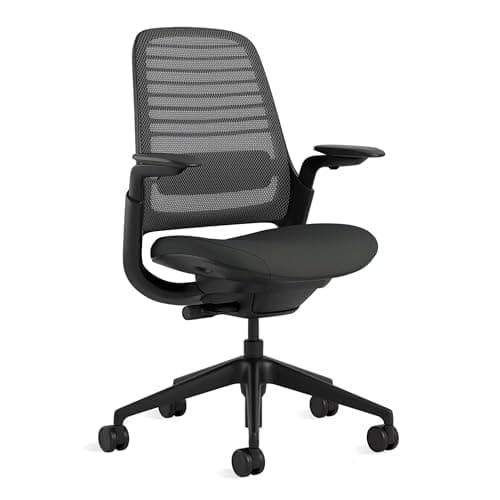
The least expensive chair here that can be ordered with a genuine adjustable lumbar control, and it keeps the things that usually disappear at this price: a 12-year multi-shift warranty, a 400 lb rating, a 16.5 to 21.5 in seat height and a functional seat depth of 15.5 to 17.75 in. Steelcase treats lumbar the same way it does on the Gesture - an option, not standard - so the base configuration gives you weight-activated tension and a fixed back.
Who it fits
Anyone who wants commercial-grade build and warranty terms without premium pricing, and who is willing to specify the lumbar option at order time.
Who it does not fit
Anyone who assumes the lumbar is included. Anyone under about 5 ft 4 in, since the seat floor is 16.5 in.
Published specifications
Seat height
16.5"–21.5"
Seat depth
15.5"–17.75"
Weight capacity
400 lb
Lumbar
Optional adjustable lumbar; weight-activated tension as standard
7. Best for When no chair's travel reaches your curve
Everlasting Comfort Lumbar Support Pillow
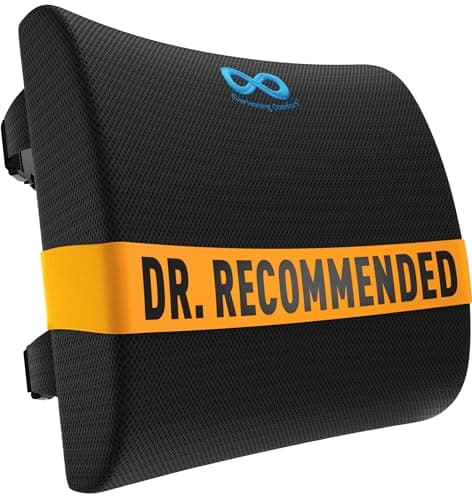
Every adjustable lumbar on this page has a range, and a range can run out. Short torsos are where it happens most: the pad bottoms out above the point where the back actually curves, and the chair has nothing left to give. A strapped cushion has no range to run out of - you put it where you want it. It also answers the prior question cheaply. If a cushion placed at your curve makes a difference in a week, placeable lumbar is worth paying for; if it makes none, the problem is probably seat height or seat depth instead.
Who it fits
Anyone with a short torso, anyone on a chair with a fixed back, and anyone testing whether lumbar support is their issue at all before spending.
Who it does not fit
Anyone whose chair is the wrong height or depth - a cushion fixes neither, and on an already-shallow seat it makes things slightly worse by pushing you forward.
Published specifications
Lumbar
Fixed-contour memory foam; position set by two adjustable straps
Which office chairs have adjustable lumbar support as standard?+
In our registry: the Steelcase Leap v2 (height-adjustable pad plus a separate firmness dial), the Sihoo M57 and the HON Ignition 2.0 Big and Tall. On the Steelcase Gesture and Series 1, and on the Herman Miller Mirra 2, adjustable lumbar is a configuration option rather than standard equipment.
Is adjustable lumbar support worth paying extra for?+
It is worth paying for if you can point to where your back hurts, because a fixed pad is molded to an average spine and yours may not be average. It is not worth paying for if your seat height or seat depth is wrong, because you will not be in contact with the backrest for the pad to matter. Settle fit first - see the seat depth guide.
What is the difference between adjustable and dynamic lumbar support?+
Adjustable means you set it: a pad moves to a height you choose, and sometimes a dial sets how hard it pushes. Dynamic, self-adapting and three-zone lumbar all mean the support flexes as you move, with no control to set. Both are real designs, but only the first one lets you place the support at your own curve. Adjustable versus fixed lumbar goes into the mechanism.
How much does adjustable lumbar travel, typically?+
Where it is published at all, around 4 inches of height: the Herman Miller Mirra 2 publishes 4.5 in of height plus 1 in of depth, and the Steelcase Gesture publishes 4 in of height. Most makers, including Steelcase on the Leap v2, state that the lumbar is height-adjustable without printing a figure. We do not estimate the ones they leave out.
Can I add adjustable lumbar to a chair that does not have it?+
Not as a mechanism, but a strapped lumbar cushion gets you most of the practical benefit and is more precisely placeable than any built-in track, because you are not limited to the chair's range. It is less stable over a full day and tends to need repositioning. Where to place a lumbar support pillow covers getting the height right.
Does the Herman Miller Aeron have adjustable lumbar?+
It can, and you choose at order time. Herman Miller offers either PostureFit SL, which adds a second pad supporting the sacrum below the lumbar curve, or a conventional adjustable lumbar pad. Both are height-adjustable. It is the one chair here where the configuration choice is between two genuine mechanisms rather than between a mechanism and its absence - see the Aeron review.