Picked on published fit specifications, not on hands-on testing. How we pick.
The short answer
Put it at the inward curve of your lower back, roughly level with your belt line - usually lower than the straps naturally want it to sit. If it is pushing between your shoulder blades or above your waist, it is too high, and too high is the mistake almost everybody makes.
We earn a commission if you buy through our links. It does not change your price, and it does not change our ranking. Prices are pulled from Amazon's own API and stamped with the date we fetched them — where we have no live figure, the button opens the current price on the retailer's page instead. Full disclosure.
Ranked picks with published seat height, seat depth and weight capacity
#ad Seat height and capacity are the manufacturer's published figures, sourced under each pick. Prices come live from Amazon's own API and carry the date we fetched them; where a figure is missing the button opens the current price instead. Seat depth for every pick is in the spec block below. Seat depth summary: Everlasting Comfort Lumbar Support Pillow — · ComfiLife Premium Comfort Seat Cushion — · Steelcase Leap v2 15.75"
The belt-line rule
Your lower back curves inward. That curve - the lumbar curve - is the gap between your spine and a flat backrest, and the job of a lumbar cushion is to fill it so the muscles around it do not have to hold the shape themselves all day. The useful landmark is your belt line: the fullest part of the cushion should sit at or just above it, which on most people is somewhere between the top of the pelvis and the bottom of the rib cage.
Almost everybody places it too high. There are two reasons for that. The straps on most cushions are sized for the mid-back of a chair, so the natural resting place is above where you need it. And a cushion placed high feels like more support when you first sit down, because it pushes your chest up - a sensation that reads as good posture for about ten minutes and then becomes an arched back with the work done by muscle.
Four signs it is in the wrong place
What a misplaced lumbar cushion feels like, and which way to move it
What you feel
What it usually means
What to do
Ache between the shoulder blades that was not there before
The cushion is too high and is pushing your upper back forward
Move it down to the belt line; see our upper back page if it persists
You feel pushed forward out of the chair
Too thick, too high, or both - your pelvis is being rotated forward
Lower it first, and look for a thinner cushion second
No change at all after a week
Either it is sitting below the curve, or support was never your problem
Check placement once, then look at seat height and seat depth
Fine in the morning, wrong by the afternoon
The cushion is riding up as you move - a one-strap mount, or loose straps
Tighten both straps; mark the position so you can see it has moved
That third row is the one worth sitting with. A lumbar cushion only addresses one of the four things that commonly cause desk back pain. The others are seat height, seat depth and armrest height, and no cushion touches any of them - can office chairs cause back pain runs through the full set. If a correctly placed cushion changes nothing in a week, that is useful information rather than a failed purchase: it points you at the other three.
How this differs from the pages either side of it
Three pages on this site are close to each other and it is worth saying what each one is for. Best lumbar support cushion is which one to buy. How lumbar support should feel is about built-in support in a chair - what correct feels like versus too firm or too high. This page is narrower than both: you already own a cushion, and the question is where it goes.
And if your chair already has a lumbar mechanism, read adjustable versus fixed lumbar before you add anything. Stacking a cushion on top of a built-in lumbar pad usually produces too much depth in one place and pushes you forward - the fix there is to move the chair's own support, not to pad it.
Three placement details people miss
Set the chair before the cushion. Seat height changes where your pelvis sits, which changes where your lumbar curve is relative to the backrest. If you adjust the chair after strapping the cushion on, the cushion is now in the wrong place. How to adjust your office chair is the order to do things in.
A seat cushion moves your lumbar cushion. Put a 2.8 inch seat cushion underneath you and your whole torso rises by nearly three inches, so a lumbar cushion that was correct is now three inches low. Reposition it the same day.
Reclining changes the requirement. The gap between your back and the backrest is largest when you are upright and smallest when you recline. A cushion sized for upright typing can feel like too much when you lean back, which is one reason the guidance on changing position matters - how to adjust tilt and recline covers using recline deliberately rather than slumping into it.
If a towel would do
It would, for the test. A rolled hand towel held in place behind your lower back is close enough to a contoured cushion to tell you within a day or two whether support at that height changes your afternoon, and it costs nothing. The reasons to buy a real cushion after that are that it holds its shape, it holds its position with straps rather than falling down the chair every time you stand, and it has a contour rather than a cylinder.
The reason to run the towel test first is more useful: it stops you spending money on the wrong axis. Roughly as often as we see people with a support problem, we see people with a seat-depth problem who have bought a lumbar cushion - the seat depth guide is a two-minute check that rules that out, and whether your chair is too high or too low rules out the other common one.
Doing it in the car, and doing it in a dining chair
The rule is the same and the obstacles are different. In a car the seat back is already contoured and often has its own lumbar adjustment, so start by using that before adding anything, and remember that a cushion changes your distance from the wheel and the belt geometry. In a flat dining chair there is no contour at all, which is actually the easiest case: the cushion is doing all the work, so belt-line placement is both simple and important.
In both, the same failure shows up: the cushion slides upward with movement. Two straps, tightened, solve it; one loose strap does not. That is the single most practical reason to care about how a cushion mounts rather than how thick it is.
The picks in full
1. Best for A cushion whose position you can actually set
Everlasting Comfort Lumbar Support Pillow
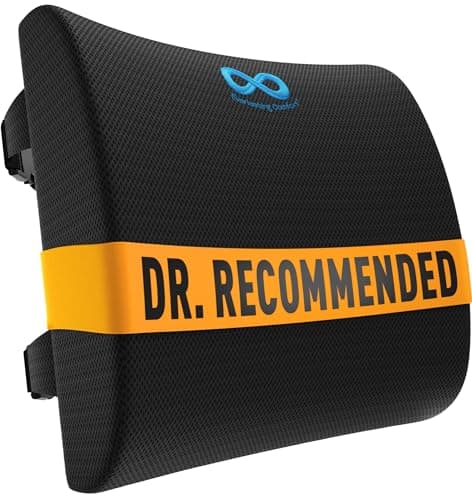
The whole subject of this page is position, so the only cushion specification that really matters is whether you can control it. Everlasting Comfort publishes a 20.08 by 12.01 by 3.94 in contoured memory foam cushion held by two adjustable straps rated to fit chairs up to 32 in wide, with a stated lifetime replacement guarantee. Two straps rather than one is the relevant detail: a single strap lets the cushion rotate and ride upward through the day, which is exactly how a correctly placed cushion ends up between your shoulder blades by mid-afternoon. The contour is fixed, so it provides a set amount of support - the variable you control is height.
Who it fits
Anyone whose chair has no built-in lumbar support, and anyone testing whether support is their problem at all.
Who it does not fit
Anyone whose chair already has a height-adjustable lumbar - move that instead of adding this.
Published specifications
Lumbar
Fixed-contour memory foam; position set by two adjustable straps
2. Best for When the problem is under you, not behind you
ComfiLife Premium Comfort Seat Cushion
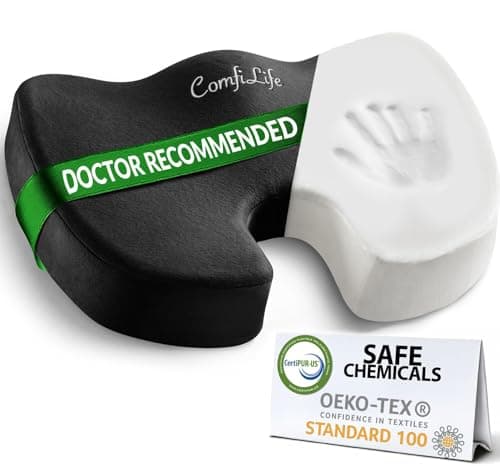
Included because a meaningful share of people who buy a lumbar pillow are solving the wrong axis. If the ache is at your tailbone, or at the sit bones after an hour, no amount of back support reaches it - that is seat pressure and it needs a seat cushion. ComfiLife publishes a 17.7 by 13.7 by 2.8 in memory foam cushion with a U-shaped coccyx cutout that removes contact under the tailbone rather than softening it, with a stated lifetime replacement guarantee. Note the side effect that matters on this page: it raises your seat height by nearly 3 in, which moves your whole back up relative to any lumbar cushion you already have, so you will need to reposition that too.
Who it fits
Anyone with tailbone or sit-bone pain rather than lower-back ache.
Who it does not fit
Anyone whose desk is already too high, and anyone looking for back support - this provides none.
3. Best for The alternative: move the chair's own lumbar instead
Steelcase Leap v2
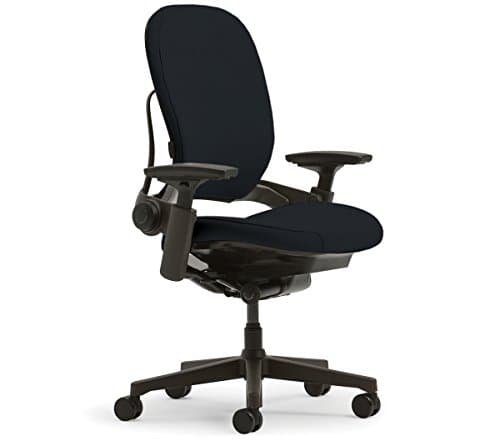
Worth knowing before you buy any cushion: the better answer is a chair whose own support moves. The Leap v2 has a lumbar that adjusts for height and a separate dial for firmness, which is both variables this page is about, built into the backrest where it cannot slide. Steelcase publishes a 25 in backrest, a 16 to 20.5 in seat height, armrest height of 7 to 11 in, a 400 lb rating and a 12-year multi-shift warranty. A cushion is the cheap way to test whether lumbar support is your problem; this is what you buy if the answer comes back yes and you are going to sit in it for years.
Who it fits
Anyone who has confirmed with a cushion that support helps and wants it built in.
Who it does not fit
Long-thighed sitters - the 15.75 in pan is fixed - and anyone not ready to replace the chair.
Published specifications
Seat height
16"–20.5"
Seat depth
15.75"
Seat width
19.25"
Back height
25"
Arm height
7"–11"
Weight capacity
400 lb
Lumbar
Height-adjustable lumbar plus a lower-back firmness dial
Where exactly should a lumbar support pillow sit?+
At the inward curve of your lower back, roughly level with your belt line - the point where, sitting upright without the cushion, two fingers fit between your back and the backrest and a third does not. Most people place it two to four inches too high.
Should a lumbar pillow be at the shoulder blades?+
No. That is the thoracic spine, and a cushion there pushes your upper back forward and tends to produce a new ache between the shoulder blades. If that is where your pain already is, the fix is backrest height rather than a cushion - best office chairs for upper back pain covers it.
How do I know if my lumbar cushion is too thick?+
You feel pushed forward out of the chair, or your lower back feels arched rather than supported, or you find yourself sitting away from the backrest to escape it. Try lowering it to the belt line first - too high and too thick feel almost identical, and height is free to change.
Do lumbar support pillows actually work?+
For the problem they address - a backrest that does not fill your lumbar curve - yes, and cheaply. For the three other common causes of desk back pain, no: a cushion cannot change seat height, seat depth or armrest height. Which is why it is best used as a one-week test before you spend more.
Can I use a rolled towel instead?+
For the test, yes - it tells you within a day or two whether support at that height helps. A proper cushion is worth it afterwards because it keeps its shape, keeps its position with straps, and is contoured rather than cylindrical.