The lumbar pad feels supportive for the first hour and like a fist in your back by the fourth, and the only control the chair gives you is whether to sit in it.
Picked on published fit specifications, each linked to its source. How we pick.
The short answer
Over a long day, a lumbar that moves beats a lumbar that is firm. The Steelcase Leap v2 is the pick: a height-adjustable lumbar with a separate firmness dial, so you can change both where it pushes and how hard, backed by a 12-year multi-shift warranty.
We earn a commission if you buy through our links. It does not change your price, and it does not change our ranking. Prices are pulled from Amazon's own API and stamped with the date we fetched them — where we have no live figure, the button opens the current price on the retailer's page instead. Full disclosure.
Ranked picks with published seat height, seat depth and weight capacity
#
Product
Best for
Seat height
Capacity
Price
1
Steelcase Leap v2
Height-adjustable lumbar plus a separate firmness dial, 12-year multi-shift
#ad Seat height and capacity are the manufacturer's published figures, sourced under each pick. Prices come live from Amazon's own API and carry the date we fetched them; where a figure is missing the button opens the current price instead. Seat depth for every pick is in the spec block below. Seat depth summary: Steelcase Leap v2 15.75" · Herman Miller Aeron 16"–18.5" · Hbada E3 Pro — · Sihoo Doro C300 18.11"
Why long hours changes the lumbar answer
Over an hour, a firm lumbar pad in roughly the right place feels supportive. Over eight, the same pad in the same place is the problem: it is a single unchanging contact point against a back that has been loaded all day, and there is no version of that which stays comfortable. The chair that wins a showroom test and the chair that wins a working week are routinely not the same chair.
Which means the spec to shop on shifts. For an occasional-use chair, the presence of lumbar support is enough. For six hours or more, what you want is adjustment range - the ability to move the support, soften it, or shift position without getting up. The general version of this argument is in the lumbar support roundup, and the long-hours roundup takes it from the pressure side. This page is the intersection.
What each chair actually lets you change
Published lumbar adjustment across our registry
Chair
Published lumbar
What you can change
Steelcase Leap v2
Height-adjustable lumbar plus lower-back firmness dial
Height and firmness - the only chair here with both
Herman Miller Aeron
PostureFit SL or adjustable lumbar pad, both height-adjustable
Height, plus shell size A/B/C to scale the backrest
Hbada E3 Pro
Three-zone dynamic lumbar, 3.15 in of backrest height adjustment
Height, by a published amount
Autonomous ErgoChair Pro
Adjustable lumbar with a stated 6 in of height range
Height; sold direct only, no buy link on this site
Herman Miller Embody
Backfit adjustment across the whole spine rather than a lumbar pad
Overall back curvature, not pad position
Steelcase Series 1
Optional adjustable lumbar; weight-activated tension as standard
Height, if you specify the option at order
Branch Ergonomic Chair
Removable lumbar pad
On or off, not height
Sihoo Doro C300
Self-adapting dynamic lumbar
Nothing - it adapts, you do not set it
Sihoo M57
Adjustable lumbar support
Stated as adjustable; no range published
Two rows there deserve a flag. "Self-adapting" and "dynamic" mean the support follows your movement rather than being set by you, which is a legitimate design - it just is not adjustment, and a reader buying it expecting a height control will be disappointed. And an optional adjustable lumbar is a configuration choice at the point of order, not something you can add later. Adjustable versus fixed lumbar is the full argument about when the fixed version is genuinely fine.
Duty wording is the second filter
A lumbar mechanism is a moving part under load for every hour you sit, and nobody publishes a cycle count for one. The closest available proxy is the warranty, and specifically whether it carries duty wording. Steelcase publishes 12-year multi-shift terms on the Leap v2 and Series 1; Herman Miller publishes 12-year, 3-shift on the Aeron. Those phrases mean the maker accepts warranty exposure on a chair used for more than one working day per day. Hbada splits its term by component, five years on the base, gas lift and casters against three elsewhere. Sihoo publishes three years flat. How long office chairs last works through why that is the most honest durability signal available to a buyer.
What support should feel like at hour six
Contact, not pressure. A lumbar pad that you are aware of all day is set too firm or too far forward; one you never notice may be too low to be doing anything. The useful sensation is that your low back is being met rather than pushed. How lumbar support should feel goes through it, and the check that matters on this page is whether the sensation is the same at hour six as at hour one. If it is not, you want the firmness control.
It is also worth ruling out the seat before blaming the back. The most common cause of losing lumbar contact over a long day is not the pad at all - it is sliding forward because the pan is too long or too slippery, which leaves the support behind you doing nothing. How to stop sliding forward is the free fix, and the seat depth guide has the measurement.
The part the chair does not do
NIH guidance on back pain is explicit that when sitting for a prolonged period you should get up, move around and switch positions frequently, and the World Health Organization sets the adult activity floor at 150 minutes of moderate-intensity activity a week regardless of your chair. No lumbar mechanism substitutes for either. What a good one does is make the hours you do sit less costly, and that is worth paying for - just not worth over-claiming.
How we picked these four
On published lumbar adjustment range first, then warranty duty wording, then the seat figures that decide whether you stay in contact with the support at all. Every number is sourced below. We have not sat in these chairs for a working week and how we pick says so in detail.
The picks in full
1. Best for Two controls instead of none
Steelcase Leap v2
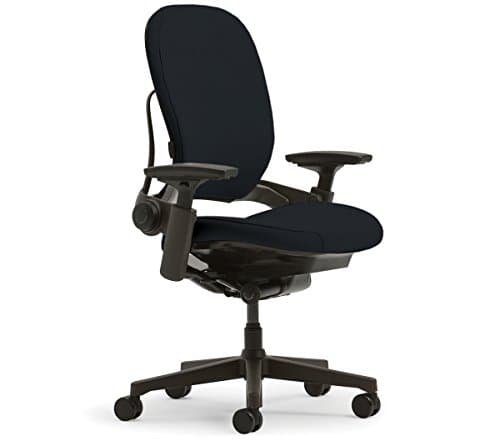
The only chair in our registry that lets you change both where the lumbar pushes and how hard it pushes. Steelcase publishes a height-adjustable lumbar alongside a separate lower-back firmness dial, and over a long day that second control is the one that matters: the support level that feels right at 9 a.m. is often too firm by 3 p.m., and a chair with no firmness control leaves you only the option of sitting away from it. Published seat height 16 to 20.5 in, a fixed 15.75 in pan, 25 in back height, arms 7 to 11 in above the seat, 400 lb capacity, 12-year multi-shift warranty. The fixed pan is the real limitation and it hits long-thighed readers hardest.
Who it fits
Anyone sitting six hours or more whose lumbar comfort changes through the day.
Who it does not fit
Long-thighed sitters - the pan does not slide. Anyone outside the premium band.
Published specifications
Seat height
16"–20.5"
Seat depth
15.75"
Seat width
19.25"
Back height
25"
Arm height
7"–11"
Weight capacity
400 lb
Lumbar
Height-adjustable lumbar plus a lower-back firmness dial
2. Best for Height-adjustable support in a sized shell
Herman Miller Aeron
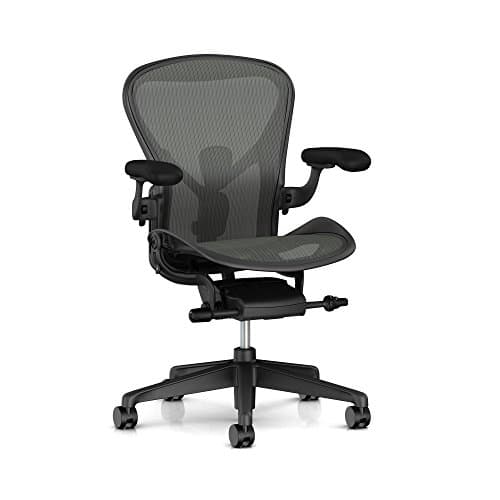
The other premium answer, and the only one where the shell itself is sized to you. Herman Miller publishes PostureFit SL or an adjustable lumbar pad, both height-adjustable, across three shells: size A at a seat height of 14.4 to 19.3 in with a 16 in pan and 300 lb, size B at 14.8 to 22.8 in with a 17 in pan and 350 lb, and size C at 15.8 to 22.8 in with an 18.5 in pan and 400 lb. For long hours the sizing matters because lumbar height only lands correctly if the backrest itself is scaled to your torso. The warranty is 12-year, 3-shift - the most explicit duty wording any maker in our registry uses. PostureFit SL supports the sacrum as well as the lumbar curve, which is a different approach from a single pad and not everyone gets on with it.
Who it fits
Anyone at the short or tall end of the range who wants support height matched to a shell that fits.
Who it does not fit
Anyone who orders a shell size by guesswork. Anyone who dislikes a firm sacral pad.
Published specifications
Seat height
14.4"–22.8"
Seat depth
16"–18.5"
Weight capacity
400 lb
Lumbar
PostureFit SL or adjustable lumbar pad, both height-adjustable
Sizes
A (seat height 14.4-19.3 in, seat depth 16 in, warrantied to 300 lb), B (14.8-22.8 in, 17 in, 350 lb), C (15.8-22.8 in, 18.5 in, 400 lb)
3. Best for Published adjustment range on a budget
Hbada E3 Pro
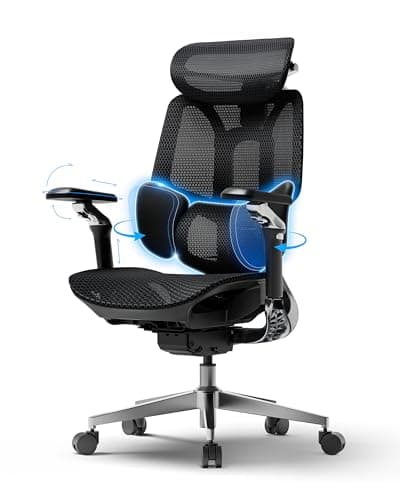
The budget chair here that publishes an actual number for its lumbar adjustment rather than describing it. Hbada gives a three-zone dynamic lumbar with 3.15 in of backrest height adjustment, a 25.6 in seat width - the widest in our registry - a 330 lb capacity, a claimed fit range of 5 ft 1 in to 6 ft 5 in, and a warranty that runs five years on base, gas lift and casters against three on other components. Over a long day, 3.15 in of height travel is enough to move the support from below your curve to above it, which is the adjustment that matters most. What you give up: Hbada publishes overall height of 43.7 to 51.8 in and no seat height, and no pan length, so two of the fit figures cannot be checked before it arrives.
Who it fits
Readers who want a movable lumbar without premium money, and who are broad through the hips.
Who it does not fit
Anyone over 330 lb, and anyone who needs the seat height confirmed before ordering.
Published specifications
Overall height
43.7"–51.8" (seat height not published)
Seat width
25.6"
Weight capacity
330 lb
Lumbar
Three-zone dynamic lumbar, 3.15 in of backrest height adjustment
Maker's fit range
5 ft 1 in to 6 ft 5 in, per Hbada
Warranty
5-year on base, gas lift and casters; 3-year on other components
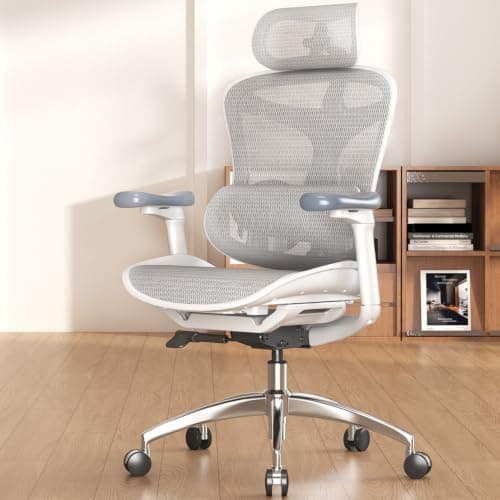
The cheapest sensible entry, and it earns its place on this page for the seat rather than the back. Sihoo publishes an 18.11 in seat depth and a 20.28 in seat width with a self-adapting dynamic lumbar and a 330 lb rating - and over a long day a pan long enough to support the whole thigh does as much for low back comfort as the lumbar pad does, because it stops you sliding forward out of the backrest entirely. The honest limits: self-adapting means the support moves with you rather than being set by you, so there is no height control and no firmness control, and the three-year warranty carries no duty wording at all.
Who it fits
Readers whose late-day problem is sliding forward out of the support rather than the support itself.
Who it does not fit
Anyone who needs to set the lumbar height themselves, or a warranty rated for continuous use.
What is the best lumbar support chair for long hours?+
The Steelcase Leap v2, because it is the only chair in our registry that publishes both a height-adjustable lumbar and a separate firmness dial - two controls, so the support can change as your back does through the day - under a 12-year multi-shift warranty.
Is adjustable lumbar worth it if I sit all day?+
Yes, more than for occasional use. Over a long day the support level that is right in the morning is often too firm by mid-afternoon, and a fixed pad gives you no way to respond to that except to sit away from it.
What does dynamic or self-adapting lumbar actually mean?+
That the support follows your movement rather than being positioned by you. It is a real design and it works for many people, but it is not adjustment - there is no height control and no firmness control to set.
Why does my lumbar support feel fine at first and bad later?+
Usually because it is firmer than your back can tolerate for a full day, or because you have slid forward out of contact with it. Check the second one first: it is free to fix and it is the more common cause.
Can a cushion do the same job as an adjustable lumbar?+
For testing, yes - you can move a strapped cushion up and down and find the right height in a week. For a full working day it is less stable than a built-in mechanism and tends to shift, but it is a tenth of the price and it answers the question before you spend.