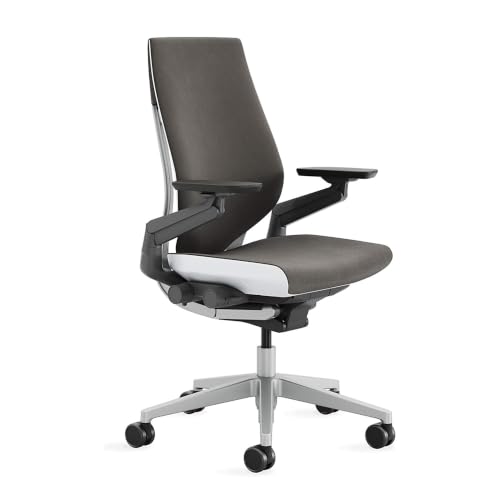
Every review of this chair is about the arms. None of them tells you that the seat height you get depends on a cylinder choice most listings never mention, which is the one decision that can make the chair wrong for you before it arrives.
Picked on published fit specifications, each linked to its source. How we pick.
The short answer
The Gesture is a 400-pound-rated chair with the roomiest seat pan Steelcase puts on a task chair: 20 inches wide and a functional depth of 15.75 to 18.5 inches. The published seat height is 16 to 21 inches on the standard cylinder, but Steelcase also sells a short cylinder from 14.5 inches and a tall one to 22.5 inches. Order the wrong one and no adjustment fixes it.
We earn a commission if you buy through our links. It does not change your price, and it does not change our ranking. Prices are pulled from Amazon's own API and stamped with the date we fetched them — where we have no live figure, the button opens the current price on the retailer's page instead. Full disclosure.
The verdict
Buy it if your hands move more than your back does. That sounds glib and it is the honest summary: the Gesture's defining feature is an armrest that travels through a full 360-degree range of motion, and the people who get the most out of it are the ones who switch between a keyboard, a tablet held in the lap, and a phone held up to the ear several times an hour. For that reader this is the best-engineered answer on the market.
Do not buy it expecting the Leap v2's lower back. Steelcase fits the Gesture with what it calls a Core Equalizer as standard and sells adjustable lumbar as an option, with 4 inches of height travel when you specify it. The Leap ships with a height-adjustable lumbar and a separate firmness dial in the box. If your pain has one location you can point to, that difference is the whole decision, and we have put the two side by side in Gesture vs Leap v2.
And read the cylinder line below before you order anything. It is the most consequential sentence on this page.
The published figures
Steelcase Gesture as published by Steelcase and by The Human Solution
Specification
Published figure
Seat height (standard cylinder)
16-21 in
Seat height (short cylinder)
14.5-18.25 in
Seat height (tall cylinder)
17-22.5 in
Seat width
20 in
Seat depth
18.25 in overall; functional 15.75-18.5 in
Back height from the seat
24.0625 in
Back width
16.25 in
Arm width (spread)
10.25-22.5 in
Overall
22.375-34.625 in wide, 39.25-44.25 in high
Weight capacity
400 lb
Warranty
Steelcase Limited Lifetime - 12 years, multi-shift, 24/7 parts and labor
Lumbar
Core Equalizer standard; adjustable lumbar optional, 4 in of height travel
Recline
Three recline angle stops plus an upright back lock
Headrest
Optional - adjusts vertically, tilts, rotates 90 degrees
Sources: the Steelcase Gesture product page for the weight rating, the warranty terms, the Core Equalizer and the arm and recline behavior, and The Human Solution's specification table for the dimensions, which Steelcase's current US page does not print. Both were checked in October 2026. We have not sat in this chair and do not claim to have - how we pick sets out the method in full.
Fit, mapped to your body
Seat height. On the standard cylinder the floor is 16 inches, which is the same floor as the Leap v2 and half an inch below the Series 1. That suits roughly 5 ft 2 in and up. The short cylinder at 14.5 inches is the interesting one: outside the Aeron's A shell at a published 14.4 inches, nothing else in our registry goes that low, which makes a short-cylinder Gesture one of very few 400-pound chairs a sitter under 5 ft 2 in can actually use. The tall cylinder reaches 22.5 inches, above the Leap v2's 20.5-inch ceiling by two full inches. See chairs for short sitters and chairs for tall sitters for where that lands against the rest of the field.
Seat depth. Functional depth - the depth you can actually sit back into, not the cushion's outside measurement - runs 15.75 to 18.5 inches. That is 2.75 inches of travel, against 2.25 inches on the Series 1 and none at all on the Leap v2, whose pan is a fixed 15.75 inches. If the front edge of your current seat presses into the back of your knees, this is the specification that fixes it, and the seat depth guide turns your own thigh length into the number to look for.
Seat width. 20 inches, which is three quarters of an inch wider than the Leap v2 and the widest pan Steelcase publishes on anything in our registry. It is still not a big-and-tall seat - the HON Ignition 2.0 Big and Tall publishes 23 inches - so if width across the hips is the constraint rather than depth, read chairs for wide hips first.
Back height and width. 24.0625 inches tall from the seat and 16.25 inches wide. The height is close to the Leap v2's published 25 inches; the width is the number worth noticing, because a 16.25-inch back is narrow and the Gesture is designed that way deliberately so your shoulders stay free to rotate. If you want a back that holds your upper body still, that is the opposite of what this chair is doing.
What the arms actually do
Most chairs sold as 4D give you four separate adjustments, each along its own axis, each with detents you can feel. The Gesture's arms are built as a single jointed assembly that moves the way a human arm does, and Steelcase publishes the spread as 10.25 to 22.5 inches - which is the range that lets the arms sit close enough together to support typing on a narrow laptop and far enough apart to be out of the way entirely.
Whether that is worth paying for depends entirely on how you work. If your forearms rest in one place for eight hours, a good 4D arm does the same job for less money. If you spend the day picking a phone up and putting it down, reading from a tablet in your lap and then going back to the keyboard, the arms follow you instead of being re-set. Whether you need armrests at all is worth reading first, because some people are better off without them.
One real consequence for neck and shoulder pain: an armrest that supports your forearm at the height your desk actually sits takes load off the trapezius, and an armrest that cannot reach that height does not. That is the mechanism behind the picks in chairs for neck and shoulder pain, and it is the one place where the Gesture's headline feature is doing something a cheaper chair genuinely cannot.
Where it is strong
Three seat-height cylinders. Covered above, and it is the reason this chair belongs on a site that sorts by body. 14.5 to 22.5 inches between the three options is wider coverage than any single-cylinder chair can offer.
The roomiest Steelcase pan here. 20 inches wide with 2.75 inches of functional depth travel. Both numbers beat the Leap v2.
400 pounds on every configuration. No shell to specify, no option to tick. The Aeron only reaches 400 pounds in the C shell.
The warranty. Twelve years, multi-shift, with 24/7 parts and labor cover stated on Steelcase's own page. That is a commercial-grade commitment, and how long office chairs last explains why the warranty terms tell you more than the materials do.
The arms, for the right reader. Genuinely without equal if your arm position changes all day.
Where it is weak
Adjustable lumbar is a cost option. The single biggest caveat. You can buy a Gesture with no adjustable lumbar at all, and plenty of listings sell exactly that. Adjustable versus fixed lumbar sets out what you give up.
The cylinder trap. One product name, three different chairs as far as your legs are concerned, and a retail channel that rarely specifies which one.
A deliberately narrow back. 16.25 inches. Fine if you want shoulder freedom, wrong if you want to be held.
Steelcase does not publish the dimensions itself any more. The current US product page lists the weight rating and the warranty and sends you to a document library or a configurator for everything else. We have used an authorized dealer's table and said so, but a figure you have to source from a reseller is a figure that can change without notice.
No published arm height range. Steelcase and its dealers publish the arm spread, not how far the armrest travels vertically above the seat. On a chair whose entire argument is the armrest, that is a strange omission, and we are not going to fill it with a number we cannot cite.
Price. It sits at the top of the premium band, above the Leap v2 in most configurations. Is Steelcase worth it is the honest version of that question.
Who should not buy one
Anyone whose pain has one exact location. Buy the Leap v2 instead, or specify the adjustable lumbar and confirm it is on the order. A height-adjustable lumbar pad in the box beats a better armrest every time for that reader - the lower back pain roundup ranks on exactly that basis.
Anyone buying from a listing that will not confirm the cylinder. You are gambling on a 1.5-inch difference in seat height floor.
Anyone who works in one position all day. The arms are the premium you are paying, and a static worker will not collect it. A Series 1 delivers the same warranty and the same 400-pound rating for far less.
Anyone who wants a padded, enveloping back. Wrong chair, by design.
Alternatives worth reading
Gesture vs Leap v2 - the two Steelcase flagships side by side, with every published figure in one table.
Herman Miller Mirra 2 - the same twelve-year warranty class for a great deal less money, with its own published-figure problem.
Herman Miller Aeron - if what you need is the chair built in your size rather than adjusted to it.
Arms that follow your hands, and a seat with room in it
Steelcase Gesture
The Gesture is the chair Steelcase built around the armrest, and the arms do move through a genuine 360-degree range rather than the four fixed positions most chairs call 4D. What makes it interesting to us is quieter: the seat is 20 inches wide with 2.75 inches of functional depth travel, which is the most room Steelcase publishes on any task chair in our registry, and the chair is sold with three different gas cylinders covering 14.5 to 22.5 inches between them. The 400-pound rating and the 12-year multi-shift warranty come as standard on every configuration.
Who it fits
Anyone whose thighs have never matched a fixed seat pan, anyone who works across a laptop, a tablet and a phone and keeps changing arm position, and - with the right cylinder specified at order - sitters at either end of the height range.
Who it does not fit
Anyone who needs adjustable lumbar support as standard, because here it is a cost option. Anyone shopping on price: this sits at the top of the premium band. Anyone buying a listing that does not say which cylinder it ships with.
Published specifications
Seat height
16"–21"
Seat depth
15.75"–18.5"
Seat width
20"
Back height
24.06"
Weight capacity
400 lb
Lumbar
Core Equalizer as standard; optional adjustable lumbar with 4 in of height travel
Sizes
Three cylinder options - short (14.5-18.25 in), standard (16-21 in), tall (17-22.5 in). The standard figure is the one quoted above.
Warranty
Steelcase Limited Lifetime - 12 years, multi-shift, 24/7 parts and labor
It is worth it for one specific reader: someone whose arm position changes many times an hour, because the 360-degree arms are the thing nothing cheaper reproduces. It is poor value for someone who sits in one position and needs lower-back support, since adjustable lumbar is a cost option here and standard on the Leap v2. The warranty and the 400-pound rating are identical across both chairs, so brand quality is not the variable.
Does the Steelcase Gesture have lumbar support?+
It has what Steelcase calls a Core Equalizer as standard, and adjustable lumbar support with 4 inches of height travel as an option you have to specify. A Gesture bought without that option has no height-adjustable lumbar pad. Check the configuration on any listing before ordering, and read adjustable versus fixed lumbar for what the difference means in practice.
What is the seat height of a Steelcase Gesture?+
It depends which cylinder your chair ships with. The standard cylinder is published at 16 to 21 inches, the short cylinder at 14.5 to 18.25 inches, and the tall cylinder at 17 to 22.5 inches. Retail listings usually quote the standard range only. Confirm the cylinder with the seller - it is not something you can adjust after delivery without ordering a part.
Is the Gesture good for tall people?+
With the tall cylinder, yes: 22.5 inches of seat height is two inches above the Leap v2's ceiling, and the 18.5-inch functional seat depth suits a long thigh. With the standard cylinder it tops out at 21 inches, which is adequate rather than generous. Work from our picks for tall sitters before deciding.
What is the weight limit on the Steelcase Gesture?+
Steelcase publishes 400 pounds, on every configuration rather than on a particular shell or size. Steelcase's UK page gives the equivalent as tested up to 180 kg, which is the same figure.