Steelcase Gesture vs Herman Miller Aeron: Which One to Buy
Two flagships at similar money, two completely different answers to the same question - how do you make one chair fit bodies that are not average - and no comparison that puts those answers next to each other.
Picked on published fit specifications, each linked to its source. How we pick.
The short answer
Both solve fit by selling more than one version, but they change different parts. The Aeron changes the shell, so the whole backrest scales to your torso. The Gesture changes the gas cylinder, so the seat height moves but the back stays one size. Short torso, buy the shell. Unusual leg length, buy the cylinder.
We earn a commission if you buy through our links. It does not change your price, and it does not change our ranking. Prices are pulled from Amazon's own API and stamped with the date we fetched them — where we have no live figure, the button opens the current price on the retailer's page instead. Full disclosure.
Ranked picks with published seat height, seat depth and weight capacity
#
Product
Best for
Seat height
Capacity
Price
1
Herman Miller Aeron
Three shells, each a different backrest as well as a different seat
#ad Seat height and capacity are the manufacturer's published figures, sourced under each pick. Prices come live from Amazon's own API and carry the date we fetched them; where a figure is missing the button opens the current price instead. Seat depth for every pick is in the spec block below. Seat depth summary: Herman Miller Aeron 16"–18.5" · Steelcase Gesture 15.75"–18.5"
The verdict, up front
Choose the Aeron if your torso is the part that has never fit. A different shell is a different backrest, so the lumbar curve, the back height and the seat all move together to match your proportions. Nothing the Gesture offers does that, because swapping a gas cylinder changes how high you sit and nothing else.
Choose the Gesture if your legs are long, your arms move constantly, or you need 400 pounds without being restricted to one specific size. The sliding pan and the 360-degree arms are capabilities the Aeron does not have at any shell size.
The useful framing is this: both makers accept that one chair cannot fit everyone, and both sell three versions in response. Herman Miller varies the shell. Steelcase varies the cylinder. Those sound similar on a spec sheet and are completely different in what they solve.
Every published figure, side by side
Steelcase Gesture and Herman Miller Aeron as published - Herman Miller direct, and an authorized dealer for the Gesture where Steelcase no longer prints dimensions
Specification
Gesture
Aeron
Seat height, standard
16-21 in
14.8-22.8 in (size B)
Seat height, other versions
Short cylinder 14.5-18.25 in; tall 17-22.5 in
A 14.4-19.3 in; C 15.8-22.8 in
What changes between versions
The gas cylinder only
The whole shell - back, seat and capacity
Functional seat depth
15.75-18.5 in, sliding
16 in (A), 17 in (B), 18.5 in (C), fixed per shell
Seat width
20 in
Not published per shell
Back height from the seat
24.06 in
Not published
Arms
360-degree range; spread 10.25-22.5 in
Height-adjustable; figures not published
Lumbar
Core Equalizer standard; adjustable lumbar optional (4 in travel)
PostureFit SL or adjustable pad, both height-adjustable
This is the whole comparison, so it is worth being precise about what each one buys.
A Gesture cylinder changes one number. Short, standard or tall moves the seat height band - 14.5 to 18.25, 16 to 21, or 17 to 22.5 inches - and leaves the seat, the backrest and the 400 lb rating exactly where they were. That is the right fix when your legs are an unusual length relative to your desk, and no fix at all when your torso is short, because the back is still 24 inches tall whichever cylinder is underneath it.
An Aeron shell changes three numbers at once. Size A is not just a lower chair; it is a smaller backrest, a 16-inch pan and a 300 lb rating. Size C is a bigger backrest, an 18.5-inch pan and 400 lb. That is the right fix when your proportions differ from average, and it comes with a cost the Gesture does not have: the capacity is tied to the size, so a heavy sitter who needs a low seat has a genuine conflict to resolve.
The seat pan: sliding versus sized
The Gesture has 2.75 inches of functional seat depth travel, 15.75 to 18.5 inches, and you set it. The Aeron fixes the pan per shell at 16, 17 or 18.5 inches, and you choose it once at order time. Both approaches reach 18.5 inches at the top, so for a long-thighed sitter either can work - but only one lets you change your mind, and only one accommodates two people sharing a desk.
Measure the back of your knee to the back of your hip before deciding; the seat depth guide gives the method and the target. If your figure lands between two Aeron shells, that is an argument for the Gesture, because an adjustment range covers the gap a fixed pan leaves.
Lumbar: the Aeron's clear win
On the Aeron, both back options adjust. PostureFit SL adds a second pad supporting the sacrum below the lumbar curve; the alternative is a conventional height-adjustable lumbar pad. Whichever you pick, you get a control.
On the Gesture, the standard build gets Steelcase's Core Equalizer, adjustable lumbar with 4 inches of height travel is a paid option, and there is no firmness control at any price. If lumbar is why you are shopping, this row decides the comparison on its own - and the Gesture is not even the best Steelcase for it, since the Leap v2 beats it on exactly this with a height-adjustable pad and a separate firmness dial as standard. Our page on chairs with adjustable lumbar sorts the whole field by whether the control is standard or an upgrade.
Arms: the Gesture's clear win
The Gesture was designed outward from the armrest, around the observation that people hold devices in their hands all day. The arms move through a full 360-degree range and spread from 10.25 to 22.5 inches. Herman Miller publishes that the Aeron's arms are height-adjustable and does not publish the travel, so we cannot put a number against it - but nothing in the Aeron's design claims the Gesture's range of motion, and no source suggests it matches.
Warranty. Twelve years on both, with explicit multi-shift or 3-shift duty wording. Steelcase states 24/7 parts and labor on the Gesture; Herman Miller states 3-shift on the Aeron. Both mean a parts supply that still exists in year ten.
Top-end capacity. 400 lb on both - but the Gesture gets there on every configuration and the Aeron only in size C. If you are near the limit and also need a low seat, the Gesture removes a conflict.
Fit range overall. 14.5 to 22.5 inches on the Gesture against 14.4 to 22.8 inches across the Aeron shells. Within a quarter of an inch at both ends. What differs is what else changes along the way.
Who should buy neither
Anyone shopping below the premium band.The Steelcase Series 1 carries the same twelve-year multi-shift warranty and the same 400 lb rating for a fraction of either chair, and chairs under $500 is the right page if that is your budget.
Anyone whose real need is a lumbar control. The Leap v2 does it better than either of these and usually costs less than both.
Anyone above 400 lb. Neither chair goes there - big-and-tall picks covers the 450 lb options.
The short version
Short or tall in the torso: Aeron, in the correct shell. Long in the thigh, or working across three devices all day: Gesture, with the cylinder confirmed. Lower back pain as the single reason you are shopping: neither - buy the Leap v2. If you are still weighing the Herman Miller line against itself, Aeron vs Embody vs Mirra 2 is the page that sorts that out.
The picks in full
1. Best for A back that is scaled to your torso
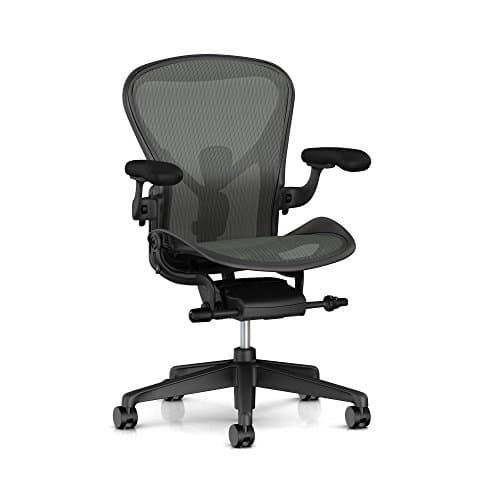
Herman Miller Aeron
Pick the Aeron when the thing that has never fit you is above the waist. Changing shell changes the backrest, the seat pan and the rated capacity together: Herman Miller publishes size A at a 14.4 to 19.3 in seat height with a 16 in pan and 300 lb, size B at 14.8 to 22.8 in with a 17 in pan and 350 lb, and size C at 15.8 to 22.8 in with an 18.5 in pan and 400 lb. Lumbar is PostureFit SL or an adjustable pad, both height-adjustable, under a 12-year 3-shift warranty. That combination reaches a published 14.4 in at the bottom, which is the lowest seat height in our registry.
Who it fits
Short torsos, tall torsos, anyone over 350 lb (size C only), and anyone who runs warm - it is mesh front and back.
Who it does not fit
Anyone who orders without the size chart. Anyone who wants a padded seat. Anyone whose complaint is their arms rather than their back.
Published specifications
Seat height
14.4"–22.8"
Seat depth
16"–18.5"
Weight capacity
400 lb
Lumbar
PostureFit SL or adjustable lumbar pad, both height-adjustable
Sizes
A (seat height 14.4-19.3 in, seat depth 16 in, warrantied to 300 lb), B (14.8-22.8 in, 17 in, 350 lb), C (15.8-22.8 in, 18.5 in, 400 lb)
2. Best for Long thighs and arms that move all day
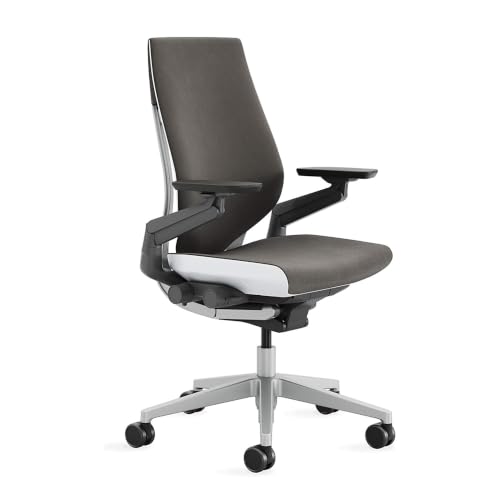
Steelcase Gesture
Pick the Gesture when the problem is your legs or your arms. The seat pan has 2.75 inches of functional depth travel against the Aeron's fixed per-shell pan, the seat is 20 in wide, and the arms move through a full 360-degree range rather than along fixed axes - the feature the chair was designed around. Three cylinders span 14.5 to 22.5 in of seat height, so the fit range is comparable to the Aeron's even though the backrest never changes size. Steelcase publishes 400 lb on every configuration and a 12-year multi-shift warranty with 24/7 parts and labor.
Who it fits
Anyone measuring over about 17 in from the back of the knee to the back of the hip, anyone working across keyboard, tablet and phone, and anyone who wants 400 lb without having to buy a specific size.
Who it does not fit
Anyone whose main complaint is lumbar - adjustable lumbar is a cost option with 4 in of travel and no firmness control. Anyone who will not chase the seller over which cylinder ships.
Published specifications
Seat height
16"–21"
Seat depth
15.75"–18.5"
Seat width
20"
Back height
24.06"
Weight capacity
400 lb
Lumbar
Core Equalizer as standard; optional adjustable lumbar with 4 in of height travel
Sizes
Three cylinder options - short (14.5-18.25 in), standard (16-21 in), tall (17-22.5 in). The standard figure is the one quoted above.
Warranty
Steelcase Limited Lifetime - 12 years, multi-shift, 24/7 parts and labor
Is the Steelcase Gesture better than the Herman Miller Aeron?+
Neither is better overall; they fix different things. The Gesture has a sliding seat pan (15.75 to 18.5 in), a 20 in seat and 360-degree arms, and is rated to 400 lb in every configuration. The Aeron comes in three shell sizes that change the backrest as well as the seat, and both of its lumbar options adjust. Torso problems point to the Aeron; leg and arm problems point to the Gesture.
Which has the better lumbar support, the Gesture or the Aeron?+
The Aeron, and not narrowly. Both Aeron back options - PostureFit SL and the adjustable lumbar pad - are height-adjustable as standard. On the Gesture, adjustable lumbar is a paid option with 4 in of travel and there is no firmness control at any price.
Does the Gesture come in different sizes like the Aeron?+
Not in the same sense. The Gesture is sold with three seat-height cylinders - short (14.5-18.25 in), standard (16-21 in) and tall (17-22.5 in) - which change how high you sit and nothing else. An Aeron shell size changes the backrest, the seat depth and the rated weight capacity together.
Which is better for a tall person?+
Close, and it depends where your height is. A tall-cylinder Gesture reaches 22.5 in of seat height and a size C Aeron reaches 22.8 in, so for long legs they are equivalent. For a long torso the Aeron's larger shell gives you more backrest, which the Gesture cannot match at any cylinder. See our picks for tall sitters.
Which is better for a short person?+
The Aeron in size A, at a published 14.4 in seat height - the lowest figure in our registry - because the smaller shell also shortens the backrest, which matters as much as the seat height for a short torso. A short-cylinder Gesture reaches 14.5 in but keeps the full-size back. Our picks for short sitters works through both.