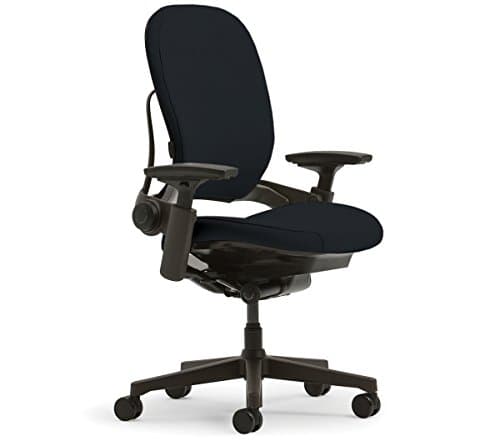
Steelcase Gesture Alternatives, by What You Are Replacing
The Gesture is the chair people recommend when your shoulders and wrists hurt rather than your lower back, and the price reflects that. You want to know which parts of it have cheaper equivalents and which do not.
Picked on published fit specifications, each linked to its source. How we pick.
The short answer
The Gesture is bought for two things almost nothing else offers: armrests that move through a full 360-degree range, and a choice of three seat-height cylinders. The Leap v2 matches its build and beats it on lumbar control, the Series 1 keeps the warranty for far less, and nothing here reproduces the arms.
We earn a commission if you buy through our links. It does not change your price, and it does not change our ranking. Prices are pulled from Amazon's own API and stamped with the date we fetched them — where we have no live figure, the button opens the current price on the retailer's page instead. Full disclosure.
Ranked picks with published seat height, seat depth and weight capacity
#
Product
Best for
Seat height
Capacity
Price
1
Steelcase Leap v2
Same build, same 400 lb, a lumbar control the Gesture charges for
The in-house alternative that trades arms for lumbar
#ad Seat height and capacity are the manufacturer's published figures, sourced under each pick. Prices come live from Amazon's own API and carry the date we fetched them; where a figure is missing the button opens the current price instead. Seat depth for every pick is in the spec block below. Seat depth summary: Steelcase Leap v2 15.75" · Steelcase Series 1 15.5"–17.75" · Herman Miller Mirra 2 16.25"–18" · HON Ignition 2.0 Big and Tall 18.74" · Sihoo Doro C300 18.11"
What the Gesture is actually known for
Name the thing you are replacing before you shop for a replacement. The Gesture has two specifications that are genuinely unusual, and a third that nobody mentions until the chair arrives:
Arms that move through a full 360-degree range. Steelcase designed them around phones and tablets, and they are the reason the chair gets recommended for shoulder, neck and wrist complaints rather than lumbar ones. Published arm width runs 10.25 to 22.5 inches apart.
Three seat-height cylinders. Short reaches 14.5 to 18.25 inches, standard 16 to 21 inches, tall 17 to 22.5 inches. That is a fit range no single chair can match, and it is also the trap - the cylinder is chosen at order time and no adjustment fixes the wrong one later.
The roomiest seat Steelcase puts on a task chair. 20 inches wide with a functional depth of 15.75 to 18.5 inches, rated to 400 pounds, with a 24-inch back and the Steelcase Limited Lifetime warranty at 12 years multi-shift.
It is an excellent chair and this page is not an argument against it - our own Steelcase Gesture review says so, and Gesture versus Aeron works through where it wins. The question here is narrower: which of those three things has a cheaper equivalent, and which does not.
Pick your alternative by the reason you are leaving
If the reason is price and your pain is lumbar, not shoulder
Buy the Leap v2. Same company, same rating, same warranty terms, and the lumbar pad slides and firms up - a control the Gesture sells as an option with 4 inches of travel. Gesture versus Leap is the head-to-head, and it does not conclude that the more expensive chair wins.
If the reason is price and nothing else
Buy the Series 1 and accept ordinary arms. It is the cheapest chair that keeps the 12-year multi-shift warranty and the 400-pound rating, and Steelcase publishes every dimension you need to check fit before ordering.
If the reason is that you wanted the cylinder choice for a short or tall body
This is the hard one, because the cylinder system is close to unique. For a short sitter the honest answer is a smaller shell rather than a shorter cylinder - best office chairs for a short person starts from a 14.4-inch published seat height. For a tall sitter, the tall cylinder has no cheap equivalent at all, and best office chairs for a tall person is where the options are.
If the reason is that you need more chair
Buy the HON Ignition 2.0 Big and Tall. A 450-pound rating on a 23-inch seat is beyond anything Steelcase offers in this line, and adjustable lumbar is included rather than configured.
What none of these replaces
The arms. Every chair on this page has armrests that move up, in and out, and some of them pivot; none of them rotates through a full circle the way the Gesture's do. If you have sat in one and found that the arms were doing the work - supporting your forearms while you hold a phone, swinging out of the way to let you turn - the honest answer is that there is no budget version of that mechanism, and a used Gesture is the cheaper Gesture.
The five alternatives against the chair they are replacing
Published manufacturer and retailer figures. A blank means the brand does not publish a figure, not that the feature is missing.
Chair
Published seat height
Arms
Capacity
Warranty
Steelcase Gesture (the original)
16-21 in standard; 14.5-18.25 short, 17-22.5 tall
360-degree range, 10.25-22.5 in apart
400 lb
Limited Lifetime - 12 years multi-shift
Steelcase Leap v2
16-20.5 in
4D, 7-11 in high, 12.75-20 in apart
400 lb
12-year, multi-shift
Steelcase Series 1
16.5-21.5 in
Adjustable; ranges not published
400 lb
12-year, multi-shift
Herman Miller Mirra 2
16-20.5 in (US store)
6-11.5 in high adjustable, or 8.3 in fixed
350 lb
12-year, three-shift
HON Ignition 2.0 Big and Tall
17-21.5 in
All-adjustable with pivot
450 lb
HON Full Lifetime (6-8 hr daily use)
Sihoo Doro C300
Not published (42-49 in overall)
Coordinated 4D
330 lb
3-year
Read the arms column rather than the price. Four of the five alternatives publish an arm range at all, which is already better than most of this market manages, and none of them publishes anything resembling the Gesture's rotation. That is the gap you are deciding whether to accept. Do you need armrests on an office chair is worth five minutes before you decide it matters, because for a lot of desk setups it does not.
Two alternatives we did not pick
The Embody. Premium, excellent, and aimed at a completely different problem - it has no lumbar pad and no arm acrobatics, just a back that changes curve along its whole length. Someone replacing a Gesture for arm reasons will not be happy; someone replacing it for back reasons should read Leap v2 versus Embody first.
The Aeron. It answers the fit question the cylinder system answers, but with three shell sizes instead - a different and arguably better solution, at a price that is not an alternative to anything. Gesture versus Aeron covers it.
If you are replacing the Gesture for fit rather than money
Two published limits send people looking. The first is the standard cylinder's 16-inch floor, which is high for sitters under about 5 ft 2 in and is solved by the short cylinder rather than by a new chair. The second is the 400-pound ceiling, above which the big-and-tall field is the answer - best office chairs for big and tall. If the budget rather than the body is the constraint, best office chairs under $700 covers the band directly below this chair, and Steelcase Leap v2 alternatives runs the same exercise for the other Steelcase flagship.
The picks in full
1. Best for The in-house alternative that trades arms for lumbar
Steelcase Leap v2
If you are shopping Gesture alternatives because of the price rather than the design, start here: at current listings the Leap v2 and the Gesture frequently sit in the same bracket, and on several days the Leap is the cheaper of the two. What you get for the same money is a different specialty - a lumbar pad that slides up and down with a separate firmness dial, which on the Gesture is a paid configuration option. Steelcase publishes a 16 to 20.5 inch seat height, a 25-inch back, arms 7 to 11 inches above the seat and 12.75 to 20 inches apart, a 400-pound rating and a 12-year multi-shift warranty.
Who it fits
Anyone whose pain is in the lower back rather than the shoulders, from about 5 ft 4 in up.
Who it does not fit
Anyone who wants the Gesture's arm range - the Leap's arms are good, not acrobatic - and anyone under about 5 ft 1 in.
Published specifications
Seat height
16"–20.5"
Seat depth
15.75"
Seat width
19.25"
Back height
25"
Arm height
7"–11"
Weight capacity
400 lb
Lumbar
Height-adjustable lumbar plus a lower-back firmness dial
2. Best for Keeping the warranty and most of the money
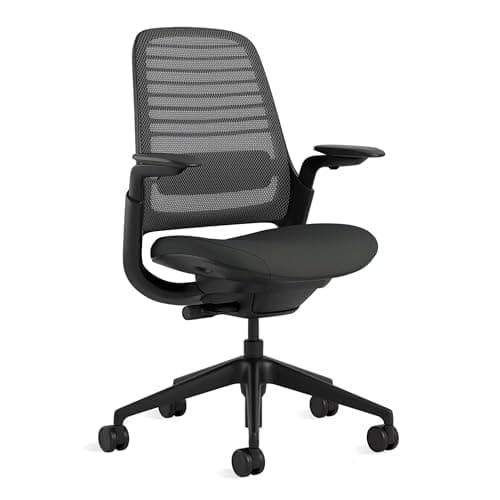
Steelcase Series 1
The Series 1 is the cheapest way to stay inside Steelcase's warranty and rating. Steelcase publishes a seat height of 16.5 to 21.5 inches, a functional seat depth of 15.5 to 17.75 inches, an overall height of 36.5 to 41.25 inches, a 400-pound rating and the same 12-year multi-shift terms. What you give up is the whole reason people buy a Gesture: the arms here adjust in the ordinary way, there is no cylinder choice, and adjustable lumbar is a cost option rather than something you can add later.
Who it fits
Anyone who wants commercial build and warranty without paying flagship money, from about 5 ft 3 in up.
Who it does not fit
Anyone buying for arm support specifically, and anyone under about 5 ft 2 in without a footrest.
Published specifications
Seat height
16.5"–21.5"
Seat depth
15.5"–17.75"
Weight capacity
400 lb
Lumbar
Optional adjustable lumbar; weight-activated tension as standard
3. Best for Crossing to Herman Miller without crossing the price
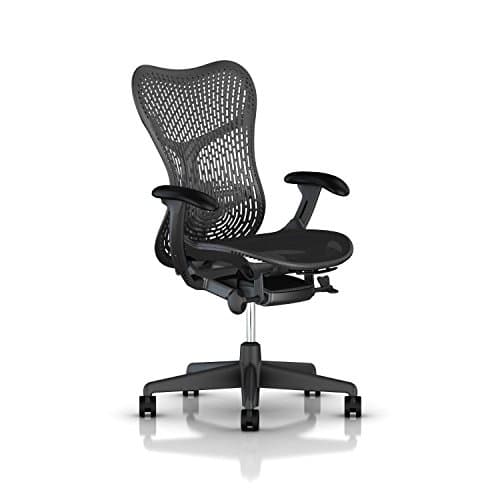
Herman Miller Mirra 2
The cross-brand answer, and the only chair on this page that publishes how far its adjustable lumbar actually moves: 4.5 inches of height and 1 inch of depth, per Herman Miller's US store. The arms adjust from 6 to 11.5 inches, the seat depth runs 16.25 to 18 inches with the FlexFront option, and the warranty is 12 years three-shift at a 350-pound rating. Herman Miller publishes two different seat heights for this chair - 16 to 20.5 inches on the US store, 14.8 to 22.2 inches on hermanmiller.com - and we quote the conservative pair throughout this site.
Who it fits
Readers who want a suspension back rather than foam, and a lumbar adjustment with numbers attached.
Who it does not fit
Anyone over 350 lb, and anyone who expects the adjustable lumbar or the FlexFront seat in the base price - both are options.
Published specifications
Seat height
16"–20.5"
Seat depth
16.25"–18"
Arm height
6"–11.5"
Weight capacity
350 lb
Lumbar
Three back-support options - basic back support, non-adjustable lumbar, or adjustable lumbar with 4.5 in of height and 1 in of depth travel
Sizes
One shell. Published seat height depends which Herman Miller source you read: 16-20.5 in on the US store listing (quoted above), 14.8-22.2 in on hermanmiller.com's product-details page. Seat depth is 16.25 in fixed, or 16.25-18 in with the FlexFront adjustable seat. Confirm the configuration with your seller.
4. Best for More capacity and a wider seat than the Gesture offers
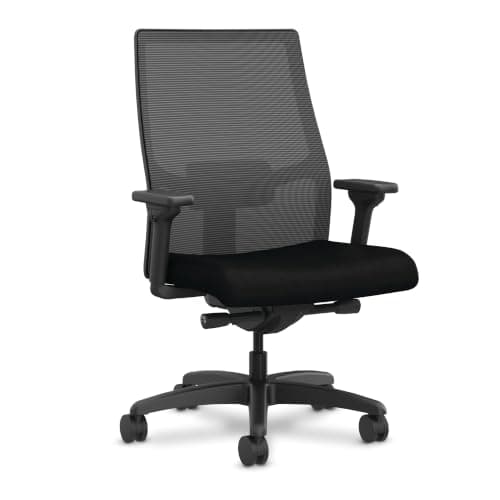
HON Ignition 2.0 Big and Tall
The Gesture's 20-inch seat and 400-pound rating are generous for a task chair and still not enough for everyone. HON rates the Ignition 2.0 Big and Tall to 450 pounds on a 23-inch seat, publishes a 17 to 21.5 inch seat height and a 24.75-inch back, includes adjustable lumbar as standard rather than as an option, and covers it with the HON Full Lifetime Warranty. Office Depot's listing rates it for 6 to 8 hours of daily use, which is the honest boundary on the word lifetime.
Who it fits
Sitters above 300 lb, or anyone who needs more than 20 inches across the seat.
Who it does not fit
Anyone under about 5 ft 6 in - the 17-inch floor and the deep pan both work against a shorter leg - and anyone sitting more than eight hours a day.
5. Best for The budget pick, and the only cheap chair here with real arms
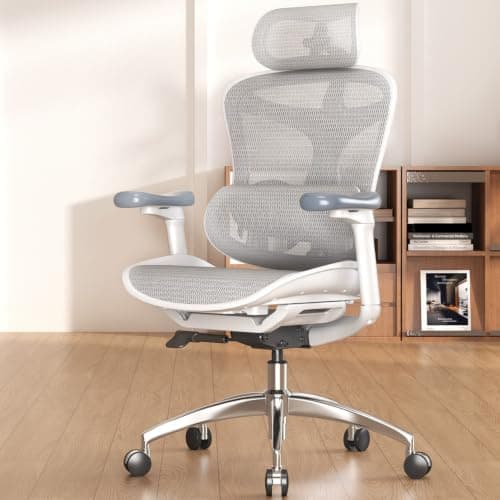
Sihoo Doro C300
If arms are what you came for and the Gesture's money is not available, this is the closest the budget end gets. The Doro C300 publishes coordinated 4D armrests, an 18.11-inch seat depth that adjusts, a 20.28-inch seat width, a backrest that lifts through 18.11 to 21.65 inches, a 330-pound rating and a three-year warranty. Four-way arms are not 360-degree arms and we are not going to pretend otherwise, but they move in the directions that matter for a keyboard and a mouse.
Who it fits
Anyone who needs a usable chair now, up to 330 lb, especially if the seat edge of the current chair presses into the thighs.
Who it does not fit
Anyone who needs a published seat height before ordering - Sihoo publishes overall height only - and anyone expecting commercial-grade longevity from a three-year warranty.
What is the best cheaper alternative to the Steelcase Gesture?+
The Steelcase Series 1 if you want to stay inside Steelcase's 12-year multi-shift warranty and 400-pound rating for much less, or the Leap v2 if your complaint is lumbar rather than shoulder - the Leap and the Gesture often sit in the same price bracket, and the Leap includes the sliding lumbar the Gesture charges for.
Does any chair have armrests like the Gesture's?+
Not in our registry. Several publish 4D arms with real ranges - the Leap v2 at 7 to 11 inches high and 12.75 to 20 inches apart, the Mirra 2 at 6 to 11.5 inches - but nothing reproduces the Gesture's full 360-degree rotation. If the arms are the reason you want the chair, a used Gesture is the only cheaper version of it.
Is the Gesture worth it over the Leap v2?+
It depends entirely on where you hurt. Arms, shoulders and wrists point to the Gesture; the lower back points to the Leap v2, whose lumbar pad slides and firms up as standard. Gesture versus Leap sets them side by side on published figures.
What should I buy instead of a Gesture if I am over 400 pounds?+
The HON Ignition 2.0 Big and Tall, rated to 450 pounds on a 23-inch seat with adjustable lumbar as standard. The wider field is in best office chairs for big and tall.
Is a used Steelcase Gesture a good alternative to a new one?+
For the arms, yes - it is the only way to get that mechanism for less. You give up the warranty and certainty about internal wear, and you must confirm which seat-height cylinder the chair was built with, because that choice is permanent and sellers rarely state it.