Steelcase Leap v2 vs Herman Miller Embody: Which One to Buy
They cost roughly the same, they carry the same twelve-year warranty, and they disagree completely about what back support is. One pushes on your lumbar curve; the other refuses to.
Picked on published fit specifications, each linked to its source. How we pick.
The short answer
The Leap v2 gives you a lumbar pad you can place and firm up, and takes 400 pounds. The Embody gives you no lumbar pad at all - the backfit control bends the whole backrest - plus a pan that adjusts from 15 to 18 inches and a seat two inches wider. Pick the mechanism, not the brand.
We earn a commission if you buy through our links. It does not change your price, and it does not change our ranking. Prices are pulled from Amazon's own API and stamped with the date we fetched them — where we have no live figure, the button opens the current price on the retailer's page instead. Full disclosure.
Ranked picks with published seat height, seat depth and weight capacity
#
Product
Best for
Seat height
Capacity
Price
1
Steelcase Leap v2
Lumbar height and firmness on separate controls, 400 lb
#ad Seat height and capacity are the manufacturer's published figures, sourced under each pick. Prices come live from Amazon's own API and carry the date we fetched them; where a figure is missing the button opens the current price instead. Seat depth for every pick is in the spec block below. Seat depth summary: Steelcase Leap v2 15.75" · Herman Miller Embody 15"–18"
The verdict, up front
Choose the Leap v2 if your back pain has a location you can point at, or if you are above the Embody's 300-pound ceiling. The sliding lumbar pad with its own firmness dial is the most complete lumbar system in our registry, and it is the whole reason the Leap leads most of the pain pages on this site.
Choose the Embody if you have tried lumbar pads and disliked all of them, or if the Leap's fixed 15.75-inch seat pan is too short for your thigh. Those are two unrelated reasons and either one on its own is sufficient.
What makes this a real comparison rather than a price-tier exercise is that the chairs disagree about the mechanism. Almost every other pair on this site differs by degree - one adjusts more, one is rated higher. These two have incompatible theories of what a backrest is for, and the one that suits you depends on something you already know about yourself.
Side by side, on published figures
Published specifications for the Steelcase Leap v2 and the Herman Miller Embody
Leap v2
Embody
Seat height
16-20.5 in
16-20.5 in
Seat depth
15.75 in, fixed
15-18 in, adjustable
Seat width
19.25 in
21.25 in
Backrest
25 in high (width not published)
23.5 in high x 14 in wide
Arm height
7-11 in
4-8.75 in above the seat
Arm width
12.75-20 in apart
11.5-21 in apart
Lumbar
Height-adjustable pad plus a separate firmness dial
No pad - backfit changes the curvature of the whole back
Read the seat height row first, because it is the one that surprises people: these chairs are identical there. Both run 16 to 20.5 inches, which means both suit a sitter from roughly 5 ft 4 in to 6 ft 2 in and neither one is the answer if you are outside that. If seat height is your binding constraint, this comparison is not the one you need - go to seat height for your height and then to the Aeron, which is the only chair here sold in three shells.
Decision axis 1: a pad, or no pad
This is the real difference and it is not a matter of quality. Both chairs support your lower back; they do it by opposite means.
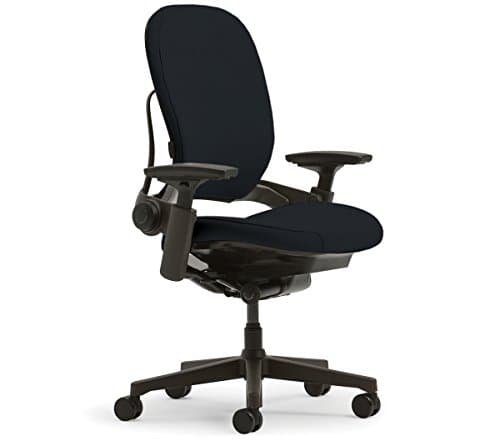
The Leap v2 uses the conventional mechanism done unusually well. A pad slides up and down the backrest so you can place it at your curve rather than at an average one, and a separate dial sets how hard it pushes. Two controls for two different questions - where, and how hard - and almost everything else on the market conflates them or leaves one out. For a reader whose pain sits at one identifiable point, this is as good as the category gets, which is why it leads our lower back pain roundup.
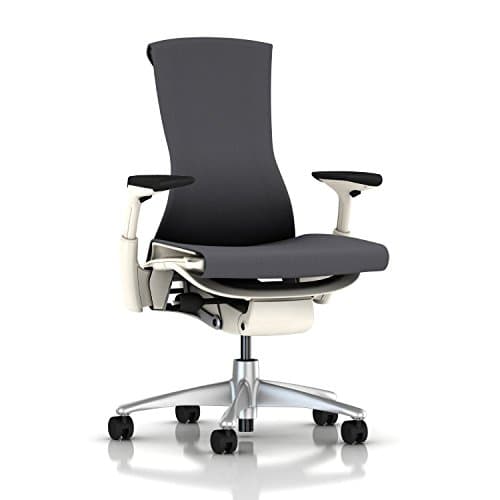
The Embody rejects the premise. There is no lumbar pad. The backfit control changes the curvature of the whole backrest so it follows the length of your spine instead of pushing one region forward, and the back itself is built as a narrow central spine with ribs rather than as a panel. Herman Miller's argument is that a concentrated pressure point is the problem rather than the solution.
Decision axis 2: the seat pan
This one is measurable and it goes to the Embody without argument.
The Leap v2's pan is 15.75 inches and it does not move. That is short, deliberately so, and it is why the Leap suits shorter thighs better than most premium chairs. But if your thigh is long there is nothing to adjust: you sit back against that excellent lumbar system with two inches of unused pan in front of you, and the thigh support the pan exists to provide is simply not there.
The Embody publishes 15 to 18 inches of seat depth adjustment. Three inches of travel covers nearly the whole adult range in one chair. Work out your own figure in the seat depth guide - roughly 27% of your standing height minus an inch - and if the answer is over about 17 inches, the Leap cannot be made to fit you and the Embody can.
Seat width runs the same direction. The Embody's pan is 21.25 inches against the Leap's 19.25, which is two inches that matter if your hips need them. Neither is a big-and-tall chair - for that, see the HON Ignition 2.0 Big and Tall, which publishes 23 inches and a 450-pound rating - but between these two the Embody is the roomier seat.
Decision axis 3: weight capacity, and who it rules out
The Leap v2 is rated to 400 pounds. The Embody is rated to 300. That is a hundred-pound gap between two chairs at similar money, and it is the cleanest disqualifier in this comparison: if you are above 300 pounds, the Embody is out, whatever you think of the backfit mechanism.
The warranty row reads the same way. Both are twelve years, but Steelcase rates the Leap multi-shift - which is the manufacturer saying it is built for three different people using it around the clock - and Herman Miller does not publish a shift rating for the Embody. For a single home-office user over an eight-hour day that distinction is mostly academic. For a chair carrying a heavier load every day it is not. Related reading: office chairs rated to 400 pounds and up.
Decision axis 4: the armrests, which nobody compares
Both publish full armrest figures, which is rare enough to be worth using. BTOD gives the Embody 4 to 8.75 inches of arm height above the seat and 11.5 to 21 inches of width between the arms; the Leap v2 publishes 7 to 11 inches high and 12.75 to 20 inches apart.
Two things fall out of that. The Embody's arms go three inches lower, which matters if you are short in the torso or work at a low desk and have ever found armrests shoving your shoulders up. The Leap's arms go higher, which matters at a desk that is too tall to lower - see what to do if your desk is too high. On width the Embody has the wider envelope at both ends, 11.5 inches at the narrow end against 12.75, and 21 at the broad end against 20.
None of that decides the purchase on its own, but armrest height set wrong is one of the most common causes of neck and shoulder ache at a desk, and it is worth checking against your own measurements before spending at this level. What armrests actually do covers the setup.
Where each one is weak
Steelcase Leap v2
A fixed 15.75-inch seat pan. The shortest premium pan in our registry and the chair's clearest limitation. Long thighs cannot be accommodated.
Upholstered, not mesh. It runs warmer than a suspension seat over a long day. If that is a known problem for you, read mesh versus foam.
Steelcase does not publish a backrest width. Back height is 25 inches; how broad that back is across the shoulders is not a published figure.
Bulky. It is a large chair and it looks like office furniture, which is a real objection in a small room - see chairs for small spaces.
Herman Miller Embody
300-pound ceiling. The lowest capacity of any premium chair here.
No targeted lumbar at all. If what you need is firm pressure at one specific vertebra, this chair structurally cannot give it to you, and no amount of backfit adjustment changes that.
A narrow backrest. 14 inches wide and 23.5 high. That is the spine-and-ribs design working as intended, and it is also less back contact than a broad panel if lateral support is something you want.
One size, no shell options. Same as the Leap, but worth saying out loud because people expect sizing at this price. Only the Aeron offers it.
No headrest, from either manufacturer. Neither chair has one. If head support is a requirement, both are the wrong purchase - whether you need a headrest explains when it genuinely is.
If neither is right
Steelcase Series 1 - the same 400-pound rating and 12-year multi-shift warranty with an adjustable pan, for considerably less. The lumbar is a configured option rather than standard.
Aeron vs Leap v2 - if you are at either end of the height range and the shell sizing is the thing you actually need.
Every figure on this page comes from a published specification with the document linked beside it. We did not sit in either chair and we do not claim to have. Our method is set out in full in how we pick.
The picks in full
1. Best for Pain with an address
Steelcase Leap v2
Choose the Leap v2 if you can put a finger on where your back hurts. It is the only chair in our registry where where the support sits and how hard it pushes are two independent adjustments, and for a localized complaint that pairing is worth more than anything else a chair offers - the usual failure is support at the right height and far too firm, or the reverse. Steelcase publishes a 25-inch backrest, a 16 to 20.5 inch seat height, arms 7 to 11 inches high and 12.75 to 20 inches apart, a 400-pound rating and a 12-year multi-shift warranty.
Who it fits
Anyone with a specific lower-back complaint, anyone between about 300 and 400 pounds, and anyone who sits more than eight hours a day and wants the multi-shift rating.
Who it does not fit
Anyone with long thighs - the 15.75-inch pan is fixed and the shortest of the two. Anyone who has tried lumbar pads and found the concentrated pressure to be the problem itself.
Published specifications
Seat height
16"–20.5"
Seat depth
15.75"
Seat width
19.25"
Back height
25"
Arm height
7"–11"
Weight capacity
400 lb
Lumbar
Height-adjustable lumbar plus a lower-back firmness dial
Choose the Embody if lumbar pads have always felt like something digging into you. The backfit control changes the curvature of the entire backrest rather than pushing one area forward, which is a different answer to the same problem and the right one for a minority of readers who are poorly served everywhere else. It is also the better-fitting chair in three dimensions the Leap does not move in: BTOD publishes a 15 to 18 inch adjustable seat depth, a 21.25-inch seat width against the Leap's 19.25, and arms that drop to 4 inches above the seat and spread from 11.5 to 21 inches apart.
Who it fits
Longer thighs, wider hips, narrow or very broad shoulders, and anyone whose pain is diffuse rather than located at one point.
Who it does not fit
Anyone over 300 pounds - that is the published ceiling, a hundred below the Leap. Anyone who wants targeted pressure at one spot, which this chair deliberately does not provide.
Published specifications
Seat height
16"–20.5"
Seat depth
15"–18"
Seat width
21.25"
Weight capacity
300 lb
Lumbar
Backfit adjustment across the whole spine rather than a lumbar pad
Neither is better in general. The Leap has a targeted, adjustable lumbar pad and takes 400 pounds; the Embody has no lumbar pad at all, an adjustable 15 to 18 inch seat pan, a two-inch wider seat, and a 300-pound ceiling. Decide on the lumbar mechanism and the seat pan, in that order.
Which one is better for lower back pain?+
The Leap v2, for most people, because pain you can point at responds to support you can place and firm up. The exception is real and worth naming: if lumbar pads have always felt like something pressing into you, the Embody's whole-back approach is the one to try. See the lower back pain roundup for the full list.
Do the Leap v2 and the Embody come in different sizes?+
No. Both are sold in one size, and both publish an identical 16 to 20.5 inch seat height. The only chair in our registry sold in multiple shells is the Herman Miller Aeron, in sizes A, B and C.
Which has the longer seat for tall legs?+
The Embody, clearly. It adjusts from 15 to 18 inches; the Leap is fixed at 15.75 and cannot be lengthened. If your calculated seat depth is above about 17 inches, that one figure settles the comparison.
Are either of them rated for someone over 300 pounds?+
The Leap v2 is, at 400 pounds. The Embody is published at 300 and should not be bought above that. If you need more headroom than either, the HON Ignition 2.0 Big and Tall publishes 450 pounds on a 23-inch seat.