Picked on published fit specifications, each linked to its source. How we pick.
The short answer
Your surgeon sets the precautions; the chair only has to make them easy to keep. On published specs the Steelcase Leap v2 leads, because the height-adjustable lumbar and firmness dial let you place support at the level you were told to protect, and the 7-11 in arms give you something to push up from.
We earn a commission if you buy through our links. It does not change your price, and it does not change our ranking. Prices are pulled from Amazon's own API and stamped with the date we fetched them — where we have no live figure, the button opens the current price on the retailer's page instead. Full disclosure.
Ranked picks with published seat height, seat depth and weight capacity
#
Product
Best for
Seat height
Capacity
Price
1
Steelcase Leap v2
Height-adjustable lumbar, firmness dial, arms 7-11 in above the seat
#ad Seat height and capacity are the manufacturer's published figures, sourced under each pick. Prices come live from Amazon's own API and carry the date we fetched them; where a figure is missing the button opens the current price instead. Seat depth for every pick is in the spec block below. Seat depth summary: Steelcase Leap v2 15.75" · HÅG Capisco 8106 13.4"–16.5" · HON Ignition 2.0 Big and Tall 18.74" · Steelcase Series 1 15.5"–17.75"
Start with the instruction you were given, not with a chair
This is the one page on the site where the chair is genuinely the second decision. Post- operative precautions after spine surgery vary by procedure, by surgeon and by patient - how long to limit sitting, how much trunk flexion is allowed, whether twisting is off the table, when you can drive, when you can return to a desk at all. Those come from the person who performed the operation. Nothing on this page overrides them, and if a spec here conflicts with your discharge sheet, the discharge sheet wins.
What a chair can do is make the instructions easier to keep. Most of them reduce to three mechanical asks: do not fold deeply at the waist, do not sit low, and do not stay in one position long. Each of those maps onto a published figure you can check before you buy.
The three specs that carry the precautions
Published figures that map onto common post-operative asks
The ask
The spec that carries it
Where our registry sits
Do not fold deeply at the waist to sit or stand
Maximum published seat height
Capisco 8106 25.8 in; Aeron B and C 22.8 in; HON Ignition BT 21.5 in; Series 1 21.5 in
Push up with your arms rather than your back
Published armrest height above the seat
Leap v2 7-11 in; Embody 4-8.75 in; HON Ignition BT all-adjustable with pivot
Keep support at the level you were told to protect
Published lumbar height adjustment
Leap v2 height-adjustable plus firmness dial; Aeron height-adjustable pad; Hbada E3 Pro 3.15 in
Change position often, without standing every time
Published seat depth range and recline
Series 1 15.5-17.75 in; Capisco 13.4-16.5 in; Embody 15-18 in
Seat height is the one that does the most work, and it is also the one makers are least consistent about publishing. Several brands give overall chair height instead, which is not the same figure and cannot be converted into it - Sihoo and Hbada both do this, which is why neither appears as a pick here despite being perfectly good chairs elsewhere on the site. The seat height lookup table gives you the number to aim for from your own height, and is your chair too high or too low is the check to run on the chair you already own before you spend anything.
Why a higher seat is the usual answer
Standing up from a low seat requires the trunk to travel a long way forward before the legs can take over. Raise the seat and that forward travel shrinks; raise it far enough and you are stepping out of a perch rather than climbing out of a well. That is the mechanism behind the Capisco pick, and it is also why a chair that is otherwise excellent - the Leap v2 tops out at 20.5 in - may be the wrong answer for a tall person in the first weeks back.
The same logic is why armrests matter more than usual here. Arms that take load let you push up through the shoulders and keep the trunk upright. Arms that are too low, too far back or absent force you to fold. Our page on whether you need armrests argues the general case; after surgery the general case does not apply and the answer is simply yes.
What a chair will not do
It will not speed up healing, it will not protect a fusion, and it will not substitute for the rehab you were given. The Merck Manual overview of neck and back pain is a useful corrective here: imaging findings and symptoms do not always correlate, and the mechanical story is rarely as tidy as a product page suggests. Read any chair claim that mentions recovery with that in mind, including ours - we are describing geometry, not outcomes.
If the chair is a stopgap while you decide, the cheapest useful intervention is often a cushion rather than a chair. A wedge or a coccyx cutout changes the seat angle and the pressure point for a fraction of the money; the lumbar cushion page covers what an add-on can and cannot do, and where to place a lumbar pillow matters more than which one you buy.
How we picked these four
On published seat height, published armrest height, published lumbar adjustment and published seat depth range - the four figures that map onto the precautions most often given. Every number is sourced below. We have not tested these chairs with anybody recovering from anything, we hold no clinical qualification, and how we pick sets out exactly what that means. The ranking here is a geometry argument and nothing more.
The picks in full
1. Best for Placing support at a specific level
Steelcase Leap v2
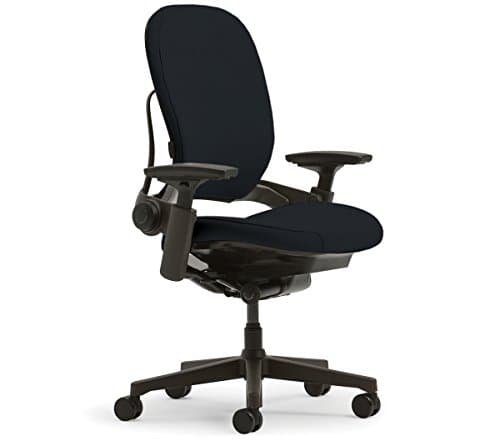
The one chair here that lets you choose where the support sits rather than accepting where the maker put it. Steelcase publishes a height-adjustable lumbar with a separate lower-back firmness dial, which matters more after surgery than at any other time: if you have been told to protect a level, you want the pad at that level and at a firmness you can tolerate, not a fixed contour pressing wherever it lands. Arms adjust 7 to 11 in above the seat, which is the published range that decides whether you can push up with your arms instead of folding forward at the waist. Seat height 16 to 20.5 in, fixed 15.75 in pan, 400 lb, 12-year multi-shift.
Who it fits
Anyone who was given a level to protect and wants the support placed deliberately.
Who it does not fit
Long-thighed sitters; the pan is fixed. Anyone who needs a seat above 20.5 in to stand up easily.
Published specifications
Seat height
16"–20.5"
Seat depth
15.75"
Seat width
19.25"
Back height
25"
Arm height
7"–11"
Weight capacity
400 lb
Lumbar
Height-adjustable lumbar plus a lower-back firmness dial
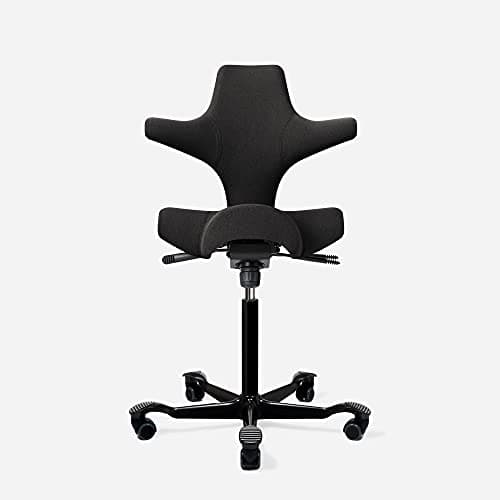
The highest published seat height in our registry by a wide margin, and that is the whole case for it on this page. Flokk publishes 18.5 to 25.8 in, which means you can set the seat high enough that standing up is closer to a step forward than a push out of a deep well - the movement most post-operative instructions are trying to limit. The saddle shape also lets you perch rather than sit, opening the hip angle without dropping the pelvis backward. Seat width 18.5 in, adjustable pan 13.4 to 16.5 in, rated to 300 lb, 10-year warranty with lifetime cover on the gas lifts. The honest trade-off is large: in the saddle position there is no backrest to lean into, so it is a chair for part of a day.
Who it fits
Anyone whose instruction is to avoid deep hip and trunk flexion when sitting and standing.
Who it does not fit
Anyone who needs full back support for a working day, and anyone over 300 lb.
Published specifications
Seat height
18.5"–25.8"
Seat depth
13.4"–16.5"
Seat width
18.5"
Weight capacity
300 lb
Lumbar
None in the saddle position; the back support is a perch rest
Warranty
10-year against production defects; lifetime on gas lifts
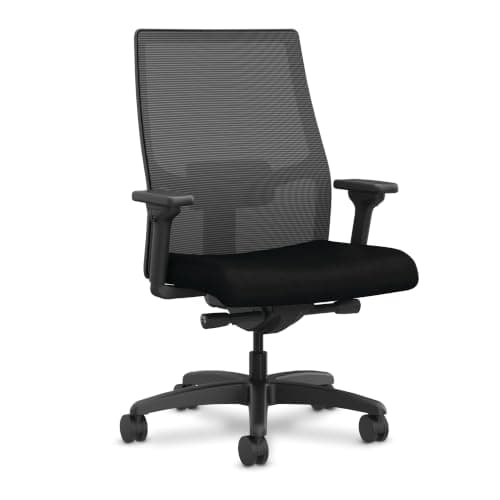
A wide, high, heavily built chair with arms you can actually load. Office Depot publishes a 17 to 21.5 in pneumatic seat height, a 23.5 in seat width with a usable depth of 17.75 to 19.5 in, a 22.75 by 24.75 in back, adjustable lumbar, synchro-tilt with tilt tension and tilt lock, all-adjustable arms with pivot, 450 lb capacity and HON's Full Lifetime Warranty. The pan never drops below 17 in, which is a problem for short sitters generally and an advantage here specifically: a higher starting seat is a shorter distance to stand from. The arms pivot, so they stay under your hands as you push.
Who it fits
Larger sitters, and anyone who stands up by pushing through the arms rather than the legs.
Who it does not fit
Short sitters - 17 in is too high to put both feet flat without a footrest. Small rooms.
4. Best for The same duty rating without the premium price
Steelcase Series 1
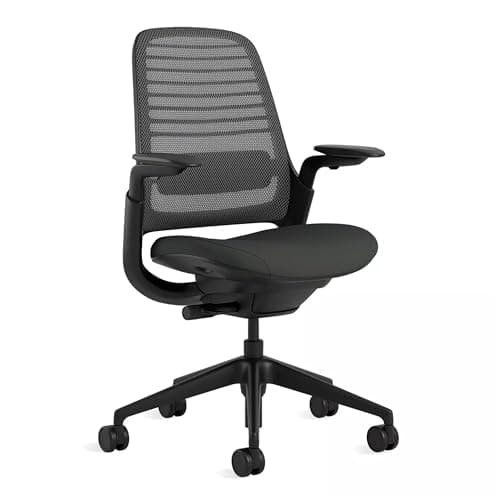
Chosen here for the sliding pan rather than the price. Steelcase publishes a functional seat depth of 15.5 to 17.75 in, which lets you shorten the seat so the front edge stops short of the back of your knees - useful when you are being careful about how you get in and out, because a shorter pan means less shuffling forward before you stand. Seat height 16.5 to 21.5 in, 400 lb, 12-year multi-shift warranty, weight-activated tension as standard. The adjustable lumbar is an option rather than standard, which is the figure to confirm before ordering if a specific level is the reason you are shopping.
Who it fits
Anyone who wants the pan length adjustable and the duty rating long, at mid-tier money.
Who it does not fit
Anyone under about 5 ft 4 in, and anyone who needs adjustable lumbar as standard.
Published specifications
Seat height
16.5"–21.5"
Seat depth
15.5"–17.75"
Weight capacity
400 lb
Lumbar
Optional adjustable lumbar; weight-activated tension as standard
After spine surgery, the people to listen to are your surgeon and your physical therapist. Buy nothing and call them if any of the following appears:
Pain that runs below the knee, or numbness and tingling in the foot
Weakness in a leg or foot, or a foot that catches when you walk
Pain that wakes you at night, or that is worse lying down than sitting
Sudden onset after a fall, a lift, or an impact
Any change in bladder or bowel control, or numbness around the groin - this one is urgent
Pain with unexplained weight loss, fever, or a history of cancer
New or worsening leg weakness, new numbness, a change in bladder or bowel control, or a fever after an operation are not chair problems and not things to research - they are reasons to contact the surgical team the same day. This page is about desk geometry for a return to work that has already been cleared.
We are not doctors, physical therapists or certified ergonomists, and nothing here is medical advice. If you are in real pain, see someone who is qualified to look at it.
Questions people actually ask
What kind of chair is best after back surgery?+
One that is high enough to stand from without folding at the waist, has arms you can push up through, and places lumbar support at the level you were told to protect. On published specs that favors the Steelcase Leap v2 for support placement and the HAG Capisco 8106 for seat height.
How high should the seat be after back surgery?+
Higher than you would otherwise choose - a taller seat shortens the forward trunk travel needed to stand. Your surgeon may give a specific instruction; absent one, start from the seat height table and set it at or slightly above the figure for your height.
Is a kneeling chair a good idea after back surgery?+
Usually not in the early weeks. A kneeling chair loads the shins and holds the trunk upright with no back support, and getting into and out of one involves exactly the movement most instructions limit. See our page on the risks.
Do I need a chair with a headrest?+
Only if the surgery was cervical or you have been told to support the neck. For lumbar procedures a headrest changes nothing; our headrest page explains when it earns its place.
Can I just add a cushion to my current chair?+
Often yes, as a stopgap - a wedge raises the front of the seat and opens the hip angle, a coccyx cutout takes the tailbone off the pan. Neither changes seat height, which is the spec that usually matters most here.