Varier Variable Balans Review: Who It Actually Fits
It is the kneeling chair every other kneeling chair is copying, and the one specification that decides whether it can work at your desk is the one it does not have.
Picked on published fit specifications, each linked to its source. How we pick.
The short answer
The Variable Balans is the original rocking kneeling chair and it is built with no mechanism at all - no gas lift, no levers, nothing to fail. That is also the catch. The seat is fixed at 18 inches at the front edge and 20.5 at the back, so the chair cannot be matched to your desk; your desk has to suit the chair.
We earn a commission if you buy through our links. It does not change your price, and it does not change our ranking. Prices are pulled from Amazon's own API and stamped with the date we fetched them — where we have no live figure, the button opens the current price on the retailer's page instead. Full disclosure.
The verdict
Buy it if you want to rock, and if you have measured your desk first. The Variable Balans does one thing that no mechanical kneeling chair does as well: it is a sled you can move on continuously for hours, with no mechanism to wear out and no levers to set wrong. The seven-year warranty on the wood frame is a reasonable statement about how long a chair with no moving parts should last.
Do not buy it as the chair you sit in all day, and do not buy it expecting to adjust it to a desk you already own. Those are the same limitation stated two ways. BTOD publishes the seat as 18 inches high at the front and 20.5 at the back - a fixed, sloped pan, not an adjustment range - and there is no gas cylinder in the chair to change it. If your working surface does not suit a seat at that height, nothing about this chair bends to meet you.
What the rocking is actually for
A kneeling chair opens the angle between your thigh and your torso, which lets the pelvis sit upright without a backrest pushing it there. That is the argument for the whole category and it is set out properly in what a kneeling chair actually does.
The Variable Balans adds a second idea on top: the base is a curved sled rather than a fixed frame, so the chair moves under you the whole time you are on it. BTOD describes two rocking zones - a forward one for working at the desk and a rearward one nearer upright for pausing - and the practical effect is that you change position constantly instead of holding one. That is worth something specific. The problem described in what happens when you sit all day is not really a problem of bad posture, it is a problem of unchanging posture, and a chair that will not let you stay still is a direct answer to it.
It is also the reason this chair has survived while most kneeling chairs are interchangeable. The rocking does not depend on a mechanism, so there is nothing in it to loosen, sink or seize.
The published figures
Varier Variable Balans as published by BTOD
Specification
Published figure
Seat height
18" at the front edge, 20.5" at the back - fixed
Seat
16" wide x 12" deep
Knee pad
10.5" long x 5.5" wide
Overall
28" deep x 19" wide x 20.5" high
Weight capacity
240 lb
Chair weight
11.5 lb
Frame
Beech plywood, natural ash or black lacquered finish
Padding
Polyurethane foam; recycled polyester fabric on the Revive line
Adjustment
None - no gas cylinder, no levers
Casters
None - sled base, with floor tape supplied for hard floors
Warranty
7 years on the wood frame, 5 years on foam and fabric
Lumbar
None - the open hip angle replaces a backrest
Source: BTOD's published dimensions for the Variable Balans. Note what is absent as well as what is there. Varier does not publish a recommended user height for this chair, so we are not going to invent one - the usable check is the seat height against your desk, worked below. A backrest is sold as a separate accessory; it is not part of the chair reviewed here.
Fit, mapped to your body
Seat height is the gate and it is covered above. There is one wrinkle worth stating plainly: on a kneeling chair part of your weight goes through your shins, so the seat height is not doing the same job it does on a task chair. It still sets how high your torso ends up, which is what decides whether your forearms reach the desk level.
Seat depth is 12 inches, which would be absurd on an office chair and is normal here. You are not sitting back into this pan; you are perched forward on it with your shins taking the rest. Do not compare that figure to the one you calculate in the seat depth guide - that method assumes a conventional seated posture with a backrest behind you.
Seat width is 16 inches, the narrowest in our registry. If width across the hips is your constraint this is structurally the wrong shape, and chairs for wide hips is the page you want.
Weight capacity is 240 pounds, and this is the hardest limit on the chair. It is 60 pounds below the next-lowest rating on this site and 210 below the highest. A capacity rating is a structural number, not a comfort preference, so if you are near it, treat it as a no. Office chairs rated to 400 pounds is the other end of the same specification.
Where it is strong
Nothing to fail. No gas lift, no tilt mechanism, no tension spring. The most common office chair failure on this site is a sinking gas cylinder - why chairs keep sinking - and this chair cannot have it.
Continuous movement, by design. The sled base means you rock the whole time you are on it, in a forward working zone and a rearward resting one. No task chair offers that, and sitting still is the actual problem for most people reading this site.
It weighs 11.5 pounds. Light enough to pick up with one hand, which is what makes a two-chair rotation practical rather than theoretical.
A seven-year frame warranty on a chair with no mechanism. Five years on foam and fabric alongside it. Those are the parts that actually wear here.
No shin-pressure shortcut. The 10.5 by 5.5 inch knee pad and the polyurethane foam are published, so you can see what is carrying your shins rather than guessing from a photograph.
Where it is weak
Nothing adjusts. This is the defining limitation and it is not a flaw so much as a design position. A chair with no mechanism cannot have adjustment, and the two things you most want to set on a kneeling chair - seat height and the seat-to-knee angle - are both fixed here.
240 pounds. The lowest published capacity on this site, and a hard structural ceiling.
No backrest unless you buy one. BTOD is direct about this: beyond two to three hours most people want the accessory backrest, and it is a separate purchase at a meaningful fraction of the chair's own price. Budget for it or plan on short sessions - how long you can actually sit in a kneeling chair is the honest version.
No casters. A sled base does not roll, so you cannot push back from the desk or move sideways to a second monitor without standing up. BTOD lists low sitting mobility as a downside and it is a real one for a working day.
Shin pressure is still shin pressure. Padding helps and does not remove it. If your knees are the reason a previous kneeling chair failed, read are kneeling chairs bad for your knees before spending premium money to find out again.
It is priced in the premium tier. This is a wooden sled with foam on it, sold against chairs with ten adjustments and twelve-year warranties. The money buys durability and the rocking action, not features.
Who should not buy one
Anyone whose desk does not suit an 18-inch seat. The most important line on this page, and the one that is not fixable later.
Anyone over 240 pounds. Structural, not negotiable.
Anyone who needs lumbar support. Sciatica, a herniated disc or stenosis all want adjustable support behind you, which this chair deliberately does not have. The sciatica roundup is the right page, and kneeling chairs for back pain is where the category's limits for pain are set out.
Anyone with knee, shin or ankle problems. The mechanism that makes a kneeling chair work is pressure on the shins.
Anyone buying one chair for eight hours a day. Rocking is excellent in stretches and tiring as a default. Kneeling chair versus office chair sets out the trade.
Alternatives worth reading
Best kneeling chairs - the full category, including the adjustable ones that can be matched to your desk.
This review is built on the published figures with the source linked, and it states what Varier does not publish rather than filling the gap. We did not sit in this chair and do not claim to have; our method is set out in full in how we pick.
The published specifications
Rocking, not sitting still
Varier Variable Balans
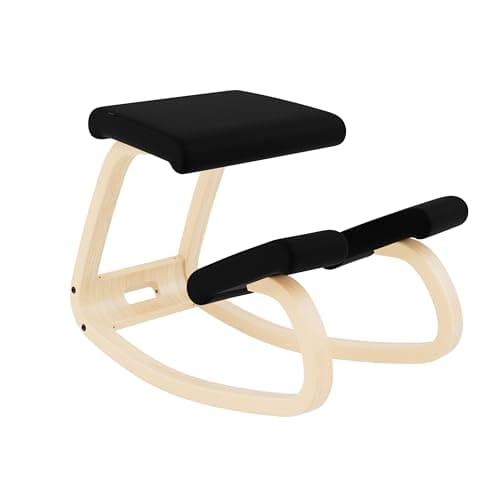
The Variable Balans is the only chair in our registry with no mechanism in it. There is no gas lift, no tilt lock and no tension dial - the whole chair is a beech plywood sled you rock on, with two usable zones: forward for working and back toward the upright for pausing. That is why it outlasts the mechanical kneeling chairs that copied it, and it is why BTOD's published dimensions list a seat height as a fixed pair of numbers rather than a range. At 11.5 pounds it is also light enough to move between rooms with one hand, which matters more than it sounds for a chair you are meant to use in stretches.
Who it fits
Anyone who already knows they sit better with an open hip angle, anyone who wants a second seat to rotate into for part of the day, and anyone at a desk that suits an 18-inch front edge.
Who it does not fit
Anyone over 240 pounds - that is the published limit and the lowest on this site. Anyone who needs to match the chair to a desk they already own: nothing on it adjusts. Anyone who needs lumbar support, which it does not have at all.
Published specifications
Seat height
18"–20.5"
Seat depth
12"
Seat width
16"
Weight capacity
240 lb
Lumbar
None - the open hip angle replaces a backrest
Sizes
One size, fixed - 18 in at the front edge, 20.5 in at the back, no gas lift
Warranty
7-year on the wood frame, 5-year on foam and fabric
No. There is no gas cylinder and no lever. BTOD publishes the seat as 18 inches at the front edge and 20.5 inches at the back, which describes a fixed sloped pan rather than an adjustment range. That is a deliberate design choice - it is why there is nothing in the chair to fail - and it means the chair has to suit your desk rather than the other way around.
How long can you sit in a Variable Balans?+
In stretches rather than all day, and BTOD puts the practical limit at around two to three hours before most people want the accessory backrest. Shin pressure and the lack of anything to lean into are what end a session. How long you can sit in a kneeling chair covers the build-up properly.
What is the weight limit on the Variable Balans?+
240 pounds, which is the lowest published capacity of any chair on this site. Weight capacity is a structural rating rather than a comfort guideline, so if you are close to it, this is not the chair.
Does the Variable Balans come with a backrest?+
Not as standard. Varier sells a backrest as a separate accessory and BTOD recommends it for sessions beyond a few hours. The chair reviewed here is the one without it, which is how it is normally listed and priced.
Is the Variable Balans good for lower back pain?+
It can help the specific case where holding one seated position is what aggravates you, because the sled base makes you move continuously and the open hip angle lets the pelvis sit upright. It is a poor choice for pain that needs targeted support behind you, and it is not something we can promise will work for any particular condition. See the back pain roundup for chairs that support rather than reposition.