Picked on published fit specifications, each linked to its source. How we pick.
The short answer
Our top pick under $500 is the Sihoo Doro C300: its backrest raises and lowers through 3.5 inches, which is how you place support at your own curve at this price. The budget pick is the Everlasting Comfort lumbar pillow, which is the only way to get a pad you position by hand without leaving the band.
We earn a commission if you buy through our links. It does not change your price, and it does not change our ranking. Prices are pulled from Amazon's own API and stamped with the date we fetched them — where we have no live figure, the button opens the current price on the retailer's page instead. Full disclosure.
Ranked picks with published seat height, seat depth and weight capacity
#ad Seat height and capacity are the manufacturer's published figures, sourced under each pick. Prices come live from Amazon's own API and carry the date we fetched them; where a figure is missing the button opens the current price instead. Seat depth for every pick is in the spec block below. Seat depth summary: Sihoo Doro C300 18.11" · Sihoo M57 18.11" · Everlasting Comfort Lumbar Support Pillow — · Herman Miller Mirra 2 16.25"–18"
Three different things are sold as adjustable lumbar support
This is the whole page, so it goes first. When a listing says adjustable lumbar support it means one of three things, and they are not close to equivalent:
What the phrase covers, and which price it lives at
What it is
What you can change
Where it appears
A lumbar pad on a track
Height, and sometimes prominence
Above this band - the Mirra 2's adjustable lumbar option, the Leap v2's pad plus firmness dial
A backrest whose whole height adjusts
Where the supported area sits on your back
Inside this band - the Doro C300, 18.11-21.65 in
A dynamic or self-adapting lumbar
Nothing - it responds to your weight and movement
Throughout the budget tier
Only the first of those is a pad you set by hand, and we cannot cite one under $500 from a maker that publishes its travel. That is the honest answer to the question this page exists for, and it is why a strapped cushion is ranked here rather than mentioned as an afterthought: on a chair that adjusts for height, a cushion is the cheapest way to get support exactly where your back bends.
The three-way split by what the control actually is - standard equipment, a paid configuration option, or a dynamic system with no control at all - is covered across the whole registry in best office chairs with adjustable lumbar. This page is the same question with a five-hundred-dollar ceiling on it.
Why height is the adjustment that matters
Lumbar support works by filling the gap behind the inward curve of your lower back, and that curve is at a different height on everybody. Support above it pushes your mid-back forward; support below it pushes on your pelvis and does nothing for the curve at all. That is why a chair with excellent built-in support can feel wrong, and why the figure to shop on is travel rather than the word firm.
How lumbar support should feel describes the target: firm, continuous contact that you stop noticing, rather than a bump you are aware of all day. If what you have is a bump you are aware of all day, it is too prominent or in the wrong place, and where to place a lumbar support pillow is the five-minute version of the fix.
What the band gives up, and what it does not
You do not get firmness control. A separate dial for how far the support protrudes is a premium-tier feature; in our registry the Steelcase Leap v2 is the chair with a height-adjustable lumbar and a firmness dial, and it is well above this band - adjustable vs fixed lumbar explains what each one changes.
You do not get a published travel figure from the budget brands. Sihoo lists an adjustable lumbar on the M57 without saying how far it moves. We report that rather than filling the gap.
You do get depth adjustment, which for a lot of readers changes a working day more than lumbar support does. If the front edge of your seat presses into your thighs, fix that first - the seat depth guide has the measurement.
Three cases, and they are specific rather than aspirational:
Your pain has a precise location you can point to. You need a pad you can put there, which means the Mirra 2's adjustable lumbar option or, further up, the Leap v2 - best lumbar support office chairs ranks the whole field on the control rather than the band.
You sit eight hours a day, five days a week. The three-year warranties in this band are home-office warranties. A twelve-year multi-shift warranty is a different engineering target.
You are over 330 lb or need a published seat height. Neither is available from the budget brands here - best office chairs under $700 is the next band up.
The picks in full
1. Best for Placing the support, inside the band
Sihoo Doro C300
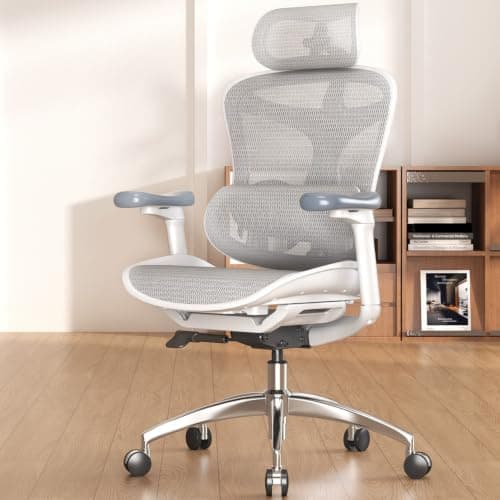
The best answer this band has, and it works by moving the whole backrest rather than a pad. Sihoo publishes a backrest adjustable through 18.11 to 21.65 inches of height - about three and a half inches of travel - so the supported part of the back can be lifted or dropped to where your lumbar curve actually is. The lumbar itself is described as self-adapting and dynamic, which means there is no control on it; the height adjustment is the control. Also published: an 18.11-inch pan with depth adjustment, a 20.28-inch seat, a 330-pound rating and a three-year warranty.
Who it fits
Anyone whose current chair supports the wrong part of their back, and anyone who wants depth adjustment in the same purchase.
Who it does not fit
Anyone who wants to set lumbar firmness as well as position, and anyone over 330 lb.
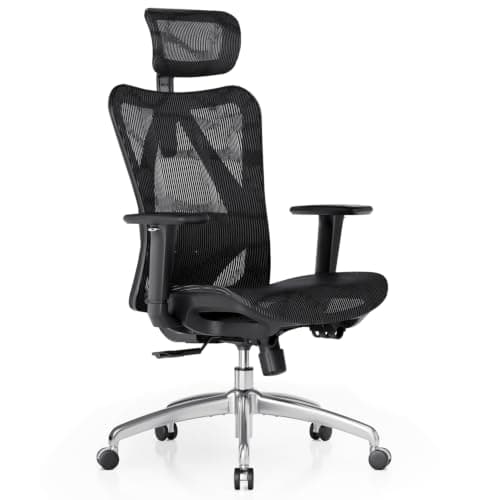
Sihoo lists an adjustable lumbar support on this chair along with a 330-pound rating, a three-year warranty, an 18.11-inch pan, a 20.08-inch seat width, 3D armrests and a mesh seat and back - all for a fraction of the band. Be clear about what that buys: Sihoo does not publish a travel range for the lumbar, so we cannot tell you how far it moves, and there is no depth-adjustable pan or backrest height figure to fall back on. It is the cheapest chair we can cite that claims the control at all.
Who it fits
Anyone upgrading from a chair with no back support whose budget is well below the band.
Who it does not fit
Anyone who needs a published travel range before buying, and anyone whose thighs are shorter than an 18-inch pan.
3. Best for A pad you place by hand - our budget pick
Everlasting Comfort Lumbar Support Pillow
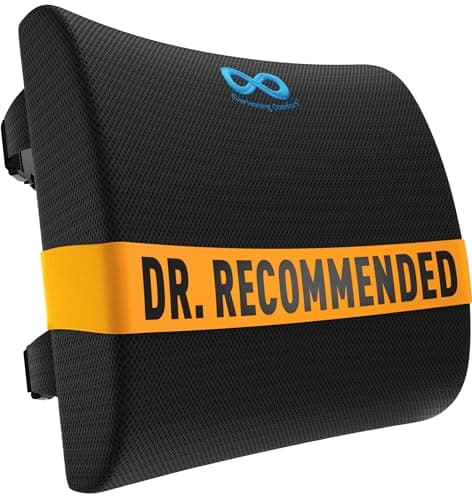
The only product inside this band that gives you what the phrase actually promises: support you position yourself, to the inch, and move again tomorrow if it is wrong. Everlasting Comfort publishes 20.08 by 12.01 by 3.94 inches of contoured memory foam held by two adjustable straps that fit chairs up to 32 inches wide. Used on a chair that already adjusts for height, this routinely beats a built-in lumbar at twice the price, because built-in support is only right if the chair happened to put it at your height.
Who it fits
Anyone whose chair is otherwise fine, and anyone who wants to find out where support should sit before buying a chair around it.
Who it does not fit
Anyone on a chair that does not adjust at all, and anyone who wants firmness control rather than position.
Published specifications
Lumbar
Fixed-contour memory foam; position set by two adjustable straps
4. Best for A real adjustable lumbar pad, just above the band
Herman Miller Mirra 2
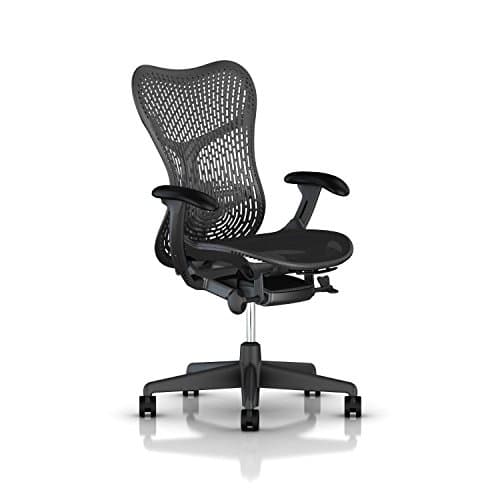
The chair to look at if the band is a target rather than a ceiling, and it usually sits just above it. Herman Miller offers the Mirra 2 with three back-support options, and the one that matters here is the adjustable lumbar: 4.5 inches of height travel and 1 inch of depth travel, which is a pad you set for position and prominence rather than a dynamic system that decides for you. Published seat height is 16 to 20.5 inches on the US store listing, seat depth 16.25 inches or 16.25 to 18 with the FlexFront seat, capacity 350 pounds, warranty twelve years on a three-shift basis. Confirm the back-support option with the seller - the basic back is the cheaper build.
Who it fits
Anyone who wants the lumbar pad itself to adjust, and anyone willing to go slightly above the band to get it.
Who it does not fit
Anyone whose budget is firm at $500, and anyone over 350 lb.
Published specifications
Seat height
16"–20.5"
Seat depth
16.25"–18"
Arm height
6"–11.5"
Weight capacity
350 lb
Lumbar
Three back-support options - basic back support, non-adjustable lumbar, or adjustable lumbar with 4.5 in of height and 1 in of depth travel
Sizes
One shell. Published seat height depends which Herman Miller source you read: 16-20.5 in on the US store listing (quoted above), 14.8-22.2 in on hermanmiller.com's product-details page. Seat depth is 16.25 in fixed, or 16.25-18 in with the FlexFront adjustable seat. Confirm the configuration with your seller.
Can you get a chair with genuinely adjustable lumbar support under $500?+
You can get a backrest whose height adjusts, which moves the support to your curve - the Sihoo Doro C300 publishes 18.11 to 21.65 inches of that. A lumbar pad on a track with a published travel range sits above the band in our registry.
What is a self-adapting or dynamic lumbar?+
Support that responds to your weight and movement rather than being set by a control. It is not a worse idea, but it is not adjustable, and a listing that calls it adjustable is stretching the word.
Is a lumbar cushion as good as built-in support?+
On a chair that already adjusts for height, often better - you place it at your own curve instead of accepting where the chair put it. It costs a fraction of the band, so it is also the cheapest way to learn what you need.
How do I know where my lumbar support should sit?+
Sit back, find the point where your lower back curves inward, and support that. A strapped cushion lets you test it in minutes - where to place a lumbar support pillow walks through it.