Picked on published fit specifications, each linked to its source. How we pick.
The short answer
At the cheap end, buy on four figures and ignore everything else: published seat depth, published seat width, weight capacity and warranty length. Nothing at this money adjusts meaningfully, so the fixed dimensions have to suit your body out of the box or the chair is wrong no matter how it is reviewed.
We earn a commission if you buy through our links. It does not change your price, and it does not change our ranking. Prices are pulled from Amazon's own API and stamped with the date we fetched them — where we have no live figure, the button opens the current price on the retailer's page instead. Full disclosure.
Ranked picks with published seat height, seat depth and weight capacity
#
Product
Best for
Seat height
Capacity
Price
1
Sihoo M57
330 lb, 3-year, 18.11 in pan, 20.08 in width
The capacity and warranty floor at the lowest price
#ad Seat height and capacity are the manufacturer's published figures, sourced under each pick. Prices come live from Amazon's own API and carry the date we fetched them; where a figure is missing the button opens the current price instead. Seat depth for every pick is in the spec block below. Seat depth summary: Sihoo M57 18.11" · Sihoo Doro C300 18.11" · ComfiLife Premium Comfort Seat Cushion —
The principle: at this price, nothing adjusts
Everything else in this guide follows from one fact. Below roughly two hundred dollars you get a mesh or foam back, a seat pan, a gas cylinder, a five-star base and arms that move in one or two directions. You do not get a sliding seat pan, a lumbar you can position, a seat angle control or a tension dial that does anything useful.
A more expensive chair can be made to fit you. A cheap chair either fits or it does not. So the whole exercise is reading fixed dimensions against your own measurements before you buy, rather than hoping to dial it in afterwards. What size office chair you need is the measuring step, and it takes five minutes with a tape measure.
The four figures worth reading
What to check, and the floor we would not go below
Figure
Why it matters at this price
Our floor
Seat depth (pan length)
Fixed, and it decides whether the front edge cuts into your calf
Within about 2 in of your thigh measurement - see the seat depth guide
Seat width
Fixed, and raised pan edges on a narrow seat press into the outside of the hips
At least 2 in wider than your seated hip width
Weight capacity
A structural figure from the BIFMA test standards, not a suggestion
300 lb or more; below that the frame and cylinder are built lighter
Warranty length
The only durability signal a maker publishes
3 years. One year means the maker expects it to fail in two
Capacity deserves a word, because it is the figure most buyers skip and the one that tells you most about build. A BIFMA capacity rating reflects how the base, the cylinder and the seat plate were engineered and tested. A chair rated to 330 lb is not simply a chair for heavier people - it is a chair built to a higher structural standard, and that shows up in how long it lasts for everybody.
What to ignore
The star rating. An average across thousands of different bodies with different problems tells you the chair suits the average buyer. You are not the average buyer; that is why you are reading a buying guide.
The word ergonomic. It is not a regulated term and appears on chairs with no adjustment whatsoever. How to tell if a chair is actually ergonomic gives the checklist, and it is a short one.
The headrest. A headrest only carries your head when you are reclined far enough for your head to rest into it, which for most desk work is a small fraction of the day. Our headrest page makes the full argument. At the cheap end it is usually a fixed piece of plastic at a height chosen for someone else.
Armrest count. "4D armrests" at this money generally means two directions with a loose mechanism. Arms that are too high or too close do active harm; arms that simply are not there do none. Do you need armrests argues that for many sitters the honest answer is no.
When cheap is the wrong answer
Three cases, and they are worth knowing before you spend rather than afterwards.
If you are short. The cheap band publishes overall chair height rather than seat height, and the pans are long and fixed - which is the worst possible combination for a short sitter. The short person roundup explains why that cluster starts higher up the ladder.
If the pain has a location. A fixed lumbar contour supports the average spine at the average height. If yours is not that, a pad you cannot move presses in the wrong place all day. How to choose a chair for back pain takes it in order.
If you sit eight hours or more. Nothing in this band carries duty wording in its warranty, and three years flat is a home-use term rather than a working-day one. How long office chairs last explains what multi-shift wording means and why it is worth money.
The honest cost of buying twice
A chair that lasts eight months and is replaced by another chair that lasts eight months has cost more than one chair that lasted four years, and that is the real trap at the cheapest end - not that cheap chairs are bad, but that the cheapest ones are frequently bought twice. The 300 lb capacity floor and the three-year warranty floor are the two filters that keep you out of that cycle without pushing you up a price band. What you get at each price tier maps the whole ladder, and the under-$200 roundup is the shortlist if you have decided this is your band.
The picks in full
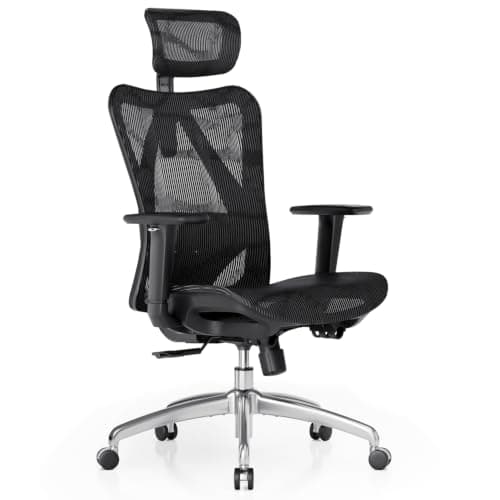
1. Best for The capacity and warranty floor at the lowest price
Sihoo M57
The chair that sets the floor this guide argues for. Sihoo publishes a 330 lb capacity and a three-year warranty at the cheapest point on this site, which is the pair of figures that separates a chair you keep from a chair you replace - most of what is sold below this rates to 250 or 275 lb and warrants for a year. It also publishes an 18.11 in seat depth, a 20.08 in seat width and adjustable lumbar support. What it does not publish is a seat height, only an overall height of 42 to 49 in, so the single most important fit figure is unavailable before purchase.
Who it fits
Anyone of average height wanting the lowest price that still meets the capacity and warranty floor.
Who it does not fit
Short sitters - the pan is long and fixed. Anyone who needs seat height confirmed first.
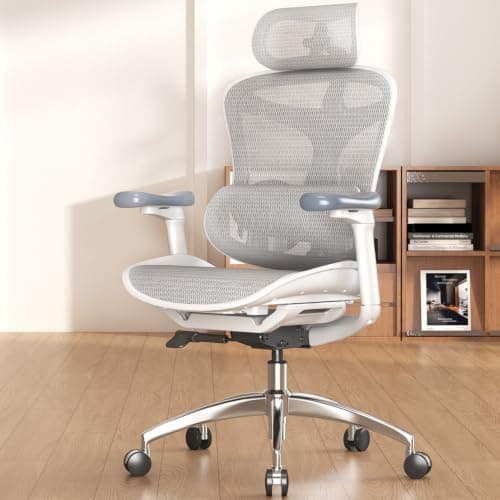
2. Best for A little more money for a published back height
Sihoo Doro C300
The step up that is worth taking if the budget stretches, because it publishes one figure the M57 does not: a backrest height range of 18.11 to 21.65 in, which tells you whether the top of the back lands above or below your shoulder blades. Sihoo also gives an 18.11 in seat depth, a 20.28 in seat width, a self-adapting dynamic lumbar, a 330 lb rating and the same three-year warranty. Self-adapting means the lumbar follows your movement rather than being set by you - a real design, but not adjustment, and worth knowing before you expect a height control that is not there.
Who it fits
Anyone whose current chair's backrest stops too low, on a budget.
Who it does not fit
Short sitters. Anyone expecting a lumbar pad they can position themselves.
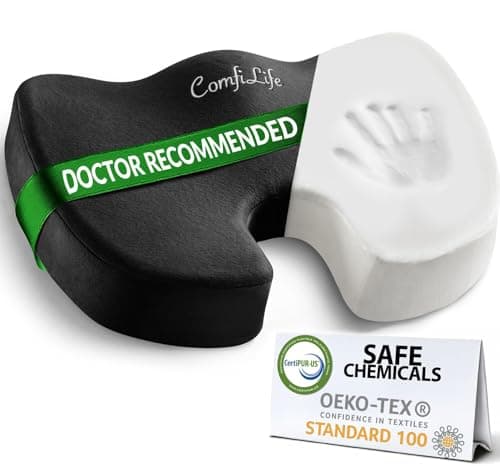
Included because on this page it is often the right answer instead of a chair. The seat is where cheap chairs fail first - the foam compresses and the pan starts registering under the sit bones within a couple of months - and a cushion addresses exactly that for a fraction of the price of replacing the chair. ComfiLife publishes a 17.7 by 13.7 by 2.8 in memory foam cushion with a U-shaped coccyx cutout that takes the tailbone off the pan entirely, under a stated lifetime replacement guarantee. It is a seat cushion and not back support, so it does nothing at all for lumbar complaints, and a cushion raises you slightly, which matters if your seat was already too high.
Who it fits
Anyone whose cheap chair has gone hard in the seat, or who is testing whether the seat is the problem.
Who it does not fit
Anyone whose complaint is in the low back rather than under the sit bones.
Four published figures: seat depth, seat width, weight capacity and warranty length. At this money nothing meaningful adjusts, so the fixed dimensions have to suit you out of the box. We would not go below 300 lb of capacity or three years of warranty.
Is a cheap office chair bad for your back?+
Not inherently. A cheap chair whose fixed dimensions suit your body is better for your back than an expensive one whose do not. The risk at this price is that you cannot adjust your way out of a mismatch.
How much should I actually spend on an office chair?+
Enough to clear the capacity and warranty floor, and more only if you are short, if your pain has a specific location, or if you sit eight hours or more. Those three cases are what the higher bands are for.
Does a cheap chair with a headrest offer better value?+
Usually not. A headrest only does anything when you are reclined, and at this price it is typically fixed at a height set for someone else. The money is better spent on seat depth and capacity.
Is a seat cushion worth buying with a cheap chair?+
Often, yes. The seat is where cheap chairs fail first - the foam compresses within a few months - and a cushion extends the useful life for a small fraction of the replacement cost.