Picked on published fit specifications, each linked to its source. How we pick.
The short answer
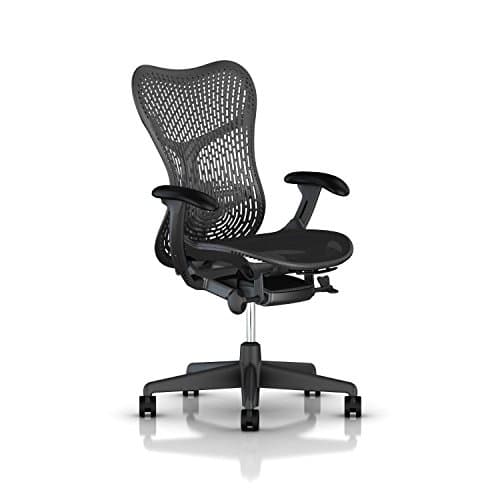
Our top pick is the Herman Miller Mirra 2: a published armrest height range of 6 to 11.5 inches is the widest travel we can cite, and the lowest starting point, which is what a short sitter needs. The budget pick is the Sihoo M57, the cheapest chair here listing 3D armrests.
We earn a commission if you buy through our links. It does not change your price, and it does not change our ranking. Prices are pulled from Amazon's own API and stamped with the date we fetched them — where we have no live figure, the button opens the current price on the retailer's page instead. Full disclosure.
Ranked picks with published seat height, seat depth and weight capacity
#ad Seat height and capacity are the manufacturer's published figures, sourced under each pick. Prices come live from Amazon's own API and carry the date we fetched them; where a figure is missing the button opens the current price instead. Seat depth for every pick is in the spec block below. Seat depth summary: Herman Miller Mirra 2 16.25"–18" · Steelcase Leap v2 15.75" · Steelcase Gesture 15.75"–18.5" · HON Ignition 2.0 Big and Tall 18.74" · Sihoo M57 18.11"
Why the number of Ds tells you nothing
2D, 3D, 4D and even 7D are marketing counts of which directions an armrest moves in. They are not standardized, nobody audits them, and crucially they say nothing about how far it moves in any of them. An arm that adjusts in four directions through half an inch each is worse than one that only goes up and down through five inches.
So this page ranks on published travel where a maker publishes it, and says so plainly where none exists. Here is everything we can cite:
Published armrest figures across the registry
Chair
Published armrest figure
Herman Miller Mirra 2
Height 6-11.5 in adjustable, or 8.3 in fixed
Steelcase Leap v2
Height 7-11 in
Herman Miller Embody
Height 4-8.75 in above the seat; arms 11.5-21 in apart (BTOD)
Steelcase Gesture
Arm width 10.25-22.5 in; 360-degree range of motion
HON Ignition 2.0 Big and Tall
All-adjustable arms with pivot; no travel figures
Sihoo M57 / Doro C300 / Hbada E3 Pro
3D or 4D claimed; no travel figures published
Kneeling chairs and the Capisco
No armrests at all
A measurement caution that matters when you compare those rows: makers do not all use the same datum. BTOD states the Embody's 4 to 8.75 inches as measured above the seat, while other published ranges do not say. Compare a figure to your own setup rather than to another brand's number, and treat cross-brand comparisons of armrest height as approximate.
The one measurement to take
Sit upright with your shoulders relaxed and your upper arms hanging straight down, then bend your elbows to about 90 degrees. Measure from the seat surface to the underside of your elbow. That is the armrest height you want, and the range you buy has to include it.
Two failure modes follow from getting it wrong, and they are the whole reason this page exists:
Arms too high. Your shoulders are held up all day. The ache lands in the neck and across the top of the shoulders, which is why people buy a headrest to fix an armrest problem - do you need a headrest takes that apart, and best office chairs for neck and shoulder pain is the pain-first version.
Arms too low or too wide. Your arms hang unsupported, so the shoulders carry their weight, and you end up leaning on one side of the desk. Width matters here as much as height, which is why the Gesture's published 10.25 to 22.5 inch range is worth more than another D.
Before you buy: the free fixes
Set the desk and the chair first, arms last. Armrest height is measured from the seat, so it changes every time you change seat height - how to adjust your office chair runs the six adjustments in the order that works.
Try the chair with the arms dropped to the bottom. Most people have never done this. If your shoulders settle, the arms were the problem.
Consider using no arms at all. For some setups - a low desk, a keyboard tray, a narrow room - arms are a liability, and best armless office chairs covers the seating that does without them.
Check the arms clear your desk. If they hit the apron you sit further back and reach forward all day, which is a worse problem than the one you were solving - what to do if your desk is too high has the measurements.
Herman Miller publishes an armrest height range of 6 to 11.5 inches for the adjustable-arm configuration of this chair - five and a half inches of travel, the widest figure we can cite, and more importantly the lowest bottom end. The bottom end is the one that matters: arms that will not drop far enough hold your shoulders up, and that load is felt in the neck. The fixed-arm build is published at 8.3 inches, so confirm which one a seller is shipping. Also published: a 16 to 20.5 inch seat height on the US store listing, a 16.25 to 18 inch FlexFront seat depth, 350 pounds, twelve years on a three-shift basis.
Who it fits
Short sitters, anyone whose shoulders ache by mid-afternoon, and anyone who has to get the arms under a desk apron.
Who it does not fit
Anyone over 350 lb, and anyone buying a listing that does not state the adjustable-arm configuration.
Published specifications
Seat height
16"–20.5"
Seat depth
16.25"–18"
Arm height
6"–11.5"
Weight capacity
350 lb
Lumbar
Three back-support options - basic back support, non-adjustable lumbar, or adjustable lumbar with 4.5 in of height and 1 in of depth travel
Sizes
One shell. Published seat height depends which Herman Miller source you read: 16-20.5 in on the US store listing (quoted above), 14.8-22.2 in on hermanmiller.com's product-details page. Seat depth is 16.25 in fixed, or 16.25-18 in with the FlexFront adjustable seat. Confirm the configuration with your seller.
2. Best for Arm travel plus the best lumbar control
Steelcase Leap v2
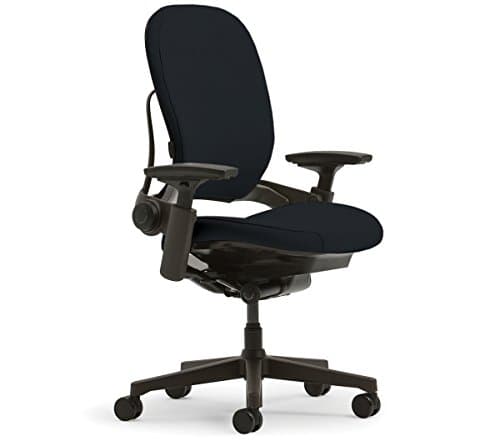
The published armrest height range is 7 to 11 inches, four inches of travel, and the reason this chair ranks second rather than fifth is what comes with it: a height-adjustable lumbar with a separate firmness dial, which is the most useful pair of controls in the registry if your pain has a specific location. Add a 25-inch backrest, a 19.25-inch seat width, a 15.75-inch pan, a 16 to 20.5 inch seat height, a 400-pound rating and Steelcase's twelve-year multi-shift warranty. If your neck and shoulders are the symptom, the arms and the back height are doing the work together here.
Who it fits
Anyone with neck or shoulder ache during the working day who also wants placeable lumbar support.
Who it does not fit
Anyone under about 5 ft 1 in, and anyone whose thighs need more than a 15.75-inch pan - it does not adjust.
Published specifications
Seat height
16"–20.5"
Seat depth
15.75"
Seat width
19.25"
Back height
25"
Arm height
7"–11"
Weight capacity
400 lb
Lumbar
Height-adjustable lumbar plus a lower-back firmness dial
3. Best for Arms that move out of the way entirely
Steelcase Gesture
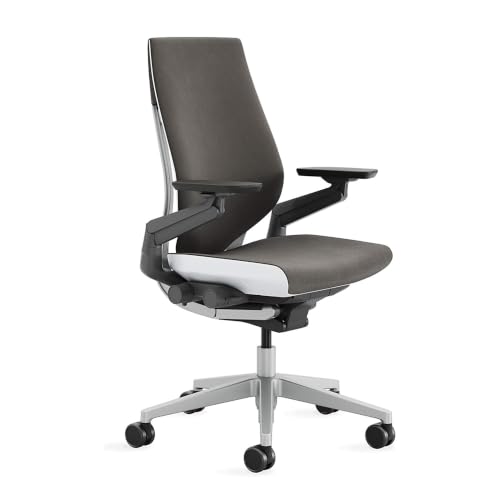
The only chair here that publishes how far apart the arms go rather than just how high. The Human Solution's specification table lists arm width from 10.25 to 22.5 inches, and Steelcase describes the arms as moving through a full 360-degree range of motion - which is the difference between arms you position and arms you tolerate. That range is the answer if you work on a laptop in your lap, use a tablet, or turn to a second desk. Also published: 15.75 to 18.5 inch functional seat depth, a 20-inch seat, a 400-pound rating, three seat-height cylinders and a twelve-year multi-shift warranty.
Who it fits
Anyone who changes posture or device through the day, and anyone whose arms need to go wide or come right in.
Who it does not fit
Anyone on a fixed budget - this is the most expensive pick here - and anyone who wants a published armrest height range, which Steelcase does not give for this model.
Published specifications
Seat height
16"–21"
Seat depth
15.75"–18.5"
Seat width
20"
Back height
24.06"
Weight capacity
400 lb
Lumbar
Core Equalizer as standard; optional adjustable lumbar with 4 in of height travel
Sizes
Three cylinder options - short (14.5-18.25 in), standard (16-21 in), tall (17-22.5 in). The standard figure is the one quoted above.
Warranty
Steelcase Limited Lifetime - 12 years, multi-shift, 24/7 parts and labor
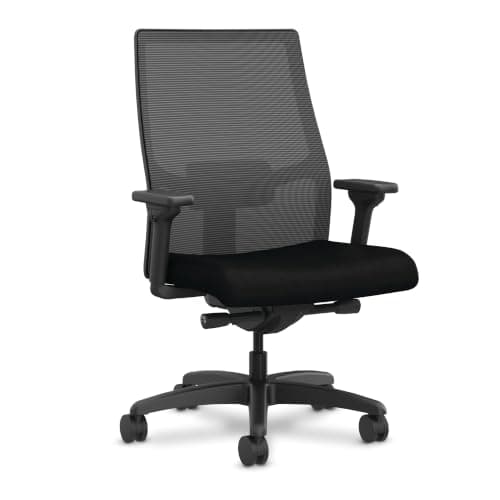
The pick where arm adjustment arrives on a chair sized for a larger sitter. Office Depot's listing for this model publishes all-adjustable arms with pivot, an adjustable lumbar, a 23-inch seat width with a usable seat depth of 17.75 to 19.5 inches, a 24.75-inch backrest, a 17 to 21.5 inch seat height and a 450-pound capacity behind the HON Full Lifetime Warranty. The relevant catch on a wide chair: the arms start further apart, so check that your forearms reach them without your shoulders traveling outward.
Who it fits
Larger sitters who want arms that adjust and a frame rated for them.
Who it does not fit
Anyone under about 5 ft 5 in, and anyone with a narrow frame who would be reaching outward for the arms.
5. Best for The cheapest listed arm adjustment - our budget pick
Sihoo M57
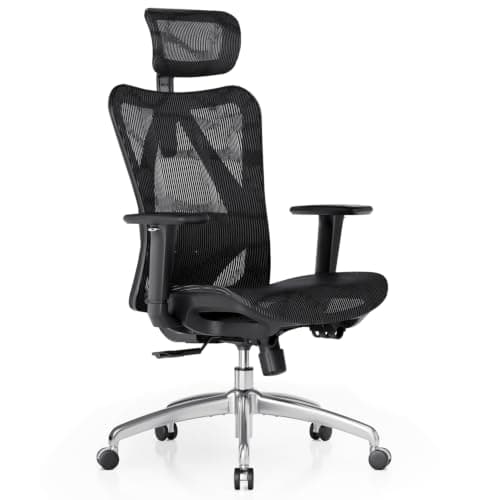
Sihoo lists 3D armrests on this chair - height, width and pivot - along with an adjustable lumbar, an 18.11-inch pan, a 20.08-inch seat width, a mesh seat and back, a 330-pound rating and a three-year warranty, for a fraction of what anything else on this page costs. What you do not get is a number: Sihoo does not publish how far the arms travel in any direction, so there is no figure to check against your own elbow height before ordering. At this price that is the trade, and it is worth knowing rather than discovering.
Who it fits
Anyone upgrading from a chair with fixed or no armrests on the tightest budget.
Who it does not fit
Anyone who needs a published travel range, and anyone over 330 lb.
What is the best office chair with adjustable armrests?+
The Herman Miller Mirra 2 in its adjustable-arm configuration, because 6 to 11.5 inches is the widest published travel we can cite and the lowest bottom end. The Steelcase Gesture is the pick if the arms need to move outward and inward rather than just up and down.
What does 4D armrest mean?+
That the arm moves in four directions - usually height, width, depth and pivot. It is a marketing count with no standard behind it and no indication of how far the arm travels in any direction.
How high should armrests be?+
So your forearms rest on them with your shoulders relaxed down and your elbows at about 90 degrees. Measure from the seat surface to the underside of your elbow in that position, and buy a range that includes it.
Are adjustable armrests worth paying for?+
If your shoulders or neck ache during the working day, yes - arms set too high are one of the few mechanical causes of that. If your current arms already sit under your relaxed elbows, the money is better spent on seat depth adjustment.