Herman Miller Aeron vs Steelcase Series 1: Which One to Buy
One of these costs several times the other, both are rated to 400 pounds, and both carry a twelve-year commercial warranty. Brand hierarchy is not a reason, so you need a specification that is.
Picked on published fit specifications, each linked to its source. How we pick.
The short answer
The Aeron sizes itself to you and the Series 1 adjusts itself to you. Herman Miller sells three shells covering 14.4 to 22.8 inches of seat height with a fixed pan in each; Steelcase sells one shell at 16.5 to 21.5 inches with a pan that slides 15.5 to 17.75 inches. Pick the mechanism your body needs.
We earn a commission if you buy through our links. It does not change your price, and it does not change our ranking. Prices are pulled from Amazon's own API and stamped with the date we fetched them — where we have no live figure, the button opens the current price on the retailer's page instead. Full disclosure.
Ranked picks with published seat height, seat depth and weight capacity
#
Product
Best for
Seat height
Capacity
Price
1
Herman Miller Aeron
Three shells, 14.4-22.8 in of seat height between them
#ad Seat height and capacity are the manufacturer's published figures, sourced under each pick. Prices come live from Amazon's own API and carry the date we fetched them; where a figure is missing the button opens the current price instead. Seat depth for every pick is in the spec block below. Seat depth summary: Herman Miller Aeron 16"–18.5" · Steelcase Series 1 15.5"–17.75"
The verdict, up front
Choose the Aeron if you are outside the range a one-size chair covers. That is the only thing it does that nothing else here does, and it does it completely: the A shell starts at a published 14.4 inches, which is more than two inches below the Series 1's floor and lower than every other chair in our registry.
Choose the Series 1 if you are an ordinary height and the thing that has never fit you is the seat pan. It slides across 2.25 inches of functional depth; the Aeron does not slide at all, it is simply manufactured at 16, 17 or 18.5 inches depending on the shell you ordered.
The framing to drop is the one that treats this as a premium chair against a cheap one. Both are rated to 400 pounds. Both carry a twelve-year commercial warranty. The real difference is how each one proposes to fit a human being - by being built in your size, or by adjusting to it - and one of those approaches is clearly better for you already.
Side by side, on published figures
Published specifications for the Herman Miller Aeron and the Steelcase Series 1
Aeron
Series 1
Seat height
14.4-22.8 in across the three shells
16.5-21.5 in
Seat depth
16 in (A), 17 in (B), 18.5 in (C) - fixed
15.5-17.75 in functional, adjustable
Sizes
Three shells: A, B, C
One size
Weight capacity
300 lb (A), 350 lb (B), 400 lb (C)
400 lb in the only size made
Lumbar
Height-adjustable lumbar pad or PostureFit SL, per configuration
Adjustable lumbar is a cost option; weight-activated tension standard
Seat surface
Suspension mesh, unpadded
Not fixed by the spec guide - check the listing
Overall height
Not published as a single figure
36.5-41.25 in
Warranty
12-year, three-shift
12-year, multi-shift
Sources: Herman Miller's Aeron specifications and the Aeron Size/Fit Reference for the per-shell figures and the per-shell warranty ratings, and the Steelcase Series 1 spec guide for everything in the right-hand column. Steelcase sells the Series 1 in several surface materials and the spec guide does not fix one, so that row is left open rather than guessed - confirm it on the configuration you are actually buying.
Two rows in that table decide most purchases, and they point in opposite directions. Read the seat height row if you are short or very tall. Read the seat depth row if you are neither.
Decision axis 1: sized to you, or adjusted to you
Every chair has to solve the same problem - human beings are not one size - and there are only two ways to do it. You can build the chair in several sizes, or you can build one chair with a lot of travel in it. The Aeron does the first and the Series 1 does the second, and almost everything else about this comparison follows from that one choice.
Sizing has a hard advantage at the extremes. A gas lift has a minimum length, so a one-size chair has a floor it cannot go below no matter how it is specified. The Series 1's floor is 16.5 inches, which on the seat height estimate serves a sitter from roughly 5 ft 2 in upward. An Aeron A publishes 14.4 inches, which reaches someone around 4 ft 10 in. There is no setting on a Series 1 that gets there.
Adjusting has a hard advantage in the middle. The Aeron's pan does not move. If your thigh wants 16.5 inches of depth you are choosing between a 16-inch A and a 17-inch B and living with whichever is closer - and since depth is set by the shell, you cannot change your mind afterward without buying a different chair. The Series 1 covers 15.5 to 17.75 inches continuously, so it hits your number rather than bracketing it. Work out what your number is in the seat depth guide before you decide which of those two situations you are in.
Decision axis 2: the 400-pound rating is not the same 400 pounds
Both chairs publish 400 pounds and the number means something different on each. The Series 1 is rated to 400 pounds in the only size Steelcase makes, so the rating comes with the chair. The Aeron's 400 pounds belongs to the C shell only: Herman Miller's Size/Fit Reference warranties the A to 300 pounds and the B to 350.
That matters because the B is the default. It is the shell most often shown in listings and the one you will end up with if you order without specifying. If you are above 350 pounds and buy an Aeron on its headline capacity, you can quite easily receive a chair warrantied 50 pounds below your weight. Office chairs rated to 400 pounds lists what else clears that bar, and the big-and-tall roundup covers seat width, which is the specification capacity ratings tend to hide.
Decision axis 3: lumbar support, and what each chair assumes
Neither of these is the right chair for pain you can point at with one finger - that is the Leap v2, and Leap v2 versus Series 1 is the comparison for it. But they are not equal here either.
The Aeron is specified with either a height-adjustable lumbar pad or PostureFit SL, which supports the pelvis and the lower spine as two separate pads. Both are part of a standard configuration; which one you get is a choice at order time, and it is worth making deliberately rather than accepting a default.
On the Series 1, adjustable lumbar is a cost option. The standard chair gives you weight-activated tension and a fixed back shape. That is not a defect - most chairs at mid-tier money have no adjustable lumbar at any price - but it does mean a Series 1 ordered at its lowest price is a chair without lumbar height adjustment, and that is the single most useful control for a located complaint. Specify it, or budget for a lumbar cushion on top. Adjustable versus fixed lumbar support is the longer version of why that control is worth paying for.
Where the Aeron is weak
The pan does not adjust. Three fixed depths, and the one you choose is permanent. For a long thigh at an average height, this is the Aeron's real failure and it is not fixable afterward.
Nothing about the chair catches a wrong order. The entire advantage lives in the size chart. Order a B by default and you have paid premium money for a one-size chair with a fixed pan.
No padding, and that is a real objection. The suspension mesh spreads load rather than compressing under it. Plenty of people prefer that and plenty dislike it - see mesh versus foam.
No headrest. Herman Miller does not make one for the Aeron, so if you want head support this is not the chair.
The price. It is the most expensive chair on this site, and for a sitter in the middle of the range it is paying for a sizing system they do not need.
Where the Series 1 is weak
16.5 inches is the floor. Below roughly 5 ft 2 in there is no setting and no smaller shell. The short-sitter roundup is the right page in that case.
Adjustable lumbar costs extra. Covered above. The cheapest Series 1 configuration is not the one most of this site's readers want.
Steelcase publishes very little else. No seat width, no back height and no armrest ranges in the spec guide - only an overall height of 36.5 to 41.25 inches. You cannot check those dimensions against your own measurements before ordering, and we are not going to estimate them for you.
No top-end reach for a tall sitter. 21.5 inches is good, and an Aeron B or C reaches 22.8. At a high desk that difference is decisive - the tall-sitter roundup works through it.
Who should buy neither
If your pain has one specific location and you want the support placed exactly there, both of these are compromises and the Leap v2 is the chair - it is the only one in our registry with lumbar height and lumbar firmness on separate controls. Aeron versus Leap v2 runs that pairing properly.
This page is built on both manufacturers' published figures with every source linked. We have not sat in either chair and do not claim to have; our method is set out in how we pick.
The picks in full
1. Best for Bodies outside the one-size range
Herman Miller Aeron
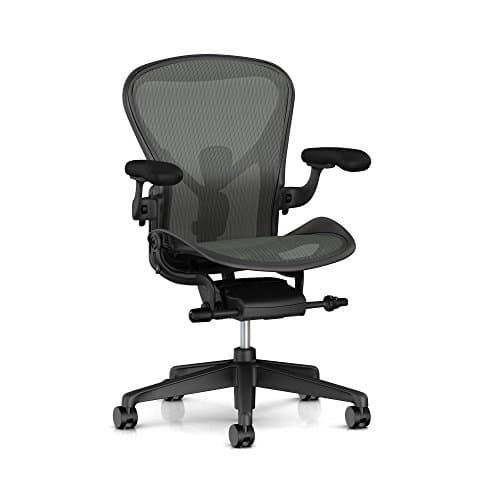
Choose the Aeron if you are at an end of the height range rather than in the middle of it. Herman Miller publishes a size A at 14.4 to 19.3 inches with a 16-inch pan, a B at 14.8 to 22.8 inches with a 17-inch pan and a C at 15.8 to 22.8 inches with an 18.5-inch pan, and that A shell is the lowest seat and the shortest pan on this site. No amount of adjustment on a one-size chair reaches 14.4 inches, because the gas lift has to start somewhere. Warranty is 12 years on a three-shift basis, and the lumbar is a height-adjustable pad or PostureFit SL depending on how you specify it.
Who it fits
Short sitters in an A, average builds in a B, large or tall sitters in a C. Anyone who has already found that one-size chairs leave their feet dangling or their thighs crushed.
Who it does not fit
Anyone who orders without reading the size chart - the wrong shell throws away the whole advantage. Anyone who wants a padded seat, which the suspension mesh is not. Anyone who needs 400 pounds in anything other than a C.
Published specifications
Seat height
14.4"–22.8"
Seat depth
16"–18.5"
Weight capacity
400 lb
Lumbar
PostureFit SL or adjustable lumbar pad, both height-adjustable
Sizes
A (seat height 14.4-19.3 in, seat depth 16 in, warrantied to 300 lb), B (14.8-22.8 in, 17 in, 350 lb), C (15.8-22.8 in, 18.5 in, 400 lb)
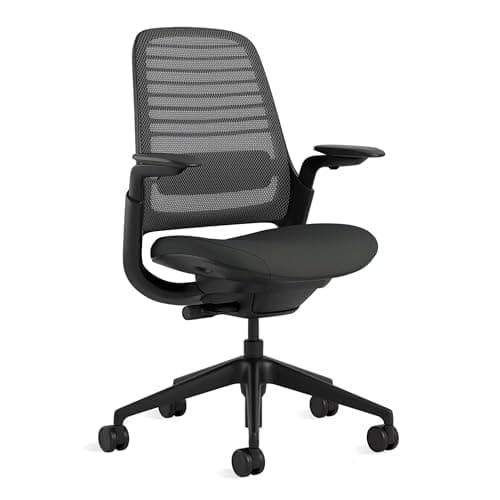
Choose the Series 1 if you sit inside the ordinary height range and your problem is seat depth rather than seat height. Steelcase publishes a functional seat depth of 15.5 to 17.75 inches - the depth you can actually use, not the cushion's outside measurement - which is a dimension the Aeron does not adjust at all. It also publishes 16.5 to 21.5 inches of seat height, a 400-pound rating on the only size it makes, and the same 12-year multi-shift warranty, at a fraction of the money.
Who it fits
Roughly 5 ft 2 in to 6 ft 2 in, long or short thighs either way, and anyone who needs a 400-pound rating without specifying a particular shell to get it.
Who it does not fit
Anyone under about 5 ft 2 in - 16.5 inches is the floor and there is no smaller size. Anyone whose pain has one exact location: adjustable lumbar is a cost option here, not standard.
Published specifications
Seat height
16.5"–21.5"
Seat depth
15.5"–17.75"
Weight capacity
400 lb
Lumbar
Optional adjustable lumbar; weight-activated tension as standard
Is the Herman Miller Aeron worth it over a Steelcase Series 1?+
Only for a specific reason, and the usual one is sizing. If you are shorter than about 5 ft 2 in or need a seat above 21.5 inches, the Aeron reaches where the Series 1 cannot and the money buys you a chair that fits. If you sit inside the ordinary range, the Series 1 publishes the same 400-pound rating and the same twelve-year commercial warranty, and it adjusts seat depth, which the Aeron does not.
Which Aeron size compares to a Steelcase Series 1?+
The B, which is the default shell - 14.8 to 22.8 inches of seat height, a 17-inch pan and a 350-pound warranty rating. Against the Series 1's 16.5 to 21.5 inches, a sliding 15.5 to 17.75 inch pan and 400 pounds, the B wins on height range and loses on depth adjustment and capacity.
Do both chairs really have a 12-year warranty?+
Yes, and the terms are close enough to treat as equivalent: Herman Miller publishes 12 years on a three-shift basis for the Aeron, Steelcase 12 years multi-shift for the Series 1. A multi-shift rating means the chair is warrantied for more than one working day's use per day, which is a stronger engineering claim than the number of years on its own. How long office chairs last covers what that does and does not promise.
Does the Steelcase Series 1 come with adjustable lumbar support?+
Not as standard. The Steelcase spec guide lists adjustable lumbar as an option, with weight-activated tension on the base chair. If lumbar height adjustment is the reason you are buying an ergonomic chair, specify it at order time - a Series 1 bought on price alone will not have it.
Is the Aeron good for long thighs?+
Not especially, and it is the one fit question the Aeron answers worst. Seat depth is fixed by the shell at 16, 17 or 18.5 inches, so you pick the nearest and accept it. A chair with an adjustable pan - the Series 1, or the Sihoo Doro C300 much further down the price range - lets you set the depth to your own measurement instead. Take the measurement first in the seat depth guide.